 RSS Feed
  Twitter
 The wonder of the driverless Copenhagen Metro...


by Tim Anderson (timothyanderson2005@gmail.com)
Change can be dramatic and fast, and so it has been across the Danish beer market where a quiet revolution has been occurring over the past years. Though the mainstream beers of Carlberg/Tuborg remain dominant, foreign beer consumption in Denmark has skyrocketed from 0.7 million litres consumed in 2000, to 8.7 million litres in 2004.
The humble beginnings of this revolution started in 2001 with the introduction of a very limited selection of premium quality foreign beers displayed on small wooden racks in a couple the national supermarket chains. These small wooden racks remain, however they now bookend an entire row of premium foreign beers in the stores of every major supermarket chain. The total space they are now allocated is comparable to that of Carlsberg and (Carlsberg-owned) Tuborg and the other low-quality Danish beers on offer.
An slowly expanding selection...
These foreign beers are sold at a price that is between double to triple that of Carlsberg and Tuborg, yet sales continues to skyrocket. Apparently, taste does mean something to a good number of people after all. The turnaround within the beer market has been astoundingly profound, and far beyond what even an amateur beer enthusiast like myself could have anticipated, must less hoped for, given the sorry the state of affairs that existed less than five years back. The tide is certainly shifting.
Most bars across Copenhagen now offer a small but increasing range of quality foreign beers, particularly Belgian and Czech ones. Whereas back in 2000, Carlsberg and Tuborg flowed exclusively from all but a tiny handful of taps in the bars of Copenhagen, now bars offering only Carlsberg/Tuborg on tap are sliding into the minority. And Hoegaarden, Chimay, Leffe, Staropramen, Erdinger, Franzikaner, Urquel and Budvar flow increasingly freely, with a few of the newer bars opting to leave Carlsberg/Tuborg off the menu entirely. In terms of taste, there is little challenge from Carlsberg/Tuborg for these other far superior mainstream quality offerings.
Unfortunately, for Carlsberg, of the largest brewers in the world (and owner of Tuborg), taste and quality has always been a distant goal after profit, and zooming in on Denmark, the strategy has always been market domination. Countless amounts of sponsorship and promotional cash are doled out by the company to ensure its products remain embedded deep within the collective national psyche of the nation. It has been a successful strategy - the company has generally held its ground and generated a mountain of cash in the process.
This truth was perhaps hammered home most forcefully one night back in 2001, sitting at one of the three bars in Copenhagen at the time that offered a decent selection of quality foreign beers. Carlberg had just released a new beer, called ‘Tuborg Hvede Øl’ (‘wheat beer’), it’s first unfiltered wheat beer. As far as I was concerned, this was fantastic news – at last an attempt to produce a quality mainstream beer from Carlsberg.
The bartender that night, recognising a couple of my friends from previous visits, offered us a round these on the house – he had received a complimentary batch from Tuborg. That night, we happened to be drinking some Belgian wheat beers – I cannot recall which one but I believe it was Hoegaarden. Doing a quick taste comparison, it was evident that Tuborg’s offering, though good, simply couldn’t hold a candle to the far superior Belgian wheat beer we were drinking. And admittedly, there are even better wheat beers than Hoegaarden! The Belgian beer had a depth of flavour that left one feeling Carlsberg/Tuborg’s offering must have been watered down, albeit with a decent flavour at least.
Now there is a couple ways this result could be interpreted. On one hand, in spite of a deep history of brewing, perhaps Carlsberg/Tuborg really did suffer from an underdeveloped experience brewing unfiltered beers - meaing maybe this was the best they could come up with. The bartender believed this was the first unfiltered wheat beer the company had ever attempted. Or perhaps, the real story was economic, and Carlsberg was quite capable of producing something better but couldn’t be bothered to offer up something even more interesting - acceptability over excellence with a strong dose of marketing to bridge the gap, in line with the traditional strategy that ran through the company’s and storied long history.
Bare in mind that around this time period, Carlsberg was running a sort of contest – which was rather in reality a marketing gimmick – involving four new beers introduced for a limited period (Hvede was one of them, the others being Dark, Red and Lager). Consumers could vote for their favourite, the winning beer would remain on the market, the losers would disappear into the black hole of Carlsberg history. Carlberg should have be trumpeting the arrival of four new members of its mainstream family. Instead, it proclaimed it would shortly remove three of them.
Now, for example, in Belgian – a comparably small country but one with a rich and deep history of brewing – between one to two hundred different types of beers are sold in all major supermarkets, double to triple this selection in the numerous specialty beer stores across the country. Similarly, in Germany and Czech, two other countries with a similarly long and proud brewing tradition, choice abounds. Surely, a slightly wider product line from Carsberg would meet with some acceptance in beer-oriented Denmark as well? Rather, Carlsbers’s mass marketing strategy revolved around a very small range of beers – Carl’s Special, Pilsner, and in it’s Tuborg range represented by Green and Guld. It still does, by in large.
The rest of the mainstream Danish market consists largely of smaller, low-cost, copy-cat producers who use the same Carlsberg/Tuborg formula - offering a range of cheap, similar tasting beers - though theirs cost on average around half the price of Carlberg/Tuborg. Interestingly, the taste difference is slight. One could quite convincingly argue a good many of them, such as most of the Harboe and Ceres range of beers, are perhaps even superiour in taste to Carlberg and Tuborg.
There is also one notable high high point of the beer-year in Denmark during the Christmas and Easter season when Carlsberg/Tuborg release, for a very limited time, a Christmas and Easter beer that happens to be a surpringly tasty beer - with the discount breweries also releasing their own competing products to match. Carlberg/Tuborg's is of a similar in quality to Hvede, which is to say, much higher than the standard of their other mainstream products.
Incidently, I recall Carlsberg Dark won that popularity contest a few years back, though the beer has subsequently all but disappeared from bars and pubs and does not generally feature in Carlberg's promotional efforts. From this outcome, one might be tempted to conclude that Denmark’s beer drinkers are conservative and not prone to shift their loyalties to a newcomer, in spite of taste and quality issues. One might thus conclude that to focus on expanding the product range, particularly on the quality end, may not be worth much, especially for a company like Carlberg.
Fortunately, this has proven to be far from the truth, as the exploding foreign beers sales figures demonstrate.
The latest development has seen the introduction of a small range of foreign beers at one of the two (high-volume) discount supermarket chains (Netto). To appreciate the significance of this development, one must shop at these discount supermarkets (and they are extremely successful) to experience just what an extremely limited range of products they sell, particularly on the quality end of things.
It is a genuine pleasure to experience such a rare turn of events where quality emerges from the shadow of a dominant other, much less worthy.
Curious to know more? Read on, Carlsberg strikes back - The remarkable Danish beer market (Part 2) and Setting the record straight - The remarkable Danish beer market (Part 3)
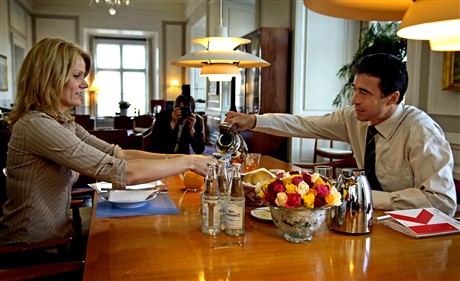
Pictures can be telling. In few countries would you find the Prime Minister carrying around an unstylish 10 kr (1.5 Euro) notebook such as the one Danish Prime Minister Anders Fogh Rasmussen is pictured with here (a cheap notepad available in countless discount stores all over Denmark) during his first official meeting with the new leader of the Social Democrat party Helle Thorning Schmidt (the main opposition party). Try to find a picture of Jacques Chiraq or Tony Blair taking notes in such a thing...
But what about it's contents? With regards to Denmarks continuing support and participation in the Iraq war, did Anders remember to pen a reminder note to himself to stop acting like the American puppet he has been and get Denmark out of Iraq and start raising questions such as just how many non-military human casualties ('collateral damage') there have been? Perhaps somewhere he penned an even more pressing reminder to himself to start (re-)humanising Denmark's "xenophobic immigration policies" - the highly quotable (and not exactly insignificant) qualification offered by The Economist when it recently assessed Denmark as the best place in the world to do business. Those immigration policies have taken a decided turn towards radical paranoia under his leadership. Pictures can be telling, but they don't tell everything.
by Tim Anderson (timothyanderson2005@gmail.com)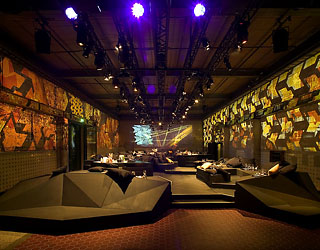
Club Volkswagen in Copenhagen...I mean, Club Fox.
An odd series of events took place in Copenhagen over the past three of weeks. Under the name ’Project Fox’ (project-fox.org), the events centred around a series of consecutive club evenings (20 of them!) in Østerbro (‘Club Fox’), an event hall in Christianshavn (‘Studio Fox’), and a Hotel (formerly known as Park Hotel, now ‘Fox Hotel’) in the centre of the city. Ostensibly the project, initiated by Volkswagen, has a commercial backbone, the launch of a new car model, the Volkswagen Fox. In truth, it is not Volkswagen that has fleshed the project into reality, rather a bunch of street artists, event promoters, performers, and a weekly internet newsletter read by those supposedly in the know (that has surely had a significant role in bringing out the crowds (humanmail@humanwebsite.com to get on this list – I highly recommend it if you live in Copenhagen).
With Volkswagen’s involvement all but invisible by the standard of more typical corporate-artistic endeavours, almost shockingly, this one simply doesn’t fit the prototypical vision one associates with promotional arrangements. I'm going to stick to talking about Club Fox, and only mention that 'Hotel Fox' is a rather original project involving about 60 street artists who each redisigned a room the hotel (with basically NO limitations placed upon what they were allowed to do), while Studio Fox has been the sight of a handful of public debates. But Club Fox has perhaps the most interesting.
Club Fox can certainly not be accused of being staged on the cheap. No budget has been spared to achieve a memorable configuration of design, lighting and sound. I couldn’t be bothered to count how many projectors were hanging from the roof - a lot. Volkswagen’s largely ghost presence is one that has evidently included a donation of a significant chunk of change that has made it all possible. This is not the real story. The club nights have not only been top-notch, they have been unique and steadfastly non-commercial, featuring numerous outstanding (very) underground acts from around Europe.
Furthermore, staged everyday throughout the week (not only weekends), they have challenged the Copenhagen clubbing crowd that typically only appears on weekends, to alter their nightlife habits. There basically is no such thing as clubbing in Copenhagen on Monday or Tuesday (some notable activity can be found occasionally on Wednesdays and Thursdays, I will acknowledge). Project Fox, in wholeheartedly ignoring this longstanding convention, has effectively gambled it’s offering will prove more seductive than television or sleep. As a famous Monty-Python line once went, ‘nobody expects the Spanish Inquisition’ – and perhaps in the same vein, nobody expects such routine-defying provocation from a supposedly dull, corporate entity such as Volkswagen. But they have done it, and it has worked. The crowds have turned up most nights, even knowing (though I’m not even sure that many do) that it is all at the behest of Volkswagen! This is no small feat.
Is anybody buying a Volkswagen Fox?
Achieving such an level of authenticity has allowed the project to in effect ‘breath’ and it has taken on a certain life of it’s own as a result (with still a few days left to go before it’s all over). The feeling at the club by now each night is more akin to an ongoing underground music festival, not the promotional production that it nonetheless remains. It is a rare instance where a commercial presence has truly facilitated one hell of a cool party, rather than simply appearing as an incoherent presence stamped onto an event to which it just didn’t belong, or worse still, offering up some big-budget, dead-on-arrival piece of propaganda propped-up lifelessly by a big-name performer or two. This is the typical history of most promotional engagements of this commercial nature.
Now it is not at all obvious why Volkswagen, in initiating such a high profile event, would decide to keep their involvement at such a low profile. Yet something about the whole arrangement suggests that the strategy seems to have worked – at least in my reading of the whole thing. There is simply no other club or festival in Copenhagen that has managed to put together a comparable twenty night program of live performances in recent years – not to mention create a surprisingly funky setting to stage the thing. What is Volkswagen trying to do?
Almost the only hints of their involvement in all of this, or any other company for that matter, is the Volkswagen people carriers sitting outside the club, shuffling the German ‘VIPs’ and local organisers to and from the club each evening, and the shiny red Volkswagen Fox sitting outside the club a few meters from the entrance. In fact, it was only leaving the fourth arrangement at the club that I noticed the car for the first time. Its presence seemed like more the result of a last-second afterthought someone had, remembering it was probably a good idea to actually display the car for which the event was created and named.
Whatever the intentions, in this simple, strategic stoke of low-profile genius, Volkswagen has managed to avoid the inevitable pitfall that virtually every other sponsor of corporate-artistic collaborations has fallen victim to: the inability to refrain from demanding that their logos and attestations trumpeting their involvement get schlepped all over, in every which place imaginable. Crass commercialism ultimately detracts from any purity of artistic vision that such events may have otherwise possessed, which consequently doesn’t leave one feeling much enthusiasm for the event and even less the sponsor. Even on the widely distributed ‘Club Fox VIP’ passes that serve as the public admission tickets to Club Fox, only a single, very subtle mention of Volkswagen as the project ‘initiator’ is made – and not even on the booklet front page! All this has made it work.
It will never be entirely possible to produce a measure of ‘Project Fox’ as a success of failure; this must remain a subjective opinion. One cannot measure any translation into new car sales that may result. However, what can be suggested is that by avoiding almost all conventions of such sponsorship branding-promotional exercises, Volkswagen has perhaps hit upon the elusive magic equation for successful corporate-artistic cooperation. Put your corporate money in, but keep your corporate image out. When companies try to step inside of the artistic arena themselves, propaganda results, something that has always been of questionable artistic merit, meaningfulness and relevance.
Without being beaten over the head with the message from the first step inside (or even earlier), those attending tend to pretty quickly figure out the purposes behind such events, in any case. The less that is said, the more curiosity is aroused – a pretty effective way to get a message heard. When people are assumed to be intelligent, attentive and receptive - and actually treated that way - POOF, suddenly they just might listen!
Still, all of this begs an answer to the question: did Volkswagen get what they wanted to out of all of this, whatever it was? Let me offer an answer of sorts: WHO CARES! It has been fun, and I’m looking forward to attending one or two more nights before it’s all over. I’m sure there will be great debate at Volkswagen regarding the merits of getting involved in such conceptual ideas in the future. Myself, I am the first to admit that the ‘bang for the buck’ from this project besides being impossible to calculate, is highly debatable. In terms fun for those watching the spectacle, it has surely been an unparalleled success.
Okay, not everyone agrees...
A LITTLE NOTE: I have taken some flak from certain corners for not being more critical of Volkswagen for introducing yet another hardly necessary gas-guzzler to their existing line of hardly-necessary gas-guzzlers. My apologies for this. Nonetheless, it must be said that pollution takes many forms, and Volkswagen's Fox launch, in not being another mechanically cranked-out, brain-dead, loud and overhyped affair, at least avoided contributing to a couple froms of it - the visual and aural sorts. If more companies began taking such an approach - more subtle and requiring perhaps requires a little more intellectual engagement on the part of the subject, well, perhaps surprising and unexpected results touching seemingly unrelated areas may begin to follow...in time.
This article was featured in Sew Magazine - thanks to Nick and Roger at SEW.
SEW Magazine, Issue 10.
Live at Club Vesterbrogade 77: DJ Persia and Anderson hard at work...
by Tim Anderson (timothyanderson2005@gmail.com)
Recently a number of advertisements for the Danish army have quietly appeared all over Copenhagen. They show a young, normal-looking man below the caption, ’there’s war in the world’. On the flip side is the same young man in a tank - he has obviously decided to join the army and fight the (good) fight. A few days after these ads appeared, I noticed that the street artists had not allowed this one to slip by them. ‘Kill4Maersk’ and ‘Kill4Bush’ stickers were quickly being pasted onto some of these ads. To gratuitously slip in a bit of pop-culture, we may not have started the fire, but we sure know how to keep it burning.
To the questions: should the army be recruiting in this manner? And is a response in the manner of the ad-hackers constructive in any way to the wider discussion?
All of this has proven to be a provocative subject for discussion amongst my friends, people who position themselves politically slightly left-of-centre, some less slight than others. Nonetheless, a couple of them have been surprised to discover that in spite of being self-labelled left-wingers, they found themselves arguing from the right to a greater extent than they would have believed themselves capable of or interested in doing.
Let me declare my position straight away. To me the army ads are not only highly visible, they are clearly one-dimensional and intentionally provocative. Imagery blatantly employed to call upon the Danish participation in the ongoing Iraq war is bound to be just that. Consequently, a reaction from those incensed that creating ads that effectively ignore the various controversies stemming from Denmark’s decision to join the Americans (and all that has occurred as a result) is not only to be expected, it is justifiable. Attempts to coax people towards a position without any discussion – as the army’s ads do - challenge my neutral instincts. These ads are advertisements for fighting, a crude recruitment tactic for the Danish army to take. The ad-hackers message is equally crude and unreasoned, but at least each and every person walking by the ads gets a short blast from both sides, rather than only one. I accept that most people probably don’t really care to think especially hard on the issue, so the ad-hackers tactics may not change anything. Ad-hacking should certainly not be the only means of reacting - more intelligent discussion is also clearly required.
To begin with let’s first consider the ads themselves placed by the Danish army. As a Canadian, I’ve have been brought up - some might claim indoctrinated - in a ‘peace-keeping’ culture. This is what Canadians pride themselves on when they speak of their global military role. The Canadian military, often under the guise of blue UN helmets, has for better or for worse offered its services in this way for decades to various hotspots around the world. The Danish army’s ads are not about peacekeeping. There is nothing wrong with this since not all countries use their armies precisely in the manner Canada does. But in its place I would expect some reference to the greater good that will come from joining the army. Peace and harmony - those things one perhaps idealistically hopes will spring from the aftermath of fighting are not at all the point in this ad. This disturbs me. I have a sense that the Danish army has far a far greater purpose and responsibility in recruiting than this ad suggests, but this ad could lead one to believe the army has all but abandoned that idea. I know it is only a single recruitment ad, but is this why people should want to join the army? Does Denmark really want an army full of those attracted by the chance to fight? I hope not.
Yet the ad-hackers message is equally controversial. I’m uncertain how many in Denmark would be overly offended by the ‘Kill4Bush’ suggestion, especially those like me still in disbelief that the Americans could pass up the chance to elect a thoughtful and dignified leader precisely when they needed one the most. It is debatable just how much ‘killing for Bush’ the Danish army has in fact done in Iraq, but their is a certain guilt by association that Denmark must be accepted in going along with the Americans – in particular that right wing 51.5% who voted for Bush again. The Danish army is ultimately subject to the whims of the Americans forces – the same force that has killed an awful lot of innocent Iraqi civilians (though the Americans have opted not to keep an official count of the numbers). So, I accept the ‘Kill4Bush’ signs. But ‘Kill4Maersk’? Bringing Maesk into the picture is something else. What does Maersk have to do with any of this? Should they shoulder any of the blame?
Well, perhaps.
Maersk was contracted by the American Department of Defence before the start of the current hostilities in Iraq to provide transportation and logistics for the troops, supplies, weapons and ammunitions. This is serious business, indeed. As arguably the most economically significant company in Denmark, Maersk’s influence is felt in many ways - just look at the not-exactly-inconspicuous Maesk-funded opera house in the Copenhagen harbour. Even if Carlsberg had managed to land a contract to supply almost every liquid substance in the desert, and Danfoss had quietly convinced the Americans that only fools would dare cross the hot sands of Iraq without a mountain of radiator dials for the liberated to regulate their heating systems, no Danish company stood to benefit from the war in Iraq from the outset more than Maersk. Is it possible that the Danish Prime Minister might have the loud and persistent whispering in his ear shortly before he opted to join the coalition of the willing? In any event could he have been influenced, or like Tony Blair, was his mind already made-up?
As one left-wing friend of mine rather indignantly argued, if war is inevitable and some will profit as a result – an old story - what does it matter if it happens to be Maersk getting some of the cash? A professional company like Maersk can presumably help the situation in Iraq, not hinder it, so their presence is probably a good thing. If Maersk wasn’t involved, somebody else would surely have taken their place. Nothing changes with or without Maersk.
Well, maybe, maybe not. Maersk has taken on a significant level of moral and ethical responsibility by participating directly or indirectly in the war. If a weapon they have shipped kills somebody, as was the case when they were supplying Nazi’s with weapons during the second world war (recently chronicled in a series of articles run in Berlinske Tidende), the company must accept their actions played some role in the killing – which is not to say that the killing may not have otherwise occurred. But where does their responsibility begin and end? And who are the people in Maersk specifically tagged with this responsibility? Is an open discussion about such sensitive matters not a necessity if there is any hope that conflicts of interest are avoided? The open question remains: are companies particularly well-suited for making sound moral and ethical judgements? What evidence exists to suggest they can be entrusted with issues that wider society in itself struggles to handle? Are governments any better? After years of business studies, culminating in a Masters Degree in Economics and Business Administration, the answers are not at all clear to me.
Clearly not all companies are evil, or destined to become so, but assessing this issue is a fuzzy matter. Google’s recent declaration in their shareholders prospectus that the company will strive to ‘not be evil’ does not prove if they are or not. Neither does it foreshadow an inevitable future lapse, nor guarantees the long-term saintliness of the company. It does acknowledge the issue, which is a start. Recent documentaries like ‘The Corporation’ conclude companies may even be psychopathic by nature. This is only one side of the issue. The Economist, in arguing that companies are not necessary doomed to spread evil, has consistently, convincingly and intelligently argued over the years that those governments who have set the strictest limits on private-business are also the ones who have most consistently ignored and violated their own citizens basic human rights. But The Economist is also cautious to sound a note of warning at any suggestion that private business should be handed the only set of keys to the car.
The moral implications of choices are most likely be considered by companies when they could have an obvious negative effect on short-term profitability. Just think of Nike taking fast action to improve the pathetic standards of many of its third-world sweatshops a few years back when the issue was a hot media topic. Yet today when buying an unbranded pair of shoes to avoid the ubiquitous Nike swoosh-thing, one is still left with no way of knowing what conditions those who made the shoes were under. But do we trust that Nike will in future not use its influence to argue against further regulation regarding their behaviour in the third-world countries in which they do so much business? How do we know that Maersk has behaved responsibly in the lead-up to the Iraq war when the issue of whether the Danish government should participate at all was still officially undecided? Did they quietly try to influence the government? It may have lead to an lot of uncomfortable questions if the largest company in a company formally against the war was making so much money from it. What has been Maersk’s role since? What assurance should their be that the delicate moral and ethical issues that surround a companies actions, tactics and influence are being appropriately considered and addressed? So we come to the heart of the issue.
Are we just to turn a blind eye to Maersk’s habit of wartime profiteering because they are (in this war) on the side of the 'good' guys? Is it too late to ask such questions? The silence from Maersk on such matters is hardly reassuring.
So we are back to the ad-hacking dragging Maersk into a criticism of the Danish army’s recruiting tactics. Are these constructive attacks to be making? Well, why not? Maersk is involved in the war, and the company is big and rich enough to take criticisms. There surely should be means for holding companies accountable for all their actions, and somebody might as well start somewhere. Not everybody can get the mainstream media to broadcast their questions and opinions and it’s not exactly easy to ring up to old Maersk himself to get his thoughts, as interesting as this might be.
In any event, I hardly expect to hear a reaction for Maersk the person or A.P. Moller the company on the matter. But if a few people see the ads and the ad-hacking, and think for a couple seconds about the moral and ethical implications of the actions of private business in wartime, that would be a good start. In the meantime, I sure hope those army ads disappear.
by Tim Anderson (timothyanderson2005@gmail.com)
I have been complaining to anyone who will listen for several years now (which usually means my girlfriend) about Denmark’s ridiculously antiquated Sunday shopping laws (‘lukkelovn’ in Danish). These laws are based on the most utterly nonsensical logic imaginable. The arguments for allowing shops to finally open on Sundays and later on weeknights are painfully obvious and compelling – yet they haven’t sunk in.
Outside of downtown Copenhagen, nearly all shops in Denmark close by two (!!) in the afternoon on Saturdays and six in the evening on Monday to Friday. Yes, this means that for the average working person in Denmark there is at best an hour after work on weekdays and five hours on Saturday at best for shopping – if one is willing and able to sacrifice the rare chance to sleep in on Saturday.
On the few Sundays each year when shops are allowed to open, the streets are buzzing with activity. Then there are the unbelievable weekly Sunday queues at the few grocery stores that can open on Sunday. To say there is a pent up demand for this kind of shopping flexibility could not be more dramatically underscored. Still, the government refuses to cede to the overwhelming evidence before it’s eyes.
In fact, with these ridiculously limited hours, getting out of the house on Saturday mornings to run around in a frenzy alongside the thousands of others facing these identical time constraints is the only real option most people have. The realities of life mean a certain amount of time is required each week for buying stuff, and there is only limited amount of time to buy it. The most grievously frustrating aspect of this state of affairs is that shortened shopping hours produce the polar opposite effects they are intended to.
Instead of leaving more time for the sort of loving, warm, fuzzy relationships the government has historically imagined are nurtured by closing shops early, people are forced to rush around hurriedly when they could most use a bit of time to relax – the day after a long work week. Under such time pressures, their worst sides often emerge: tempers become short, frustrations boil and resentment that previously didn’t exist appears – and all for the wrong reasons. Worse still, even when everybody agrees they would rather be doing something else, they are often forced by the necessity of their needs to go shopping nonetheless.
One wonders where exactly the benefits are in this perverse system of enforced madness?
It is an entirely unpleasant experience to run around trying to buy all those things that are best shopped for at a leisurely pace (clothes, furniture and so on) over a few inadequate hours. To imagine these pressures do not have unpleasant side-effects is outright delusional - they create some of the worst tensions that families and relationships are ritually forced to endure in Denmark.
Consider that the divorce rate in Denmark is currently running around 50% - and has been increasing for decades. While there are many factors behind this, what is certain is families have many demands placed on them, and they clearly do not always succeed in coping with them. It beggars belief to imagine that these short shopping hours make things any easier.
With an extra day of shopping on Sunday and longer weekday shopping hours, individuals and families could be flexible about how and when they wanted to spend time with their loved ones – some of which would include more leisurely shopping. Saturday may be the perfect day for a walk in the park, or a visit to a museum, or to simply spend time with the kids or a boyfriend or girlfriend doing whatever they would like to do. Currently, when one need new shoes, a new jacket and so on, for whatever reason, these become the overriding Saturday priorities – it is the only time to buy the stuff, so all else must wait. Even if these ‘other activities’ being put off are precisely the ones family relations could benefit most from. It is so patently obvious it should really not need to be said.
There are countless other points to be made. The fact that Danish ideal weather conditions for having ‘a family day’ are not always co-ordinated with Sundays is a significant point. While shopping can be done in most weather conditions, a walk in the park is most appealing on sunny days – which could be Saturday! Visitors to Copenhagen from around Denmark and tourists from other countries are a small but significant portion of the Copenhagen economy – these people can only walk around on Sundays with money to spend but nothing to buy. So forget the weather, forget the visitors, and forget flexibility - Saturday is designated ‘shopping day’ by the rationally-impaired Danish government. So it must be.
So here I sit on this Sunday typing this frustrated little rant – I’ve already been out for a pleasantly leisurely walk earlier with my girlfriend, the only real choice we had anyway. I’m home enjoying some of that lovely government-imposed family time. My girlfriend and I both agree it would be great to go shopping today for the new chair for the living room we have been intending to buy for ages now. What better day than Sunday to be able to leisurely visit a few furniture shops until we found what it was we were after? In fact, perhaps along the way we could stop at a cafe and have some lunch together…hmmm, this sounds suspiciously like the sort of quality-time together Sunday closings were supposed to facilitate in the first place? Funny that…
To continue to hold up the antiquated logic of Sunday closings benefiting society is simply unreasoned nonsense. Shopping hours in Denmark as they stand currently are a significant drag on a more smoothly functioning society. It is a shame, yet things could be so easily changed. And it can’t happen soon enough, if you ask me.
by: Tim Anderson (timothyanderson2005@gmail.com)
Christianshavn including Christiania - A bit of Copenhagen.
The vibe of Christiania - the 60’s hippy ghetto/cultural experiment located in the heart of Copenhagen now in its 4th decade of peaceful existence - is as strong as ever, I am delighted to be able to report, in spite of the political challenges it is currently facing (more on those shortly).
As a resident of Christianshavn (the area of Copenhagen where Christiania can be found), I have the good fortune of being able to regularly enjoy numerous aspects of the place without actually living there. From it’s restaurants, clubs, walking paths and even the sauna, I have spent a fair amount of time in Christiania over the years, so I do feel capable of voicing a reasonably informed opinion on the subject.
Christiania rarely disappoints. What is perhaps most astonishing is the enduring popularity of the various events Christiania hosts. Some of my most enjoyable moments in Copenhagen during recent months have been there.
Loppen is a place where, for most events, a small but enthusiastic crowd spends as much time sitting at the tables beside the stage in conversation and doffing back pints as on the dance floor itself. On the evening of the recent sold-out Vive La Fete show (one of Europes finest underground electro pop/Berliner trash bands, though virtually unknown by mainstream/commercial standards), the crowd was an overwhelming mass of people. The coat room may have run out of hangars, and the floor of the rickety building may have bounced dramatically up and down as the crowd danced, but then again, at Loppen it’s all been done before.
I have listened to numerous fantastic late-evening jazz-jam sessions Wednesday nights at the Børneteatret (aka The Children’s Theatre). At a recent session with some friends, the place was buzzing, as usual. Having not been to such an evening for several months, I was amazed to re-discover that even long-after midnight it was standing room only – this on a cold, dark midweek winter night. The rest of Copenhagen is largely tranquil weeknights at this hour with but a few cars and bicycles moving through the streets. Yet a small, word-of-mouth event such as this one manages to draw a determined crowd nonetheless.
On the more pedestrian end of things, a couple weeks back I passed an enormously relaxing hour in the largely anonymous Christiania Bath House, the fantastic communal sauna existing since the 70’s. This was my first introduced to the place thanks to a couple friends who themselves had stumbled upon it only by chance. Frequented by in large by the Christiania locals, it is an infinitely pleasant experience – and costing a laughably meagre 20 kroner.
Then there are the incidentals like the Christiania falafel that is arguably (though only by those who haven’t tasted them) the best Falafel to be found in Copenhagen and the delights of the 24-hour Christiania bakery like decent coissants (a rarity in Copenhagen) and chocolate brownies (made the North American way with soft chocolate cake and plenty of rich, fudge-chocolate icing that I like oh so much). A passing conversation with a police officer (a friend of a friend of a friend) who regularly patrols Christiania provided me with the warning that Christiania is a rat-infested place – he wouldn’t eat anything sold there – but I continue to take my chances.
When my parents visited Copenhagen some months back, our obligatory tour of Christiania was inevitably successful. Our dinner at Spiseloppen, the undisputed finest of Christiania’s restaurants, ultimately proved to be one of the culinary highlights of my parents visit to Denmark. They still happily speak of Christiania, inquiring regularly about the state the current political challenges facing the place. My parents have never been hippies, so their interest stems from a genuine enthusiasm for what they saw and experienced - not some idealistic 60’s shadow persona that lingers from their past.
So here we come to a real topic of discussion, the political issues.
My experiences over the years have lead me to conclude that opponents, including those within the current parliament who have voted for legislation proposing to ’normalise’ Christiania, would be well advised to spend some hours discovering what is actually going on there. Clearly, most critics simply haven’t a clue what it is they are in fact criticising. The claims of the current government seem to mirror the views of those who alarm themselves to hysteria at the thought that a place exists (happily and peacefully, by in large) that is organised in a manner differing from much of the society they know, comprehend and believe in (read: a society conservative in nature by comparison). They simply cannot fathom it. Rather than simply being green with envy, they turn red with outrage. It is a sorry state of affairs when one finds such people in positions of power within the government and creating legislation encapsulating this ignorance in poetic legal terms.
Why is it there is such a strong sediment against Christiania, at least from certain corners of Danish society? The Danish government has recently passed legislation that, if implemented as it reads, will lead to the ‘normalisation’ of Christiania. In practise, this means that collective ownership of the area by it’s residents (or non-ownership, if you prefer) will no longer be possible. Some would be able to afford to purchase their houses, apartments and properties, while others would not. This is not the heart of the problem that will be created if the legislation is enacted.
Inevitably, the end of collective ownership would spell and end to the collective-decision making that has created the spirit of community that exists in this diverse yet closely-knit society. This would be a tragic and unrecoverable loss for Copenhagen, but moreover for those people who have spent much of their lives living and breathing it. And with spectacular success.
It is no coincidence that that which makes Christiania so unique, is found specifically in Christiania.
Nobody is forced to live in Christiania against their will. There is no overriding, compelling argument for why those who voluntarily opt to accept a system of non-ownership and collective-decision (including those who may choose do so in the future) should suddenly be forced to accept just the opposite. The government can negotiate with Christiania as a collective with regards to property issues, just as easily as it can as a society of individuals owners. The proof is the fact they have be doing it for over thirty years already. What is really motivating them?
Currently, the only representatives of government one is likely to see around Christiania come in the form of (endless) patrols of policemen - armed with full riot gear every time. They love to make their intrusive presence felt around the place. Sadly, their actions are disruptive, provocative and unnecessary. This approach to passive policing is about as subtle and endearing as is enduring a group during a movie roaming the aisles with very bright lights they shine randomly but constantly into various faces in the audience, just to see how people are doing. It is hardly the most effective way for the police to demonstrate their general engagement in the Christiania situation, nor does it show an adequate level of respect and decency for others ones expects in a civilised society. Why is it the police feel the need to endlessly patrol Christiania in a manner distinct from the methods they deploy elsewhere in Copenhagen? Some would say the answer is drugs.
After countless visits of my own to Christiania both day and night over the years, I can unequivocally state that I have never once felt threatened – even back in the days not so long ago when Pusher Street was home to a thriving and peaceful soft-drug trade that the police were will aware existed. A community of underground but easily accessible hash clubs continues exist in Copenhagen, in any event.
Something beyond the soft-drug trade is motivating these police actions, in spite of claims to the contrary. What exactly is the real problem? Is it simply a feeling felt by the government, mirrored in the police behaviour, that their absolute authority is challenged by the very existence of this continuing successful four decade-old social experiment?
The truth is that there never has been a problem in Christiania that warranted the creation of the artificial one the government has chosen to depict - and then pass legislation to supposedly rectify. But thanks to the legislation, a real problem now subsequently has been provoked – the threatened future of Chistiania and its ‘alternative’ lifestyle.
So, I would like to make a small confession: I am one of those green with envy that a place with the sense community and togetherness that Christiania has confidently thrives while I don’t know a single person living in my own multi-building complex (even in spite of its ample shared garden out back). How many others in Copenhagen have a similar relation with their neighbours? Those of us in this situation simply do not have the right to criticise those who have found a way around this issue – and nor does the government.
So I would like to also offer a small challenge to those Danish Members of Parliament that have voted in favour of normalising Christiania:
Muster some courage to enter into the unknown, and go wandering around Christiania on a few occasions. Go to some of the restaurants and participate in some of the events and try to understand just what the place really is about, for yourself. Don’t be scared to try talking to a few people. Then you will have done a genuine public service you can be proud of.
by Tim Anderson (timothyanderson2005@gmail.com)
The Danes for Bush characters...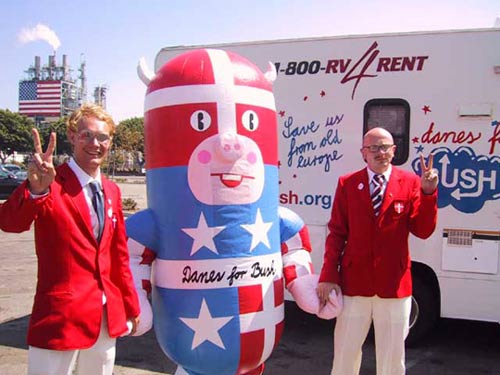
The genre of serious satire, of which Danes For Bush is a part, is a growing genre. It is satire that is lightly, if not cleverly, disguised - a part of pop culture found at some indefinite point where art, journalism and politics meet. If Michael Moore is the current king, Danes for Bush is an original derivative.
Danes for Bush hit the pavement in August 2004; just as the American Presidential campaign was beginning to heat up. The tour was timed to hit New York at the end of August at the same time as the Republican convention that would confirm George W. Bush as the Republican presidential candidate in 2004.
The two-man Danish road show of Jakob Boeskov and Mads Brugger plow their way across the United States in a camper van for a series of appointments with the right-wing grassroots of the American heartland during the weeks leading up to the Republican convention. With an air of determination they make continuous vows to do whatever they can to support the cause of making sure Bush and Cheney are around until 2008.
Their weapon of choice is a portrait of sincerity, a couple of over-the-top matching outfits, plenty of ‘Danes for Bush’ campaign paraphernalia, and a bizarre inflatable pork-sausage mascot wrapped in an American flag. Yet they steadfastly refuse to reveal that their fighting words should be taken at anything but their face value. It may all seem over the top, but so are the views espoused by hard-right republican after republican.
Ironically, Jakob and Mads’ very outrageousness and demeanour, if a dead-give away to fellow-Danes and others of a more moderate point of view, is the bait that catches and quickly convinces countless staunch Republicans. We witness a scattering of semi-formal speeches and informal discussion results where Jakob and Mads allow their mock-opinions to bubble out. Their comments regularly cross the line into what many would (hopefully) feel is outrageousness (Jakob: ‘Let’s face it, we need that fucking oil!’), before faithfully jumping back to (slightly) less outrageous territory, lest any of the less radical radicals in the crowd become disturbed and suspicious. The targets fail to register that it is pantomime and satire they are momentarily cast into. They believe in the sincerity of two passionate figures echoing their own warped thoughts!
This is the ticket into this surreal parallel world, and Jakob and Mads never give up the deep dark secret that they themselves are anything but genuine in their purported beliefs and stated intentions. Even on their website (www.danesforbush.org), they refuse to give up the gag. Their subjects remain unguarded and uninhibited. Free to speak candidly, they do. This is the source of the genius.
A district judge in Texas feels no shame in suggesting that dropping the bomb on Baghdad would save lives – his proof: it did in Japan. They create an award and give it to him – Americans love awards. There is no counterattack attack their targets face. No moment of revelation where the purpose is revealed to the unsuspecting. They will forever remain ignorant.
Yet it is the unexpected by-product of these countless encounters with hard right-wingers during their cross-country marathon that sets Danes for Bush apart in this genre of political satire.
While it is no surprise to find groups of radical right-ringers talking the talk one would expect of radical right-wingers, what is an eye-opener is the source of the feelings of uncertainty and paranoia their targets ultimately reveal.
The talk of the right-wingers they encounter is of the hopeless tragedy of friends and neighbours murdered by random gun-violence; Vietnam as a terrifying scar – one that we see lingering disturbingly on so many psyches; and of course the deep, oftentimes wildly fanatical, religious faith used to steady so many in the face of it all. The trauma of being hit by terrorists who, from the perspective of a small-timer in the heart of America, have emerged almost mystically from some unknown evil has been the final blow. These people are visibly shaken in many of the encounters. They have felt an enormous sense of betrayal of purpose over the years, and they are stunned by it. Unfortunately, they seem totally unarmed to deal with this deep bubbling well of conflict and contradiction that lays deep inside their country’s history, continuing to boil unrelentingly today.
The affects of violence, war and terrorism the Americans as individuals can see within their own homeland are dramatically at odds with the widely held belief in their own global superiority, domination and universal righteousness. These beliefs are deeply ingrained, and not easily displaced. They have been nurtured since age none, through their first steps as children; ritualistically pledged through a symbolic allegiance to the flag spoken each and every school day; hyperactively spoon-fed by a lifetime of not entirely coherent media; canonised by the deeply conservative judicial system; rubber-stamped by the various levels of government across the land and through the very words of the President himself. Mix in the symbolism, dogma and (oftentimes) fanaticism of the growing Christian right populating the heartlands in ever increasing numbers, and what is left is odd message of fearful hope amongst the senselessness.
Yet the air remains densely clouded with cynicism, confusion, tension, anger and repression because, spliced together, these disjointed fragments have become justification for policies of (pre-emptive) war and containment abroad, the curtailment civil liberties at home and few if any fundamental rights at all for those deemed as possible threats (evidence be damned). Only the hopeful language of universal freedom and peace on the march stands as the shaky premise buffering the reality of the madness they are supporting. So instead this premise has become the final nail in the coffin - what is a person to think? To imagine the issue is one extreme right-wing president and a misguided war is to miss the point.
What these people see surrounding them, all that is being told, all that has been taught, all they have learnt; it all purports to be the truth – yet not all of it can be. They themselves can sense that it all doesn’t add up, they can’t quite make sense of how this has come to be. The radicalisation of their views is the by-product, since countless friends, neighbours, colleagues and the rest would sooner part ways with them than accept a daring suggestion that another reasonable point of view may exist beyond the prevailing right-wing logic.
This is the point where surprisingly, the clouds begin to clear.
As we watch the Danes for Bush characters in full pantomime, Mads and Jacob meeting right-winger after right-winger, group after group; the puzzle pieces begin to fall into place. One now understands where it is the people they are meeting are coming from.
With this realisation, the disbelief that a group of such people and their radical viewpoints can exist mutates into a sort of momentary, if uneasy, forgiveness – which is not at all to say that one finds oneself agreeing with virtually anything being said.
The right-wingers are children stumbling through the unknown, ever fearful of what may lurk around the next corner, wishing for the impregnable protection they once imagined their parents to provide, a long time ago. Unsurprisingly, they opt to support the solutions that most closely mirror their childlike tendencies. Tough talk and unconditional support of those willing to accept war against an imaginary enemy, thereby subjecting others to the burden of their fears as they themselves cower defencelessly, waiting for the world to become the idealistic place they imagine it should be.
The enemy surely lurks somewhere in the Middle East, so attack, ATTACK! What better justification? There is no time to think about it, to debate. How can you put a price on comfort, reassurance? The violent and unpredictable world must be secured; perhaps a more manageable task than that of collectively coming to grips with ones own conflicted past.
In Bowling for Columbine, Michael Moore set out to convince anyone who cared to listen that America is a fearful nation, full of people scared silly, if not stupid. Danes for Bush has gone further still. In managing to communicate with the same group of people that John Kerry and the left wing of America were simply unable to touch, the Danes for Bush guys, if inadvertently, stumbled upon the reason why this very fear exists in the first place.
Sadly, dealing with this mess will preoccupy left-wing Americans for years to come. What can be said here and now at least, is that blended together with enough passion; politics, art and journalism certainly can reveal a lot.
Many who witnessed Groove Armada playing live in Copenhagen last night (Oct. 14) would be surprised to discover that what they were seeing was not precisely as it seemed.
Indeed, it was a fantastic and memorable performance, so much so that I have trouble recalling a live performance in Copenhagen that was filled with that much energy – and the audience responded appropriately. Most bands simply don’t have the repertoire Groove Armada has to call upon to get an audience jumping and dancing - and the band made liberal use of that last night.
The sound was pretty good, though not great. The primary complaint: the bass wasn’t particularly clear in the mix, a typical problem for less-experienced bands, though most bands with a bit of road experience manage to improve upon this over time. One might have expected a little more from an act with the road experience of Groove Armada and whose albums have always featured hallmark sound production clarity.
Or perhaps it was a consequence of something else, a small but troubling point:
Groove Armada consists of two people, Andy Cato and Tom Findlay. On their albums they feature a number of guest artists and for live performance (when not doing their DJ-thing) Andy and Tom arm themselves with a solid cast of musicians and put on what have long been acknowledge to be lively and innovative shows. Unfortunately, last night Mr. Cato and Mr. Findlay decided to give the show in Copenhagen a miss…yes, that’s right, they weren’t there! Groove Armada was not quite Groove Armada last night - it was a live band billed as Groove Armada and playing Groove Armada songs yet minus the (only) two actual band members! To say this is a new twist on live performance would be an understatement.
A quick investigation on the web reveals that this has been the case during this recent leg of their tour – including stops in Amsterdam and Vienna. Interesting, all of these recent stops (including Copenhagen) are not listed in the ‘Tour’ section of their official website – are Tom and Andy a bit sheepish to acknowledge a Groove Armada tour that is not quite a Groove Armada tour? Perhaps they’re a bit embarrassed to find themselves making such a blatant cash grab at the expense of their genuine fans? Nowhere in the concert promotion and advertising is the absence of the main band members indicated – the shows are faithfully billed as ‘Groove Armada’.
This is of course both a shame and a dilemma – on one hand, the show in Copenhagen was a fine performance, on the other the absence of the main performers leaves one with a bad taste - and feeling a bit cheated! (No wonder they opted not to perform their trademark, ‘At the River’ -featuring Andy’s trademark trombone playing!) What is a fan to think? Myself, I am at a loss for an explanation!


