Showing posts with label beer. Show all posts

A date with some delicious beer - Espisode #50 of MyDenmarkTV.com

This week was all about the beer in Episode #50 of MyDenmarkTV.com. We spent a few hours at the annual Copenhagen Beer Festival (Øl Festival) that happened last week.

Episode #50 - MyDenmarkTV.com from MyDenmarkTV on Vimeo.


So let me make a few quick comments about this episode.

Firstly, I think this was my favourite episode so far, and not just because of the beer. We've been working hard to bring our production and editing up to the next level, and I think this episode truly succeeded. Of course, that also demands something of the hosts to make it possible, and we're trying!

Secondly, I've become a huge fan of Danish beer over the years - and I am not talking about Carlsberg. There are many Danish micro-breweries these days producing more and better beer than ever. If you ask me, by far the best one we tasted during this episode was Bøgedal, which is brewed in the most low-tech manner possible, making each batch unique. It really was something else to taste, so it wasn't just the lack of technology in the production that made it special. I'll definitely be returning to the beer festival next year.

Hope you enjoy!

Hmmm, what's that beer...?


Every now and then, some little and seemingly meaningless event or incident reminds you that things are always developing, and in the case of Copenhagen, generally for the better, I would say.

A recent addition at the exit gates at Copenhagen Airport is a case in point. The orange facade and clean lines of the relatively new 'Nørrebro Bryghus' bar is the first thing passengers see as they exit the airport. And this really is something notable - notable for what it isn't.

See, in years past, dear old Carlsberg would never have let such an opportunity to blast their green logo in front of a few million people, many stepping onto Danish soil for the first time, get by them. But somehow the little Nørrebro Bryhus-microbrewery outfoxed the giant, grabbing onto this prime spot. And it's more than a symbolic victory, since this really is the first 'visual of Denmark' as passengers exit customs and effectively enter Denmark.

It's also a nice allegory to the state of the beer market in Denmark, which has been thoroughly rejuvenated with the addition of piles of small breweries and tasty beers. I like it.

Vinstue 90: Where Carlsberg beer (improbably) comes to life...

I dislike Carlsberg beer. My reasons are legitimate. There are plenty of beers - both Danish and non-Danish, that frankly have a lot more (and a lot better) taste. Until a few years ago, Carlsberg played every trick in the book in order to choke the beer market in Denmark, which created a pretty dire state of affairs in the shops and cafes across the country. Carlsberg is still pretty good at it, but the jig has now been up for a few years since the door swung open to a wider selection of beers. In particular, thanks to micro-breweries around the country, it seems there is no going back. Supermarkets, kiosks, restaurants and cafes around the city are now stocked with a remarkable selection of beer - many of which didn't even exist a few short years back. Which means that Carlsberg is fairly easily avoided these days.

But the other day, I had an experience drinking a
Carlsberg beer that was frankly and utterly novel. That is, I enjoyed it. I mean deeply, truly and sincerely enjoyed it. But allow me to explain, for though this was seemingly a normal Carlsberg, it was in fact not quite a normal Carlsberg.

Rather, it was a 'slow beer', poured at
Vinstue 90 on Gamel Kongvej, apparently the only place in Copenhagen that actually knows how to serve a proper Fadøl (draft beer). Little did I realise there was actually an art to pouring a Carlsberg.

I should also add that while
Vinstue 90 looks at first glance like a typical bodega, smells at first smell like a typical bodega, and serves a lot of Carlsberg just like a typical bodega, it is in fact not at all a typical bodega. On second glance, you realise the crowd is not that of a typical bodega, nor is the service. And the atmosphere is pretty good, as well. Let's call it a 'chatty' kind of place.

At
Vinstue 90, it takes 15 minutes to pour a single draft beer. Yes, you read that right: 15 minutes! This is exactly the same sort of Carlsberg pilsner served at countless other establishments around the city. These is only one difference - and that is in the pouring.

First, it's poured with a lot of foam that is allowed to gently and slowly settle, before the glass is further filled and again allowed to settle. It's not unlike the way a properly served
Guiness is poured, in fact. That's indeed why the sign outside the bar proclaims 'slow beer'.

And the result is truly remarkable. One ends up with a
Carlsberg that is smooth and full of taste. In a blind taste test, I would never have guessed it was a Carlsberg I was being served. The normal sharp bubbly bitterness that (at least in my opinion) makes Carlsberg so unbearable after more than a couple bottles (and sometimes only a couple sips) is entirely absent. It's a remarkable transformation.

And to prove that it wasn't just a quirk of the taste buds on this particular evening, to end the night we ordered a normal bottle of
Carlsberg - rather than the on tap version. And there it was again - that characteristic bitter and essentially unpalatable Carlsberg taste. We left the bottle unfinished. But I will soon return to Vinstue 90 - for another slow beer or two.

A Christmas beer worth sipping...

The other night while out for some drinks with friends, we happened upon a very worthwhile beer from Denmark, of all places. Needless to say, this one wasn't from Carlsberg or Tuborg. Actually, it's a seasonal one, the Christmas beer from Ørbæk, which happens to be called Santa C. appropriately enough. Now the one I tried was on tap, so it remains to be seen if the bottled version smacks the taste buds quite the same way (they don't always, after all). It wasn't a dark beer either, I should add, knowing this is a characteristic commonly associated with Christmas beers. Actually, it was rather refreshing...

What really won me over was when I came across the beer at none other than Netto, earlier today, and realised as I was examining the label that it was actually an organic beer (økologisk øl, if you prefer). The company chooses to keep the organic part rather subtle, just a small mention on the side label. So that's today's beer recommendation.

Oh, and as always gifts (um, how about BEER!!) are welcome from the Ørbæk Brewery for this unconditional product endorsement from The Copenhagen Report, sure to generate sales - contact via email for the mailing address.

Barbarelleh in Copenhagen: The place to eat a late-night plate of nachos, cheese and salsa (while sipping champagne)

by: Tim Anderson (timothyanderson2005@gmail.com)


Despite visiting Barbarellah in Copenhagen in a handful of times previously, I must admit I'd never seen the place in quite the right light. Not until yesterday. Or maybe it's just that it's only recently begun to hit it's stride.

As it turns out, Barbarellah is an excellent place to go to kick-off the night on the weekend. Arriving around 11PM yesterday, the place was standing room only - the first time I'd seen it that way - though previous visits were mostly on weeknights. As the night progressed, it got only busier and busier.


Barabarrellah on Saturday night

Since it opened about 3 years ago, Barbarellah has always been a place in Copenhagen with great potential. From the start, those behind Barbarellah had figured out a few things that most other cafes in Copenhagen hadn't.

For example, there was the insight that couches, being rather comfortable, make a quite good addition to a cafe. And by not filling the entire floor space with square wooden tables (and uncomfortable wooden chairs) squeezed as closely together as possible, a less conventional and more appealing atmosphere can be created - something Barbaralleh has managed to do quite successfully. And as music is a rather crucial aspect of ambiance, it's a good idea to have some turntables and a decent DJ set-up - and not just a stereo behind the bar. So Barbarelleh seemed to be off on the right foot from the beginning.


a couple of turntables in the corner - always a welcome addition to a cafe

Yet in spite of this great potential, Barbarellah has been a consistent underperformer.

The service has always been painfully slow and it seems to have taken a while to settle on a specific food concept for the place. Even now, I'm still not entirely sure what that concept is, in fact. There are worse places in Copenhagen for service (read: Cafe Sommersko - avoid, avoid, avoid) but the staff at Barbarrellah can leave you pretty thirsty while you wait. But last night, at least, it was not all that bad.

Barbarellah has a couple decent beers on tap (Hoegaarden and Leffe) - a prerequisite for even being considered as an interesting cafe - and they can make decent cocktails. But what is really unique is that food is served all night - not only until 10PM, the normal Copenhagen cafe cut-off time.

Meaning that at Barbarellah, it's actually possible to order a bottle of bubbly to cheerfully wash down a late night plate of nachos, cheese and salsa. An unconventional combination indeed, but hey, why not?


it's 1AM: some nachos and salsa with your champagne?

A stroll down Istedgade (Part 3): Istedgade the Nightowl

By: Tim Anderson (timothyanderson2005@gmail.com)

Following on the heals of Part 1 and Part 2 of this Istedgade series, the focus of this one will be the trendier end of Istedgade, let's call that 'upper Istedgade'. What could be referred to as 'lower Istedgade' (or 'Istedgade the Hooker' and 'Istedgade the Junkie') are areas of the street offering their own distinct set of nightlife possibilities - and these will be the subject of part 5 of this series...


Istedgade by night is pretty good, indeed. Bars and cafés abound. It's not wall-to-wall cafes or anything like that - that would in all liklihood prove to be hugely problematic. Furthermore, the target clientel at the establishment of Istedgade trendier places are not those planning to end the night in a mess of sloppy drunkiness (even if a good few end up this way, nonetheless). There are other areas of Copenhagen where those less capable of handling a few drinks with dignity tend to frequent, which is a good thing for Istedgade. This is not at all to suggest that this makes Istedgade a quiet place by night. It's certainly not.

Along upper Istedgade, there are a fair number of generally unpretentious alternatives for having a quiet drink or less quiet drink.

Until recently, Cafe Riga, with it’s laid back atmosphere and underground music was the place to hang - but an ownership change some months ago, apparently provoked by complaining neighbours, has, as if a neutron bomb exploded, left the walls (and furniture) intact but sucked the life right out of the place. The fantastic underground music and excellent local DJ’s have disappeared (along with the atmosphere they largely were responsible for creating). Still, Riga’s comfortable chairs and couches remain a pleasant option for whiling away a few quiet hours in the early evening.


Cafe Riga today...a rather unpretentious welcome

A better bet, if hip and trendy is your thing (and Carlsberg is not), would be Boutique Lize. Only open evenings from Wednesday to Saturday, Boutique Lize serves a variety fine beers (mostly foreign) while the highly competent bartenders happily serve up a wide assortment of cocktails - some of the better ones in town. A glass of ‘Brugs’, a tasty Belgian offering available on tap, or a mojito (arguably one of the best in Copenagen) are both particularly recommendable.

Then there are a couple of Istedgade’s longstanding institutions of alcohol consumption and chatter – Bang and Jenson and McKluuds.

While Bang and Jensen has always managed to effortlessly maintain an image of laidback, hipster-like cool (and rarely lets you down on any night of the week, even late in the evening on Sunday), McKluuds fits quite a different description. It is all 'Copenhagen bodega' - though one of the more accessible ones. By all means drop by McKluuds for a very cheap beer and a free game of pool, but not for the atmosphere.


Bang and Jensen by day - still pretty busy


Bang and Jensen by night - even busier and rarely a let-down...


McKluuds...always cheap and always...well, cheap...

The place that could take the prize for trendiness would be Strassen - and maybe it does in a parallel universe somewhere else. Unfortunately in this one, it doesn't quite make it. Consistently apathetic service (and a really nasty batch of raw burgers served up to us several months by a cook in the kitchen who apparently was a little overzealous about trying to close the grill down early for the night) has put Strassen way out of favour in my books. Still, when the bartenders are in the mood, they are capable of mixing up quite a tasty cocktail. And Strassen does get the prize for the most amusing fishtank in Vesterbro - a large tank built into the wall with a huge mural picture of Istedgade laid out behind it.

Another unpretentious possibility would be Simpelt V (across from Riga). Doing it's best to take over from where Riga left off when it changed owners, they still haven't quite got the music issue down to a science at Simpelt V, but they're kind of trying. It does look pretty hipster, what with all the vinyl hanging on the walls and the pleasantly comfortable seating.


Simpelt V - hidden behind the bikes and graffitti...

An untested newcomer is Malbeck, an establishment billing itself as an Argentian Wine bar. We'll see if this one flies, in time.


And still more newcomers will surely arrive in the area over the next months.

But what if you're hungry (you may be asking by now)? Well, that's up next in Part 4...

Morning delivery of draft beer in Copenhagen

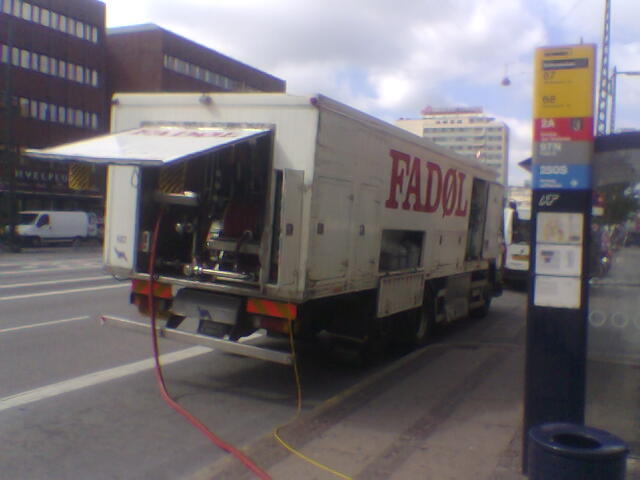
Many mornings in Copenhagen, on my way to work, I cycle by a truck that always makes me laugh. It closely resembles the oil truck that used to come a couple times a year to the house I grew up in as a kid to fill up the oil tank in our basement (that fueled the furnace in the house). Except this truck here in Copenhagen carries no oil. In fact, it is a Carlsberg beer tanker!

For those without a working command of Danish, 'Fadøl' (as written on the side of the truck pictured below) means 'draft beer'.


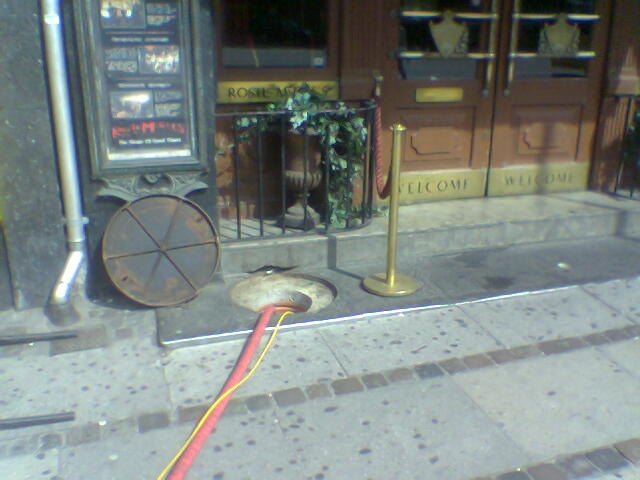
And just as it was done with those old oil trucks (that are still around), a hose is pulled from the truck and is connected to the beer tanks located in the basement of the bar...


...via a little hole in the ground, in front of the bar. Just pull the hose!


...and voila, tasty beer will be flowing from the taps in no time! Needless to say, this is not exactly the quality kind that I have been writing about in previous posts...

Setting the story straight - The Remarkable Danish Beer Market (Part 3)

by Tim Anderson (timothyanderson2005@gmail.com)

I want to set the record straight. After writing a couple of articles about the Danish beer market which I published earlier (The Remarkable Danish Beer Market (Part 1) and Carlsberg Stikes Back - The Remarkable Danish Beer Market (Part 2)), there was one crucial issue I had not tackled – exactly who was responsible for importing all of these foreign beers to Denmark? Who was it that was able to so quickly convince so many shops and bars across Denmark to dedicate less space to Carlsberg/Tuborg products, and much more to relatively expensive foreign ones? I had this nagging suspicion that maybe, just maybe, Carlsberg still had a hand in these matters. It turns out my suspicions were not without merit.

Now if I had been charged with writing these previous two articles for a mainstream news outlet, I would never have been able to get away with such a glaring omission. Fortunately, I was not. So here it is, the last pieces of the previously incomplete puzzle.


The Danish beer market makes a remarkably fascinating study. First, an influx of quality foreign beers into Denmark, alongside drastic leap in foreign beer sales over the last four years demonstrated clear willingness for Danish consumers for such quality beers. Foreign beer consumption, which stood around 0.7 million litres back in 2000, exploded to nearly 9 million litres in 2004. Sensing a definitive consumer trend towards these tastier (and more expensive) beers, a number of Danish microbreweries have been springing back to life in recent months. The average beer drinker in Denmark is now faced an abundance of choice, at long last.


Yet, there is more to this story than first meets the eye.

Few are aware that it was a decision back in 2002 by the brewing-giant, Carlsberg, long the dominant force in the Danish beer market and possessor of a finely-honed selection of market strangulation tricks, that finally kicked the doors open to a wide range of quality beers. More on that shortly.

Back in 2000, when I first moved to Copenhagen from London, the picture looked radically different then it does today. Carlsberg and Tuborg flowed exclusively from all but a tiny handful of taps in the bars of Copenhagen. Supermarkets were no better selling primarily on Carlsberg and Tuborg, the similar-tasting discount beers produced by knock-off copycat brands like Harboe and Ceres and an extremely limited selection of highly overpriced and relatively uninteresting foreign ones – names such as Fosters and Heineken.

Denmark’s long brewing tradition was never evident from tasting the narrow range mass-market beers offered in bars and supermarkets a few short years ago. It seemed these bars and supermarkets had somehow never discovered that there was a world of beers beyond the limited range they stocked – albeit a range that was essentially foist upon them by Carlsberg.

Nonetheless, as foreign beers slowly began trickling into Denmark a few years back, Carlsberg opted to take matters into it’s own hands in a significant strategy shift. Perhaps recognising that it was unlikely to ever match many of these foreign beers in terms of depth of taste, Carlsberg found another way around the issue through the creation a wholly owned import company, House of Beer (www.house of beer.dk) in 2002. Carlsberg owned House of Beer quickly became the exclusive Danish importer for many foreign beers. Perhaps it was never likely that the giant of Danish brewing would graciously risk giving away all the cash from this significant (if minor) share of its the home market.

It is largely owing to these efforts that various Belgian, Czech and German beers such as Hoegaarden, Chimay, Leffe, Staropramen, Erdinger, Franzikaner, Urquel and Budvar, among others, have come to flow increasingly freely at bars across Copenhagen over the past three years and are now sold in all major supermarkets. House of Beer is responsible for supplying many (though not all) of these quality foreign beers, and sales of foreign beers have being going through the roof as Danish consumers increasingly embrace them. In 2002, House of Beer imported 4.2 million litres of beer, and this year it will import over 13 million litres – the sort of growth most companies only fantasise about.

These foreign beers are generally priced between double or triple Carlberg and Tuborgs mainstream beers (and four to six times those of the Danish copycat producers similar knock-offs), but have become enormously popular in spite of this price disadvantage. Some of the newer bars in Copenhagen are even opting to leave Carlsberg/Tuborg off the menu entirely, an idea virtually unimaginable only a few years back.

Over the past months, the transformation has continued as a number of Danish microbreweries (brewing quality beers) have re-entered the fray. The products of Danish microbreweries such as Fur, Skand, Bryghus and Thisted now command significant shelf space on supermarket shelves, overwhelming Carlsberg’s long-neglected Semper Ardens range of quality beers which typically stand nearby (a range of specialty beers Carlsberg has long-ignored, having focussed its marketing efforts exclusively on its mainstream beers, while allocating no budget to its specialty products such as Semper). Priced similarly to the quality foreign beers now available, these small-time Danish brands appear to be succeeding.

Not to be outdone, and sensing a neglected market segment quickly being filled by these Danish microbreweries, Carlsberg recently responded by introducing another line of quality beers (beyond it’s Semper Ardens range) specifically for the Danish market. Under the name Jacobsen, these beers (Bramley Wit, Brown Ale, Dark Lager and Saaz Blonde) are marketed as ‘microbrewery’ beers and brewed at a small, purpose-built brewhouse, symbolically located beside the company’s Copenhagen headquarters. (See my previous article Carlsberg Stikes Back - The Remarkable Danish Beer Market (Part 2) for more on these.)

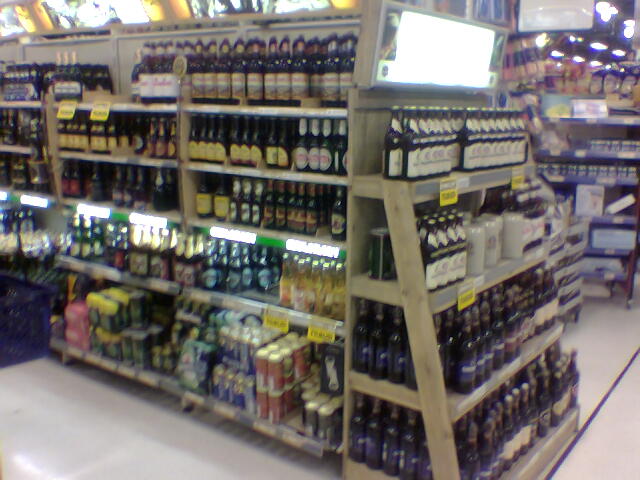
Thanks to all of this change, in Danish supermarkets an entire aisle can be found stocked with various quality beers from Denmark and around the world – an aisle that did not exist a few short years ago. Furthermore, in many of the supermarkets, the mainstream beers of Carlsberg and Tuborg are being relegated a lesser area of space then the quality foreign and domestic beers now occupy. It’s about time.

It is doubtful that even Carlsberg could have anticipated the far-reaching transformation being set in motion as it began importing beers back in 2002 – a transformation that continues unabated today.

It seems the days when an extremely limited range of quality foreign beers and quality domestic alternatives were virtually unavailable in any supermarkets are now long-gone, once and for all. I myself never imagined when I first arrived in Denmark five years ago that things would unfold in such a dramatic manner as they have. How refreshing it has been.


Carlsberg Strikes Back – The Remarkable Danish Beer Market, Part 2


by Tim Anderson (timothyanderson2005@gmail.com)

Apparently invigorated by the influx of foreign beers into Denmark over the last four years that has seen consumption of quality (generally foreign) beers skyrocket over the past years, Carlsberg has taken its first steps in response. Virtually at the same moment I hit the ’publish’ button for the last article I wrote regarding the Danish beer market (The Remarkable Danish Beer Market), Carlsberg announced the introduction of a new line of exclusive, upmarket beers, to be brewed under the name ‘Jacobsen’ (after J.C. Jacobsen, who founded Carlsberg in 1847) in a microbrewery located beside Carlsberg’s Copenhagen headquarters. The Jacobsen line of beers consists of Bramley Wit, Brown Ale, Dark Lager and Saaz Blonde.

This is an excellent sign, from my perspective. The trend towards quality, upmarket beers entering the Danish market is apparently more than a ‘blip’ on the radar screen. Unlike four years ago, when Carlsberg’s market domination of the beer market in Denmark was so comprehensive that the company's half-hearted attempt to revitalise its product range involved offering four new beers, quickly withdrawing three of them (keeping the 'best') and promptly ending all marketing and promotional efforts geared towards bringing this new offering into the mainstream beer market. But time does bring change.

So although this influx of foreign beers into Denmark may have had little financial impact on Carlsberg’s Danish operations – Carlsberg continues to dominate the market – the change is now visibly apparent when visiting bars and shops across Copenhagen, making Carlsberg’s domination seem not nearly as overwhelming as it once was. Choice has returned to the pubs and bars across the city.

Unfortunately, in terms of taste, the new Jacobsen beers, similar to it's 'Hvede' beer introduced a few years ago, do not offer a depth of taste comparable to that many of the foreign beers that are available. After enjoying a Jacobsen Dark Brown, and taking a few sips of the Jacobsen Saaz Blonde a friend was drinking, I was left with the clear impression that neither was bad at all – they were both decent beers with a fair amount of taste. And they were certainly infinitely more interesting than the typical Carlberg or Tuborg pilsner. However, I was nonetheless left with the overwhelming desire for something more. The Saaz Blonde simply did not possess the depth of flavour I have come to expect in a good wheat beer. The Hoegaarden I subsequently ordered did the trick in satisfying this urge. So Jacobsen is a nice addition to the Carlsberg beer family, no doubt, but Carlsberg hasn’t been able to cross over that invisible line that will allow it seriously challenge the more established foreign beers in the area of taste.

So the risk in all of this is that Carlsberg will reach into it’s old bag of market domination tricks, ones that have served it so well over the years, in order to try and convince significant numbers of Danish bars that may be considering adding one or two taps for more upmarket offerings, to opt for Jacobsen over those tasty foreign beers. I am the first to admit that whatever the outcome, all of this is better than no choice at all, which is how it was not that long ago.


There's more! Read on, Setting the record straight - The remarkable Danish beer market (Part 3).

The Remarkable Danish Beer Market (Part 1)


by Tim Anderson (timothyanderson2005@gmail.com)

Change can be dramatic and fast, and so it has been across the Danish beer market where a quiet revolution has been occurring over the past years. Though the mainstream beers of Carlberg/Tuborg remain dominant, foreign beer consumption in Denmark has skyrocketed from 0.7 million litres consumed in 2000, to 8.7 million litres in 2004.

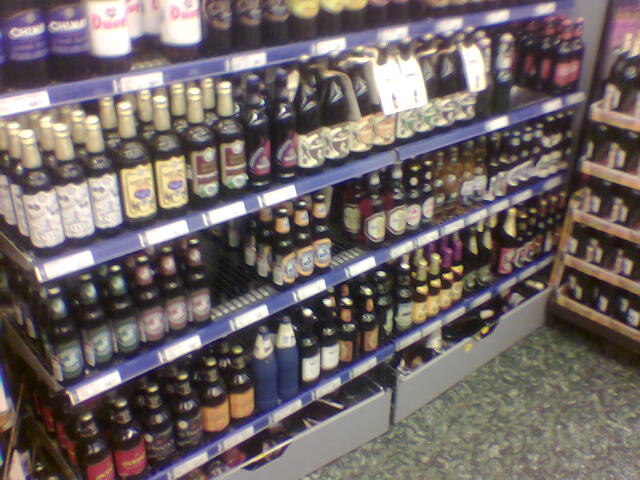
The humble beginnings of this revolution started in 2001 with the introduction of a very limited selection of premium quality foreign beers displayed on small wooden racks in a couple the national supermarket chains. These small wooden racks remain, however they now bookend an entire row of premium foreign beers in the stores of every major supermarket chain. The total space they are now allocated is comparable to that of Carlsberg and (Carlsberg-owned) Tuborg and the other low-quality Danish beers on offer.


An slowly expanding selection...


These foreign beers are sold at a price that is between double to triple that of Carlsberg and Tuborg, yet sales continues to skyrocket. Apparently, taste does mean something to a good number of people after all. The turnaround within the beer market has been astoundingly profound, and far beyond what even an amateur beer enthusiast like myself could have anticipated, must less hoped for, given the sorry the state of affairs that existed less than five years back. The tide is certainly shifting.

Most bars across Copenhagen now offer a small but increasing range of quality foreign beers, particularly Belgian and Czech ones. Whereas back in 2000, Carlsberg and Tuborg flowed exclusively from all but a tiny handful of taps in the bars of Copenhagen, now bars offering only Carlsberg/Tuborg on tap are sliding into the minority. And Hoegaarden, Chimay, Leffe, Staropramen, Erdinger, Franzikaner, Urquel and Budvar flow increasingly freely, with a few of the newer bars opting to leave Carlsberg/Tuborg off the menu entirely. In terms of taste, there is little challenge from Carlsberg/Tuborg for these other far superior mainstream quality offerings.

Unfortunately, for Carlsberg, of the largest brewers in the world (and owner of Tuborg), taste and quality has always been a distant goal after profit, and zooming in on Denmark, the strategy has always been market domination. Countless amounts of sponsorship and promotional cash are doled out by the company to ensure its products remain embedded deep within the collective national psyche of the nation. It has been a successful strategy - the company has generally held its ground and generated a mountain of cash in the process.

This truth was perhaps hammered home most forcefully one night back in 2001, sitting at one of the three bars in Copenhagen at the time that offered a decent selection of quality foreign beers. Carlberg had just released a new beer, called ‘Tuborg Hvede Øl’ (‘wheat beer’), it’s first unfiltered wheat beer. As far as I was concerned, this was fantastic news – at last an attempt to produce a quality mainstream beer from Carlsberg.

The bartender that night, recognising a couple of my friends from previous visits, offered us a round these on the house – he had received a complimentary batch from Tuborg. That night, we happened to be drinking some Belgian wheat beers – I cannot recall which one but I believe it was Hoegaarden. Doing a quick taste comparison, it was evident that Tuborg’s offering, though good, simply couldn’t hold a candle to the far superior Belgian wheat beer we were drinking. And admittedly, there are even better wheat beers than Hoegaarden! The Belgian beer had a depth of flavour that left one feeling Carlsberg/Tuborg’s offering must have been watered down, albeit with a decent flavour at least.

Now there is a couple ways this result could be interpreted. On one hand, in spite of a deep history of brewing, perhaps Carlsberg/Tuborg really did suffer from an underdeveloped experience brewing unfiltered beers - meaing maybe this was the best they could come up with. The bartender believed this was the first unfiltered wheat beer the company had ever attempted. Or perhaps, the real story was economic, and Carlsberg was quite capable of producing something better but couldn’t be bothered to offer up something even more interesting - acceptability over excellence with a strong dose of marketing to bridge the gap, in line with the traditional strategy that ran through the company’s and storied long history.

Bare in mind that around this time period, Carlsberg was running a sort of contest – which was rather in reality a marketing gimmick – involving four new beers introduced for a limited period (Hvede was one of them, the others being Dark, Red and Lager). Consumers could vote for their favourite, the winning beer would remain on the market, the losers would disappear into the black hole of Carlsberg history. Carlberg should have be trumpeting the arrival of four new members of its mainstream family. Instead, it proclaimed it would shortly remove three of them.

Now, for example, in Belgian – a comparably small country but one with a rich and deep history of brewing – between one to two hundred different types of beers are sold in all major supermarkets, double to triple this selection in the numerous specialty beer stores across the country. Similarly, in Germany and Czech, two other countries with a similarly long and proud brewing tradition, choice abounds. Surely, a slightly wider product line from Carsberg would meet with some acceptance in beer-oriented Denmark as well? Rather, Carlsbers’s mass marketing strategy revolved around a very small range of beers – Carl’s Special, Pilsner, and in it’s Tuborg range represented by Green and Guld. It still does, by in large.

The rest of the mainstream Danish market consists largely of smaller, low-cost, copy-cat producers who use the same Carlsberg/Tuborg formula - offering a range of cheap, similar tasting beers - though theirs cost on average around half the price of Carlberg/Tuborg. Interestingly, the taste difference is slight. One could quite convincingly argue a good many of them, such as most of the Harboe and Ceres range of beers, are perhaps even superiour in taste to Carlberg and Tuborg.

There is also one notable high high point of the beer-year in Denmark during the Christmas and Easter season when Carlsberg/Tuborg release, for a very limited time, a Christmas and Easter beer that happens to be a surpringly tasty beer - with the discount breweries also releasing their own competing products to match. Carlberg/Tuborg's is of a similar in quality to Hvede, which is to say, much higher than the standard of their other mainstream products.

Incidently, I recall Carlsberg Dark won that popularity contest a few years back, though the beer has subsequently all but disappeared from bars and pubs and does not generally feature in Carlberg's promotional efforts. From this outcome, one might be tempted to conclude that Denmark’s beer drinkers are conservative and not prone to shift their loyalties to a newcomer, in spite of taste and quality issues. One might thus conclude that to focus on expanding the product range, particularly on the quality end, may not be worth much, especially for a company like Carlberg.

Fortunately, this has proven to be far from the truth, as the exploding foreign beers sales figures demonstrate.

The latest development has seen the introduction of a small range of foreign beers at one of the two (high-volume) discount supermarket chains (Netto). To appreciate the significance of this development, one must shop at these discount supermarkets (and they are extremely successful) to experience just what an extremely limited range of products they sell, particularly on the quality end of things.

It is a genuine pleasure to experience such a rare turn of events where quality emerges from the shadow of a dominant other, much less worthy.

Curious to know more? Read on, Carlsberg strikes back - The remarkable Danish beer market (Part 2) and Setting the record straight - The remarkable Danish beer market (Part 3)

Powered by Blogger