Showing posts with label politics. Show all posts

Deluded nationalists unite! The Copenhagen Post wants you!

Each week, The Copenhagen Post passes across my desk at work. For those with a limited knowledge of Danish with an interest in Copenhagen, it's a often the starting point for picking up a bit of Danish news (though a better one is probably the handful of English article published at www.politiken.dk). As I can pretty much follow along with the normal Danish press, my need for the Copenhagen Post is limited - a good thing as it is hardly a comprehensive news source. But they do gamely (and oftentimes lamely) try.

The Copenhagen Post has been making effort to resemble a more traditional newspaper over the years, for example, by adding an editorial section, where newspaper takes a stand on one issue of the other. Which is what motivated me to sit down a write this little piece.

Now, trying to gracefully convey my feelings after reading the pile of smelly tripe they attempted to pass off for the reasoned opinion of the editor in the Feb. 20-26, 2009 edition will not be easy. But I shall attempt to. Fortunately, they did not pollute the cyberworld with this editorial - it can only be found in the print edition. What a shame. I shall therefore allow myself to quote at length from the article, so the nature of it's content can be understood well enough.

The subject was dual citizenship. That is, the ability for citizens to hold 2 passports. In Denmark, this is not permitted (there are a few exceptions, for example, children with parents of 2 nationalities). This in itself has always annoyed me, as it represents a very small-minded way of thinking.

However, reading this editorial left me seeing red by the end of the first paragraph. It only got worse from there.

"It is a fundamental principle of democracy that members of a community should have a say in making decisions about their community. But just as it is impossible to serve two masters, so too is it impossible to live in two countries - by belonging to both, one never fully becomes a member of either," intoned The Copenhagen Post to kick-off the editorial.

Oh, my. Are you fu*king kidding me?!? Um, what is this sh*t about not being able to serve two masters? Are we living in the times of slavery? And then to artificially equate this to serving two countries?

Elequent it may be, but nonetheless idiotic rubbish.

Personally, I don't think I could count how many entities I 'serve'. Is 'the country' really such an important one, amongst the many? And is it the 'ultimate' one (we'll return to this term shortly)?

Let's see.

I'm Canadian and my parents, sister and extended family live in Canada (and some in the U.S.A). They are pretty important to me. I live in Denmark and have for quite some time (which incidently is also a member of the European Union, which is a pretty important entity in itself). I like Denmark, in general. My girlfriend is Danish, as is her family. Would I chose country over her...hmmm, let me think about that for a while... And I have close friends all over the world, obviously some closer than others. They are also important. My employer is a Danish company, situated here in Denmark, but is actually owned jointly by a German company and a Norwegian company (oh no, two masters again!), but on a daily basis I'm working with people situated in 8 different countries (all working for this same company). Impossible to serve 2 masters?!? Impossible to serve 2 countries?!? What century was this editorial written in?

But let's allow ourselves to plow on further, even if we must hold our noses.

"Citizenship is bestowed upon us at birth, and giving it up is the ultimate sign of commitment to one's new country. But before one can make that commitment, one must be permitted to do so: to become a new citizen, one must not only be permitted to enter a country, one must be allowed to live there, and then one must demonstrate a knowledge of the country's history, language and culture by passing immigration tests," continues The Copenhagen Post.

The 'ultimate' commitment to one's new country? Well, I suppose for some it could be, but since when should making the 'ultimate' commitment, whatever it is, be the grounds for gaining something so practical as a passport? Is there not a much lower and more practical threshold that is somewhat more meaningful, or at least 'sufficient'. Does one really have to give up their first passport to make this commitment? Is there not simply, say, any number of actions that would do, such as living and working in a given country for some time (and thereby paying significant taxes), maybe raising a family there, with no additional conditions really necessary? And certainly no arbitrary judgment about which is the 'ultimate' among them.

Although The Copenhagen Post, and sadly the Danish government, supports this antiquated law, the 'ultimate' problem, if I dare suggest it, seems to be an insistence upon viewing the passport as something that is rather romantic in its nature.

Newsflash: it is not.

A passport is a practical and unfortunately necessary document. Something that enables people to move around from place to place. To cross borders. To live their lives as they see fit to. To be together with the ones they love. To make a living as they choose to, and to utilise the abilities they have chosen to develop in themselves. While there may be plenty of romance within these ideas, a passport is merely a facilitator and a cold bureaucratic reality - and those have always
had the unfortunate trait of never ever being in any way romantic in nature.

Being able to acquire an additional passport simply makes it easier for those living in a given country to become productive members of society there. Being a productive and deserving member of society can happen in many, many ways. It also so happens that it can be done without the demonstration of knowledge of a given countries language, history, and so-called culture. Or to put it another way, one can 'integrate' into society in countless ways. There is no single correct way to integrate - for example, by giving up one's former passport or passing some sort of 'immigration test'. Of course, especially with regards to language, everything should be done to encourage those who make a country their home to learn it's language.

As for reading history books?!? Give me a break! Will they tell you everything you need to know to be a good little citizen of your new country? Give you a balanced picture of society? Yeah, sure.

Which brings us to 'immigration tests'. Oh, geez. There are certainly some worthwhile practical questions potential citizens could be asked: about laws specific to Danish society, maybe some basics about government that are of practical importance. But it's pretty limited, quite frankly.

That may be tough for those who believe everything can be measured and then converted into some numerical value to understand, a group which apparently includes the editors of The Copenhagen Post. But here's the truth: sorry boys (there are no female editors of the newspaper listed), the real world ain't quite so.

Okay, let's push further into the editorial, into the Disneyland-like make-believe world of The Copenhagen Post editors. There is more still.

"Citizenship carries with it certain rights, but those rights are paid for by living up to the obligation of national service, national pride and national unity. Dual citizenship is divided citzenship, and will always prevent a 'citizen' from fully living up to those obligations."

Yes, at this point we have moved fully into fantasy land that I would never want to be a part of. In fact, it's somewhat scary. What kind of deluded nonsense is this about being 'paid for by living up to the obligation of...national pride'?

Is the implication that if someone does not demonstrate enough, ahem, 'live up to the obligation' of national pride, then they are unworthy of citizenship? What exactly is 'enough national pride'? Maybe singing the national anthem in a loud voice whenever it is demanded? Perhaps when stopped by the police? Or perhaps simply cheering wildly whenever the Danish national handball team scores a point would be enough? Whatever. What a complete joke.

This is the point when the writers have completely lost the plot. And where I have lost my respect for The Copenhagen Post's ability to write a meaningful editorial opinion.

So boys, do enjoy your freedom to express your opinion - but please, show the 'ultimate' respect for this freedom by not forgetting to engage in a bit of critical thinking while doing so. It serves us all so well.

Euro dreams...

I have to admit that I was something of a rare species, in my surroundings, back in 2000 during the last Danish referendum on whether to replace the kroner with the euro. At the time I was attending Copenhagen Business School, where support for the Euro was about as close to unanimous as one can get. Business types, you know. Myself, I was quietly something of a skeptic. Actually, it wasn't really because I was against joining. My position was that Denmark was in the enviable position of being able to afford to wait. Denmark had stability and a solid economy, after all. Which is to say, it was the 'Euro Club' that had to prove itself to Denmark, not the other way around. So why rush it? Why should Denmark rush into the scheme before the euro had proven itself as a functional currency?

So to be clear, this was by no means true opposition to the euro, more of a strategic 'what's the harm in waiting a couple years?'. A type of passive opposition. In case you didn't figure it out, the euro was voted down in Denmark.

Those couple of years have long since passed and as it turns out the euro has long since proven itself. There is really no need for Denmark to hold out any longer, and plenty of reasons to go for it. And probably it won't be long before the question is put to the public. These days, the financial crisis has brought a significant softening of public opinion in Denmark, with the majority now shifting towards a position in favour of the euro.

It seems unlikely that Danish Prime Minister and EU-superfan Anders Fogh Rasmussen will be able to resist holding a vote on the matter much longer. Now dear Anders admittedly does his best to temper his displays of excessively-overt EU enthusiasm, lest he talk himself out of his position of leader of his own party by overtly coveting a 'higher' position elsewhere in Europe, or provoke disquiet among his not-so-silent coalition partners, the embarrassingly racist Dansk Folkeparti, should they sense he is becoming a bit too overzealous about something that simply doesn't fit into their bellicosely juvenile vision of 'Danmark for Danskerne'.

Ironically, it is the very issues that the government didn't dare to address during the last referendum that are now fueling euro support. Those being any arguments grounded in economic logic - such as the point that simply adopting a currency that the Danish kroner is already tied to anyway isn't such a risk, when it comes down to it.

The fact that in the recent weeks, the National Bank was obliged to increase the interest rate spread between the euro and the kroner during the financial crisis was the real kicker that really shifted opinion. When people in Denmark, with homes and apartments already deflating in value by the day, realised that they were now also paying as much as 1.5% extra for the privilege of holding their loans in kroner instead of euro, finally a certainly logic which was previously drowned in nationalist sentiment snapped with a nearly audible 'cracking' sound (of course, that may actually have been the sound of shareholders jaws dropping open and hitting the ground when Roskilde Bank was suddenly nationalised and their stocks become instantly worthless), and almost overnight the shift the brought supporters of the euro in Denmark into a majority position.

So bring on the euro referendum. It might just be the occasion the government needs to shake the moth-balls off of those EU flags - flags which the Danish government seems to have a morbid fear of flying for even an hour longer than necessary each year, lest they be interpreted as some sort of anti-Denmark sentiment by the more rabid elements of the Danish population.


More about it here in a recent article from The Guardian.

Jeg er (ikke) dansker...


The Danish daily newspaper Politiken is currently running an outstanding - and much needed - campaign entitled 'Jeg er dansker' ('I am Danish'). It features daily photos of 'typical' and 'less-typical' Danes. These less-typical Danes have all to often, in recent years, been cast as something - anything - but truly Danish by a minority of Danish politicians (and their supporters). Sadly, these politicians at this point have all but managed to hijack not only the issues and agenda, but also much of the language of the ongoing 'discussion'.

Nowadays, when one hears talk in the Danish media of what (and who) is traditionally Danish and so forth, it is almost left assumed and unsaid that what this means is precisely as it has been defined - in a frustratingly monopolistic way - by this small xenophobic minority.

Of course, it didn't help that the one political party that tried to stand up against this issue with their heart and soul quickly fell flat and rather hard on their faces owing to their own inept clumsiness when put to the electoral test - and have since remained laying on the ground with heavily bleeding noses.

Anyway, well done Politiken. This is an issue which the volume needs to be turned up higher and higher in the coming months and years. Of course, if Politiken was really clever they should probably take out these same ads elsewhere, as readers of very liberal Politiken are probably the least likely to be the ones espousing the problematic viewpoints, or voting for the most troublemaking of the political parties in this area.

When a political project collapses...

It has been another ugly few days in Danish politics. Two members of Ny Alliance, the flailing political project which has essentially now done precisely the opposite of what it set out to do, left the party over the past days. That's 2 out of 5 of the party's elected members - or 40% if you are one for numbers. Ouch! This is a party that is flushing itself down the toilet, albeit taking a few flushes to get the job done. The leftover skid marks will likely be all but forgotten as they are worn away - perhaps rather quickly at the rate things are going.

Somehow, something went wrong for Ny Alliance when it came to agreeing upon on a strategy, back when the election was called back in the fall (and since), regarding exactly how to stand up to the Dansk Folkeparti's usual mild-to-extremely racist tactics, views and demands (not to mention the government's own particular - and often rather peculiar - manner of handling or 'appeasing' these). You see, this was what Ny Alliance detested above all else.

It seems that Gitte Seeberg, one of the founding members of the party (who left the party last week) was in favour of taking a strong stand and not being part of the governing 'block' (yes, the one that included the not so sweet-smelling, highly xenophobic Dansk Folkeparti). On the other hand, Malou Aamund, who left Ny Alliance earlier today, wasted no time in immediately joining Venstre, the Prime Minister's party in the governing coalition, suggesting that she essentially agreed with the government on mnay things, including the line that the new Immigration Minister has been taking regarding the asylum seekers in Denmark - who are stuck without being able to work in Denmark's happy immigration camps (which has been perhaps Ny Alliance's biggest issue from the start).

And then there is poor hapless Naser Khadar, the party leader, fumbling to hold it all together, whatever is left. He just has never really managed to get past repeating that Ny Alliance stands for an alternative to 'Block' politics in Denmark (which is to say either supporting the governing 'block' consisting of Venstre and Konservative as a coalition supported by Dansk Folkeparti, or joining the essentially toothless minority opposition 'block' of the Social Democrats, Socialist Folkeparti and Radikale Venstre), as opposed to actually finding a productive way to overcome this 'block' mentality. The formula he came up with was to join the governing block. So much for originality.

So now the government coalition in Denmark with the help of the supporting Dansk Folkeparti has a clear majority once again, thanks to Malou Aamund (and without even needing Ny Alliance for support, as they briefly did when one of their coalition MP's deflected her party to become an independent a few weeks back). Meaning it's back to the same old, same old.

It all looked like it might turn out so different back when it all began for Ny Alliance, which was not all that long ago...

So what now?


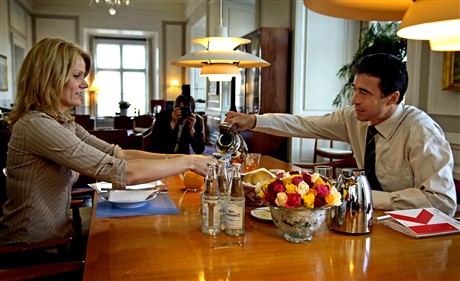
Social Democrat leader Helle Thorning-Schmidt graciously
concedes defeat on election night

So I feel there is a need for me to close the book on this election campaign before I move onto other topics (and get back to some regular posting). So it's four more years of Fogh in Denmark, after the various opposition parties failed (just) to crack the government's majority. The Ny Alliance secured themselves a position as an legitimate opposition party, but failed to obtain a position of influence, as they came so tantalisingly close to doing. So now they have a few years to demonstrate to the population that they are more than a mere protest party. It'll be an uphill battle with only 5 MP's elected, but it's more than they had before. And they sent a stong message by supporting Anders Fogh Rasmussen, but not giving any ground to Dansk Folkparti. Whether he deserved their support is another matter.

Anyway, if you believe in the prophesizing powers of The Economist, then Anders Fogh Rasmussen is hard at work chasing after one of the top posts in Brussels, perhaps as first holder of the permanent presidency of the European Council that is being created by the European Union reform treat. We'll see. There's no doubt that he's an ambitious guy, and the confines of Danish politics are, well, confines. Especially when you can't seem to shake those pesky nationalist-racists off your tail. Yes, the job of propping of the government has once again fallen on the shamefully populist Dansk Folkeparti.

A couple small surprises were the out-of-nowhere support for the leftwing Socialistisk Folkeparti, and the strong performance of Social Democrat leader Helle Thorning-Schmidt in every debate with Anders Fogh Rasmussen, where she stood her ground without conceding so much as a centimeter. Like her or not, she could be quite a force next election.

Anyway, I'm done talking about politics for a while. Time to get back to writing about other more day-to-day stuff.

So it's election time again in Denmark...hold your nose

So November 13 is the magic day - the culmination of what will be a whirlwind 20 days of flat out campaigning. There is a certain charm that is the election process in Denmark - I've been through a couple of them since living here. Within hours of an election call, the leaders of all the parties are assembled (even the minority parties with no seats in parliament) and debating the issues in front of the cameras for television.

Consider the mess in the U.S. where weeks are spent negotiating the rules of the debate, with each side trying to get the upper hand based upon their perceived strengths. Or in Canada where the few significant fringe parties (with no elected members of parliament) are endlessly pushing for the right to participate in any televised debates, and the mainstream parties are endlessly pushing for the right to exclude them.

No, in Denmark the whole process is characteristically quick and efficient, with the television station basically dictating the rules of the game - since no self-respecting leader would dare spurn the opportunity to join the live debates.

There is both a lot at stake in this election, or not much at all - depending upon where you sit and how you see things.

It seems that it would take an epic cock-up for the government to be unseated. Then again, when you've placed your bets on a racist party to prop up your government as an unofficial coalition partner (as this government has for the past 6 years in office), well, frankly all bets for the future are off.

It breaks down like this: the average Dane is loath to admit that a vote for either Venstre or Konservative, the 2 governing parties, is tantamount to jumping into bed with a bunch of racists. But it is.

Still, it's a sweet deal if you can stomach the racist stench. The government has done a commendable job keeping the economy purring over the past 6 years - by most accounts there is a overall shortage of qualified staff in Denmark, meaning companies are scrambling to find the employees the need to fill vacant positions. Which means Joe Average in Denmark has it pretty good, in spite of the high taxes (which the government has managed to slightly reduce, it should also be noted).

Unfortunately, on the human scale, this government is an embarrassment.

The act of virtually cutting off the flow of Iraqi refugees to Denmark over the past years, through neat little legalistic tricks that make it virtually impossible for such refugees to gain asylum here, while simultaneously Maersk, the largest Danish company, rakes in literally billions thanks to it's involvement in the war in Iraq (along with the recent presence of Danish troops in Iraq), is simply repugnant beyond what words can possibly express.

It took a study showing the children of those refugees who have made it into the country, only to become ensnared in the prison-like holding tank Sandholm (where they are left to languish while their claims lay in limbo often for years at a time), have an unfortunate tendency to develop mental problems during the tediously long asylum process, to finally high-voltage electric cattle prod the government into allowing these families to relocate away from this squalid place while their claims are decided. Of course, they still won't be permitted to work, lest they actually start contributing measurably to society.

And who really wants to talk about welfare (as the Social Demoncrats, the primary opposition party seem to want to), when everything else is rolling along in such a swell manner, pesky refugees and distinctly zenophobic immigration policies aside?

So we probably haven't seen the back of Anders Fogh Rasmussen just yet. But let's see what happens. You've been warned.

K.I.S.S. my ass

Intent on subjecting myself to another few weeks of pain and torment integrating myself better into Danish society, I recently signed on for another round of Danish classes. A combination of extended out-of-country traveling and the demands of a new job mean two years have passed since the last time I sat myself down at least twice a week to agonizingly memorize the 15 sentences of Danish (among other things) required by K.I.S.S (Copenhagen's Intensive Language School) for each class. Actually, I enjoy learning Danish, but I'm not a natural at languages, so it's a lot of work and very time consuming - and provides a fair amount of amusement for others, though not myself, as I stumble and stutter to form meaningful sentences. And that's not to mention the cost, call it a tax for living in a foreign country, on my social life as I dedicate some 15 hours of class and study time in the evenings each week. It's a lot.

But, an unwanted reprieve was at hand, just in the nick of time.

Much to my dismay my language school of choice, KISS, a private language school that receives the bulk of it's funding from the local Copenhagen government (who pay for most of the students, myself included), has effectively been forced into bankruptcy this past week by the overzealous lot at Copenhagen Kommune. It's the consequence of a simmering dispute, over some 4.5 million kroner (600,000 Euro) that the local government claims K.I.S.S. owes, that has now boiled over.

The escalation of the dispute began in July when funding to K.I.S.S. was cut off quite suddenly by the local government. Unsurprisingly, K.I.S.S. disputes the amount it is claimed it owes.

The story goes, very loosely, like this:

K.I.S.S. was receiving some 8,000 kroner per student enrolled from the Copenhagen Kommune, and the Kommune in turn received 18,000 per student from the national government to pay K.I.S.S. - got it? So quite a profit was being made by the local kommune. But K.I.S.S. claimed it couldn't balance the books while being paid this amount of only 8,000 kroner. Furthermore, a change in legislation meant the local government could no longer pocket the difference - the 10,000 kroner profit it made on each K.I.S.S. student. It should be noted that the local government runs it's own language schools - language schools that are not nearly as highly rated as K.I.S.S. in terms of the performance of their students, but for which the municipality receives 18,000 per student (significantly more than the 8,000 kroner K.I.S.S. receives). Hence why I, and many other, opt for K.I.S.S..

After a lengthy fight, the amount paid to K.I.S.S. was increased to 10,000 kroner per student, and K.I.S.S. was able to balance the books, at long last. Shortly thereafter came the letter informing K.I.S.S. it was time to pay all the money back that it owed, apparently from the times when it couldn't balance the books. That amount, claims the municipality, is some 4.5 million kroner.

There's obviously plenty of politics at work here, perhaps from both sides. There is surely a way to find a way to resolve this dispute - without closing the school.

Of course, out of all of this it's the students, such as myself, who suffer.

The K.I.S.S. method of teaching is absolutely unique (and Steen Christiansen, the head of the school, owns the copyright). I can attest first hand that it works (I made it to level 5 of 11). It's tough, much like being in the military (I imagine), but effective. If you can't keep up, you are booted out. That is, you are obliged to continue repeating each level until you pass. I've done that too.

I'm not sure how this will end, but I can tell you this much: my stated ambitions for my stay in Denmark of 'becoming Prime Minister' (well, you see, that was what I told my 'Danish Integration Officer' while answering one of at series of irrelevant questions I was obliged to answer during the recent 'integration to Denmark' interview that I was obliged to attend - I had to tell him something!), if not derailed, have certainly been delayed. But I'm a patient guy.

We'll see how this unfolds, this story is not over. I'll keep you updated.

Or check out http://www.kisscontinue.dk/ for the latest updates.


A problem of integration (and a modest proposal*)

By: Tim Anderson (timothyanderson2005@gmail.com)

With the threat of a possible election hanging over the country, and not-quite-but-essentially-election style posters appearing on billboards around the city, I decided it was time to come clean and acknowledge that here in Denmark, there is a problem of integration that must be politically dealt with.

In countless Danish political and non-political circles, it has been pointed out over and over again in recent years that there is a small problem of integration in Denmark. At this point that one could be forgiven for believing that what they were hearing was in fact an old vinyl record skipping skipping skipping.

But here’s the reality: there is a certain much-discussed minority group that has begun to establish themselves in this country, yet try as society does this minority group continues to have grievous problems adapting to the culture that surrounds them here – on the streets, in the schools, in the bars and cafes - and even behind closed doors in the privacy of home.

And this it is often said - and frankly I must agree - is a real problem. Because it causes, how shall we say it, a certain disease that is very uncomfortable. It’s very disturbing to have to co-exist with. It’s a bit like desperately yet futilely trying to get oil and vinegar to mix – try as you do, shake shake shake, inevitably after a short period of time it’s right back to the same situation – the oil incapable of integrating itself in any meaningful way with the vinegar. The two remain visibly apart. And that sucks.

So I’ll come out and say it openly: how exactly can we get this small minority, the Dansk Folkeparti and its supporters, to integrate into Danish society? How exactly does one to get this minority group that so stubbornly refuses to see the obvious, to understand that the way they insist on leading their lives and how they insist others should lead theirs, the things they believe in, and the viewpoints they espouse have little, if anything, to do with the values of Danish society?

In fact, I must admit that I sometimes fear that one day this minority may even insist upon covering their faces on the streets in order to shield themselves from the obvious reality that surrounds them, that they nonetheless so fundamentally disagree with. And if they ever did do that, it would surely make an already sticky situation even stickier.

So this is a call to action: I say we need to force these Dansk Folkeparti people to integrate into Danish society!

I suggest to begin with, we move them to the housing centers that already exist for this purpose - for integrating those refugees who are new to Denmark and have never previously been exposed to Danish culture.

Why not start with the center located, rather uselessly, about 15 kilometers outside of Roskilde quite in the countryside, just on the other side of a forest? Maybe being apart from Danish society in this manner will finally allow these stubborn individuals to see the error of their ways and at last adopt the values that will allow them to gracefully fit into this great country.

Of course, I acknowledge that it may not work. I mean, consider the flexibility and ingenuity these refugees have shown in getting themselves from these distant lands where they were born to the far shores of Denmark. It’s a degree of strength and character that the Dansk Folkeparti and its supporters have never demonstrated they possess. Still, it’s worth a shot, no?

If nobody will stand up and say it loudly and proudly, the perpetual problem of integrating these outsiders into Denmark will remain unsolved. Because if nobody will deal with it, a real risk exists that the consequences may slowly tear this wonderful Danish society apart. Which is precisely why we must now be ceaselessly vigilant in our efforts.

*A special thanks to very deceased Jonathon Swift for inspiring this part of the title. My proposal is, of course, far more modest than his more famous one.

Sights you unfortunately won't see in Denmark - but should!


the EU flag aflutter in the breeze...but not in Denmark

One thing that has always annoyed me is the Danish governments insistence on minimalising - which is to say entirely avoiding - flying the European flag on any official government buildings in the country. Anywhere. Pretty much every other European country happily flies the blue EU flag, alongside their own, in front of most government buildings - which is surely the way it should be.

It's a shame this doesn't happen in Denmark though. After all, Denmark has a lot to offer Europe, particularly the new members - the less developed countries.

And it's not like there is any risk that flying a few EU flags will ever overshadow the Dannebro, Denmark's own flag. After all, this is a country where families wrap garlands of Danish flags around the Christmas tree each year (thank goodness the Americans haven't caught on to that idea...), and on birthdays Danish flags are flown in front of homes, or little Danish flags decorate the table and the birthday cake, and the garden (or surround the 'birthday group' if they choose a park as the setting for a birthday gathering - which is a frequent sight in the warmer months).


But maybe this will change one day and EU flags will appear in Denmark...

Pssst!! Yes, we're talking to you! Wanna make a couple of quick bucks?

So finally the truth comes out. One of the most seemingly inconsistent positions staked out by the Danish government in recent years has been its unwavering support for the Iraq war. Though the mainstream media in Denmark was by-in-large too cowardly to shout it, anybody who spent a few minutes thinking about it (or doing a bit of internet surfing) could easily figure out just why the Danish government opted to unconditionally support the American crusade, and continue to do so.

The answer was and is Denmark's largest company, Maersk.

Shipping giant Maersk had signed contracts with the American military before the war in Iraq was even declared. Now, at last, the value of these contracts over the last few years have come out. And the numbers are huge.

Seems dear old
Maersk signed contracts with the American Defence Department totalling some 17 billion kroner (2.3 billion euro). That's a rather staggering amount.

No wonder those questionning the Danish government's loyal support of the Americans stood little chance of swaying the decision-makers. Questions surely would have been raised, in Denmark and elsewhere, if Maersk was reaping such profits from a war that the Danish government was officially against.

And that's not all.

According to American records, orders from the American Defence Department made up 97.2 percent of all the American government's contracts with Danish businesses. If the Americans had decided to direct this business elsewhere, Danish business, or more precisely Danish military suppliers (essentially Maersk, though there are others) would have suffered dearly.

Besides, it's so easy to profit from an invasion of a country that you know so little about. And such a comfort to know that once you're done making your money there, you'll be able to return to the comfy confines of your home, with nary a worry about the consequences your actions will have had on the lives of those actually living there. Let them pick up the pieces.

The politics of headscarves in Denmark...and an appeal to Kate Moss to help out

by: Tim Anderson (timothyanderson200@gmail.com)


basketball playing boys and girls at lunchtime - near a private muslim school in Nørrebro in Copenhagen...

Muslim headscarves have become a rather hot subject of late around Denmark.

Recently, there was the case of Enhedslisten parliamentary candidate who suggested she would wear her headscarf in parliament if she was elected an MP.

It's not only Denmark. Headscarves have become quite a political issue around Europe. In France, they're banned in public schools.

Yet the idea of passing such laws, in Denmark and elsewhere, just don't quite seem right. It smacks of intolerance and ignorance, and issues like censorship come to mind as not exactly unrelated ones.

A few points.

First, a bit about the comment, contributed helpfully by the leader of the Danish Racist Party Dansk Folkeparti, that Muslim headscarves should be banned in Denmark.


Um, why?

Yes, we all understand that in many Muslim countries the rights of women have been thoroughly and appallingly trampled on. However in Denmark, this is quite simply
not the case.

It's like banning pink button shirts because somewhere in the world pink button shirts are worn by oppressed people. In short, it's a pretty unprogressive viewpoint to take.

There has also been much talk in the Danish media about the childcare worker who wanted to wear a burqa to work.

This is a far more sensitive issue then the previous one, and I'm going to take a qualified position on this one that many will probably disagree with. Though I intensely dislike the idea of a woman feeling there is a need for them to cover her face for any religious or cultural reasons, I haven't seen the evidence to demonstrate that such a covered woman couldn't nonetheless be a successful and competent childcare worker. I'm doubtful that it exists.

Still, this has been the conclusion of Danish prime minister Anders Fogh Rasmussen, who has clearly stated that children should be able to see the faces of those who take care of them, and thus childcare workers in Denmark should not wear burqas.

As I said, I'm not entirely sure about the merits of that one, though there may well be something to it.

Because I can't help but think that having young children in contact with such a person is a clear acknowledgment that every person in the world is different, and in countless ways. It might just help them as they grow older and are truly confronted by just what this really means.

This seems more progressive then simply trying to create an environment as neutral, though entirely unrepresentative, as possible. And given that a fair number of burqa-wearing women can be seen walking the streets of Denmark everyday, for example around Nørrebro in Copenhagen, well, it really is a reality that is pretty close to home.

Still, I acknowledge that I may have to revisit my views on this one in the future.

And in the meantime, I'd just love to see someone like Kate Moss popularise some sort of muslim-inspired headscarf or burqa for all occasions that suddenly became the rage for young western women everywhere to wear anytime they felt like it. She could be just the one to do it, judging by the current success of her TopShop line of fashion.

Give me hope. Give me change. Give me the New Alliance Party...

by: Tim Anderson (timothyanderson2005@gmail.com)

If there is a couple of words politicians can be counted on to trade upon time and time again, it's hope and change. The formation of the Ny Alliance Party ('New Alliance') yesterday, Denmark's first new political party in the past 10 years (at least the first to actually hold a seat in parliament, that is), is the latest political development offering up the prospect of a bit of hope and dose of change.

There has been a clear and gaping hole in Danish politics since the last election - which the Ny Alliance are cleverly taking the opportunity to attempt to exploit.

In recent years, there has been a lack of parties in Denmark positioned in the very center. The existing political parties essentially form two dominant clusters - one distinctly right of center (the government of Venstre and Konservative, supported by the Dansk Folkeparti) and one distinctly left of center (Social Demoncrats, Socialistisk Folkeparti, and Radicale Venstre). And plenty of Danish voters have become skeptical of the recipe espoused by the left-of-center parties (they were in government for most of the 90's).

The Ny Alliance are positioning themselves as a just slightly right-of-center, very immigration friendly party dead against the racist politics of the Dansk Folkeparti. Given that their new leader, Nasar Khadar, moved to Denmark with his parents when he was 11, you can probably take them at face value on this particular issue.

For Danish voters opposed to basically everything that the overtly racist Dansk Folkeparti stands for (which isn't that difficult...), but uncomfortable supporting the markedly left-of-center parties on the other side, it has been a frustrating situation.

A quick look at Danish politics (and the composition of Denmark's current parliament) will give you an idea of all that is good and bad with multi-party, coalition governments and a system of proportional representation.

There is a scattering of parties in Denmark with elected parliamentary members, meaning a fair amount of choice for the average voter - and a decent opportunity to find a party that snuggly fits around your personal views and beliefs (and actually has a few elected members of parliament to boot).

On the other hand, the downside of the proportional representation system has been put on vivid display in Denmark over the past several years.

Because it has been the racist Dansk Folkeparti that has held the balance of power and propped up the right-of-center Venstre and Konservative coalition government for a number of years, a predictable and frustrating tilt of policy featuring nationalistic and all-to-often zenophobic legislation being passed has occurred, as a means of appeasing this third party.

This is legislation that the majority of the population in Denmark is
not terribly keen on - indeed many are outright embarrassed by it.

Nonetheless, not wanting another left of center government for the time being, Danish voters have sucked it up and allowed the existing coalition to continue - even knowing that this essentially amounted to handing the racist Dansk Folkparti the spare set of keys to the car.

But the political events of the past week in Denmark have been an excellent indicator of the potential strength of proportional systems of government.

In countries with first past the post systems (i.e. majority plus one), there is normally only two or three strong parties holding virtually all the seats in parliament, with possibly a very weak fringe party grasping onto one or two remaining seats. Meaning voters in such systems are often uncomfortably forced into a straight jacket when it comes to choosing who to vote for. And the main political parties can often get away with ignoring the demands of various segments of the population for extended periods of time.

However in a proportional system, if the opposition parties are not collectively deft enough to position themselves in accordance with a significant enough percentage of the population, another political party can (and will) emerge to fill in the hole. And in a proportional system, often characterised by minority/coalition governments, even a new political party can potentially gain significant influence quite quickly.

What is required of a new party isn't enough votes to form the government, only that they can mop
up a sizable enough pool of disenchanted voters in order to be allocated a few seats in parliament - which can oftentimes prove enough to hold the balance of power. The party holding the 'balance of power' in a proportional system typically has fewer elected members, when compared to a party holding the balance of power in a 'majority plus one' system (which are generally characterised by majority governments, most of the time).

In Denmark, it's exactly what happened when the Dansk Folkparti formed in 1995 and quickly gained strength.

Next election, the magic number for the Ny Alliance to make a real impact in parliament will likely be somewhere around 13% support (the percentage of votes the Dansk Folkparti obtained last time around). It could be much less.

Hence the burst of excitement surrounding the Ny Alliance (and the surge of 14,759 members and counting, who have joined the party in the last 2 days). It may amount to nothing, but with the scent of hope and change now wafting through the air, it certainly has had some affect upon the Danish political climate.


For more on this story, here's a small article from The Copenhagen Post.

Introducing: The Danish Citizenship Test


by: Tim Anderson (timothyanderson2005@gmail.com)


If there is one thing that can be said about the current government in Denmark, it's that they are becoming rather predictable.

Needing the proudly xenophobic/racist Dansk Folkeparti to prop up their minority government, the government has developed a nasty little habit of throwing their support behind various proposals propogating the idea of 'Danishness' (thereby helping to ward off perceived threats to whatever it is that this so-called 'Danishness' is...). The Dansk Folkeparti loves squeezing out these sorts of legislative turds from the bowels of their parliamentary caucus, as they are the self-proclaimed protectors of the Danish society and cultural identity in parliament. And the government knows how to apease the Dansk Folkeparti.

Their latest is the Danish 'cultural knowledge' Test, a test that prospective Danish citizens will now have to take as the final step to being granted Danish citizenship. Apparently the Danish government has granted itself monopoly rights to decree exactly what it is to be 'Danish'. Amusingly, it has been noted that many Danes are unable to answer many of the proposed questions.

The funny thing is that those taking the Danish cultural knowledge test will have already lived in Denmark for many years. So such people are already a part Danish culture and society - even if political parties like the Dansk Folkeparti have a hard time accepting this reality.

As a Canadian, I should note that a similar sort of test exists in Canada - and it is equally irrelevant and full of nonsense. (For example, I challenge any Canadian in the crowd to name the Lieutenant Governor of their province, a real question from the Canadian version.)

Prospective Danes can take the 'Danish Cultural Test' as many times as necessary in order to pass, and the questions will be published beforehand, making the test essentially an act of memorization. Which doesn't change the fact that it is laughable and unnecessary. Ironically, Danish education basically eschews memorization as a means of learning, but never mind that...

Admittedly, I have no idea whether or not I possess enough of whatever the government's version of 'Danish cultural knowledge' is to pass the 'Danish cultural knowledge' test. However, after 6 years here, I know that
I possess certain pockets of specific and highly relevant Danish cultural knowledge.

So, I thought to myself, why not help out the test writers by proposing a few Danish cultural knowledge questions of my own, from my own experience living here? The test writers are probably overworked already, just trying to pin down just what it is to be Danish, after all (and are apparently doing a lousy job of it given all the wrong answers 'real' Danes have been giving).

So here are my suggestions:

1. Name five sunny, holiday destinations abroad served by discount airlines flying out of Kastrup Lufthavn (Copenhagen airport)?
2. Name 3 Danish websites where you can book last minutes package holidays to these sunny southern vacation spots?
3. Describe how to make a proper 'Danish smørrebrod' of your own with any three or four ingredients.
4. Is the number '13' an unlucky number in Denmark, or does it mean something else to many people - for example, students?
5. Name three Danish beers that can be bought at the supermarket for under 3 kroner per bottle?
6. Name two different supermarket chains that sell these cheap beers?
7. If you are having a loud and late party in your apartment and the police show up at your door at 4 AM, what can they do about it?
8. It's 3AM in the morning. Where can you buy a pølser (hot dog)?
9. It's 5AM in the morning. Where can you buy a pølser (hot dog)?
10. It's 8AM in the morning. Where can you buy a pølser (hot dog)?
11. Can you ever NOT buy a pølser (hot dog) in Denmark? (Yes/No)
12. If it wasn't for the fruit and veg shop around the corner, it would be impossible to get fruit and vegetables after ___PM on weekdays, and ___PM on Saturday.
13. The guy who runs the fruit and vegetable shop around the corner is not from Denmark, he is from __________.
14. If you are white and/or from a 'western' country and you already meet the other criteria for being awarded Danish citizenship, will anybody actually bother to grade your Danish Cultural Test? (Yes/No)

Wondering about the answers? Well, you can cue the answers, right here.

And if you want a sample of some of the 'real' proposed test questions already considered by the real test writers, click here (questions in Danish, of course).

And finally, a little shout out to Benno Hansen for his Newsvine link to this article and Benji at YIE for the mention and link! Thanks, it's appreciated!

The Ungdomshuset action continues (but what to make of it all?)


Okay, this whole Ungdomshuset issue is getting rather confusing.

First, an update.

Following the eviction of Ungdomshuset in Copenhagen (click here for a little background on this) on Thursday, plenty of action has occurred Friday and today. Some of it obnoxiously violent and destructive (like a school in Christianshavn in Copenhagen getting looted and heavily damaged and a lot of cars getting torched yesterday). It seems an undefined portion of it was caused by troublemakers coming in from abroad in order to get in on the action. That is, opportunists using the Ungdomshuset controversy to attract attention to themselves.

Once again, thanks is in order to TV2 News (and all the rest of the mainstream media) for playing right into their hands with their largely superficial but in-your-face coverage. The police, it seems, have done a good job arresting those causing the violence, and expelling a number of people from the country. What choice did they have?

There has been a lot of peaceful protest actions, as well.


today's (peaceful) demonstration heading down Istedgade

For example, a demonstration that originated just down the street from our place on Istedgade just went by. It was as peaceful and calm as they come - there were people of varying age involved and plenty of parents with their children mixed into the crowd. And plenty of Ungdomshuset support banners. Unfortunately, there was no obvious denunciation of the more violent actions that have been occurring in the name of support for Ungdomshuset - which was a shame.


a closer look at today's protest crowd - what you didn't see much of in the news coverage - lots of kids and bikes

Because the mainstream media in Denmark (as most places) has a difficult time covering the nuances of the story - and the peaceful side of it - it's hard to know how things really are. It's easiest for the mainstream media to basically to lump everything that has happened under the same banner ('support for Ungdomshuset'). Naturally, this tars the purpose and viewpoint of all of those who are trying to peacefully make their point.

Given the violence that has broken out, should those who still believe in the wider (peaceful) cause simply abandon it and disappear?

I hardly think so. If people abandoned a worthy cause every time a few undesirable people tried to latch on to it with differing ideas and viewpoints (including the use of violence), well, frankly there wouldn't be much in the world worth trying to stand up for. People would just be continually splitting up into their own little factions and refusing to discuss, cooperate and resolve their differences. And the level of debate, in general, would remain rather unsophisticated.

That said, had the protest over the past days (and months) remained entirely non-violent, personally, it would be much easier to continue supporting the Ungdomshuset cause. This became rather more difficult to do when it came out that a number of individuals were 'protecting Ungdomshuset' by loading up piles of bricks on the roof (so they could throw them at police) and making gas bombs - just in case. There was also the rather violent clash in December with police out front of Ungdomshuset. Not terribly intelligent or productive moves (and not moves likely to succeed). You could say this was the point when they basically lost me.

Nonetheless, there has never been enough evidence to conclude that all the right decisions have been made by the local government during the dispute, prior to where we are now.

It's hard to believe the outcome - all that has occurred this week, including all the violence and demonstrations across the city - was inevitable. If the local government in Copenhagen had accepted the idea from the that start that there would always be a small minority of people who would stake out anti-establishment position (and for whom a place like Ungdomshuset could meet their social needs quite well), then an agreement could likely have been found long ago. In terms of the Ungdomshuset crowd, we're not talking about a fixed set of faces, but rather a constantly evolving group - because inevitably numerous of its members are forced by, well,
reality to become increasingly part of the very establishment they claimed to be against. At the same time, those fashioning themselves as adamentently anti-establishment (for a time) will always find a place to gather, somewhere or other in the city.

Providing an outlet for such people to 'hang' is pretty progressive and clever, as I see it.
Those using Ungdomshuset had a place to congregate, and they could organise parties and events to raise money they needed to keep the place functional. At the same time, the police could put a clear a definite border around what was and was not permitted - and could continue to come down heavily on any of those who tried to cross this border (i.e. causing damage to neighbours property, etc.).

Much like pouring a few resources into facilities for drug abusers (not that I'm suggesting that the Ungdomshuset crowd should be lumped in the same category as drug abusers) - you don't do it because you necessarily agree with the decisions they made to get them there - rather you do it because it's an effective way to deal with this permanent reality. And it makes it much easier to deal with as an ongoing issue. You also assume that those who use the facilities will be a changing group of faces over the years - much like those who use Ungdomshuset.

Yes, it does require a significant level understanding to acknowledge this reality and to accept that though it may have a cost (a very small one in this case - just let them continue using the crappy place they've been using for the past 25 years anyway), it can actually be worth it.

Now that Ungdomshuset has been taken away from them, eventually another similar place will likely emerge as the chosen 'hang-out' - probably some rundown and neglected building somewhere in Copenhagen that has been forgotten. Which means that nothing productive will have been accomplished out of all of this.
And when it does, the city will be forced to deal with it. Again.

The local government may have made its point ('you are not a group that deserves any special privledges') - but so what? It's a hollow victory, if ever there was one.

But of course, it has made for a great news story.

For the record: Apparently over 600 people have now been arrested for 'rioting' over the last 3 days. At the same time, one of the largest demonstrations in support of Ungdomshuset, 2000 -3000 people,
took place at Raadhuspladsen at the center of Copenhagen and was the entirely peaceful (and included those who marched by our apartment). Talk about a tale of two protests...

Read more about the news coverage of what went on here, the peaceful demonstrations and what it was all about here, a nice eye-witness commentary on the 'riots' here, and or watch an amusing video of a couple of the demonstrators getting arrested here

A version of this article appeared under the title Copenhagen: Riots in the streets appeared on Shortcut: A European City Blog.

Windmills aren't ugly (or expensive). Pollution is. Fortunately, the priorities of the Danish government in this area are spot on.


by Tim Anderson (timothyanderson2005@gmail.com)

I've always found it odd and annoying that whenever the mainstream western media cares to comment on clean, renewable, environmentally friendly energy sources, they often feel obliged to balance the story by making up a side of the story that basically doesn't exist.

Take windmills.

Windmills are 'green'. If civilisation still exists in a few hundred years, or few thousand years, I'm convinced windmills will still be spinning on the horizon, somewhere. Probably in vast numbers.

When mainstream media 'debates' the merits of windmills as an alternative energy source, the issue of 'ugliness' (of windmills and windmill farms spoiling the landscape) tends to appear as part of the 'downside' analysis, often coupled with a quote from someone like 'Farmer Bob' saying something like, 'windmills destroy the natural landscape so I don't like 'em!'

The problem when this occurs is not 'Farmer Bob's' view, which may or may not be real. The problem is the media actually bothering to print it. If you want an example, here's a typical one.

That fact that
pollution is ugly kind of neuters this argument. You see, never ever in the history of mankind has there been invented, much less seen, a conventional powerplant of any kind that was especially beautiful - try as the French do to draw nice pictures on the side of their nuclear generators.


you gotta love the French for trying...


this power plant in Norway (that I recently drove by) is
perhaps about as close to beautiful as is possible...

This means that debate over the potential 'ugliness' of windmills (miring the landscape) is a non-debate. It is contrived. It exists purely to provide (false) editorial balance.

On the other hand,
cost is a real issue. Simply put, windpower remains a more expensive alternative to conventional power sources. It is getting cheaper, of course. Therefore, it takes a certain amount of political willpower to push on with it as a national project while it remains, in relative terms, financially costly.

As The Copenhagen Post noted recently, Danish government policy does a good job stimulating the production of wind power by guaranteeing the rate at which it will buy power from windmill owners. This is costly, but windmills continue to spring up all over Denmark, so it seems to be having it's effect - there are currently some 5400 of them across the country, apparently, providing just under 20% of the country's power. Not bad at all.

This is an example of government policy at it's best, and the Danish government (who I have been known to criticise) deserve full credit for it. Intervention in an area where the economic cost remain hard to pin down (higher cost of energy dragging down the economy vs. an increasingly dirty and polluted country - whatever the precise economic costs of this pollution).

You see, whatever the financial or economic costs, common sense shouts the answer loud and clear. More windmills, please!

Just imagine if governments of the various developing economies of the world simply insisted on focussing on green, renewable energy sources and perhaps even chose not to develop any faster than they could implement them.

Unfortunately, unlike when I write something on my little blog, space in newspapers is limited, so the article from The Copenhagen Post failed to get to the more important outcome of this policy - namely stimulating research and development which is what really reduces the cost of windmill energy generation.

Denmark is a world leader in windmill technology, lead by Vestas, so it's smart policy of the Danish government, and a good lesson for other governments - particularly of small countries.

It's still not easy for your typical economist to account for environmental costs in a meaningful analysis thanks to decades of overfocus on outdated neoclassical economic thinking, which is still by in large overrepresented by the mainstream media and most MBA classes - and which should more meaningfully be called 'tunnel vision'. Still many economists are fully aware of the issue and try to account for it (as a mainstream publication, The Economist, is one of the best).

Fortunately, common sense is typically capable of fast-forwarding to a sensible and meaningful conclusion, even if the details of the analysis remain sketchy (cue the economic researchers).

So kudos to the Danish government for having the courage to subsidise producers of windpower. Let's hope more countries follow suit.

The cost of power in Denmark: A little bit of dignity, a lack of moral conscience and a few thousand immigrants


A friend of mine recently asked me to edit an article she's is hoping to have published that details the sad state of affairs resulting from Denmark's current immigration policies. This inspired me to comment on the situation, as I have a few times in the past on this blog. I try not to get too political here, or at least not too often, but once in a while it is necessary for my own sanity. I should also add that I do believe that these policies I'm complaining about will change before too long. It can't happen soon enough.


To be perfectly clear about my views on Denmark's Prime Minister Anders Fogh Rasmussen, I'm not all that fond of him, to put it mildly.


please Danish voters, no more of
this guy after the next election


Yes, he's done some good things during his time in office such as supporting EU expansion, keeping the Danish economy generally purring and supporting green energy policies (to be explored further in an upcoming article). However, when it comes to the fundamentals - like implementing policies that ensure as many humans as possible are treated with the respect and dignity every one of us deserves - he's a complete and utter failure.

I'm singling out a couple of policies of his government, above all others: his support of the U.S. in Iraq from the start (and his continuing gutless lack of criticism of the situation there at present, discussed previously in this article), along with the highly xenophobic immigration policies (as noted by the Economist Intelligence Unit, among others) that have become a sad reality in Denmark over the past years.

The reasons for his actions in the area of immigration are quite simple: he needs the support of the highly xenophobic Dansk Folkeparti (who garnered 13% of the popular vote last election) to stay in power, otherwise his government likely falls. The consequence is a rash of policies designed to appease these xenophobes (and the Dansk Folkeparti, understanding that this is as close to office as they are ever likely to come, shrewdly continue to cooperate by taking whatever they can get).

For the simple cost of a large chunk of his soul, Rasmussen has maintained his grip on power. Sadly, too many Danish voters have went along with him.

Yes, Danish voters actually voted him in again for a second term, opting to cover their eyes, ears and nose to the unsightly stench that are the highly undesirable effects that these policies have been having on people - real people. Human beings.

When you live in a largely insulated little bubble, as Denmark is, with it's highly developed (and tuition-free) education system, high salaries and cradle-to-grave social support system, it's easy to pretend that on a grander level it's irrelevant whether the policies of the government of your country just might be having perverse effects on real people just outside of your own limited line of vision.

It is also easy to not think about whether they reflect how you would want to be treated, if they were policies that directly affected your life. I believe that's called following the 'Golden Rule'.

And nobody in their right mind would want to be treated the way Denmark treats it's potential immigrants and asylum seekers.

Denmark, as a small country with a small population, certainly can't solve the problems of the world simply by taking in every potential refugee there is. Fortunately, relatively few of these potential immigrants ever get the idea to come to Denmark, and even fewer actually try. And the ones that do are generally quite energetic, determined and more than willing to do whatever is necessary to make a life for themselves here and contribute meaningfully to society.

So it isn't that big of an issue. Or it shouldn't be.

What's more, the fact the Danish language skills of the average immigrant are limited tends to prevent them from immediately 'stealing' those really desirable jobs away from Danes - as one of the typical arguments made by those against allowing in more immigrants goes. Rather, they tend to end up doing the jobs most Danes don't really want anyway.

What are some of the effects of these policies?

Apparently since 2001, the number of as refugees accepted into Denmark has dropped 95%. About 1% of claimants from Iraq are accepted these days. You can thank the influence of the xenophobic Dansk Folkeparti for that, and it's an accomplishment they are quite proud of, thank you very much.

There are a serious problems with the immigration process as it stands currently.

Potential immigrants and asylum seekers are not allowed to work while their application is pending - a process that often takes years. This is ridiculous and unnecessary, forcing these immigrants to rely on the meagre handouts they receive from the state, while their minds and bodies languish. If countries like Sweden and the Netherlands can let applicants work (and they do), there is no reason Denmark can't as well. Such treatment falls well below the threshold of the 'Golden Rule' - a more meaningful threshold then any law can ever prescribe or explicate.

It is a sad state of affairs to hear about the holding tank at Sandholm, where many of Denmark refugee claimants are housed, stuck in a state of inhuman limbo while their application and various appeals are pending.

Danish citizens seem to understand, a recent survey suggested that almost 97% of Danes believe that Iraqi waiting for there claims to be precesses should be allowed to work while they wait, and almost 88% believed they should be able to pursue an education. Unfortunately, only 25% believed they should be offered a full residence permit. So what is the government, lead by Anders Fogh Rasmussen, waiting for?

There are other areas of policy that hit closer to home for a lot of people and their families.

Thanks to recent changes to immigration policy, any Dane under the age of 24 who marries a foreigner is not considered to be mature enough to enter into such a decision - and so they kindly asked not to apply to bring their spouse back to Denmark on this basis. I would be unable to look myself in the mirror every morning if I was responsible for such tripe and the effects it has on real people and real families with real lives and real emotions.

No person in Denmark can claim to have done more to keep families and loved-ones apart in the past few years than Anders Fogh Rasmussen can.

Priority for voters should be clear: if there is one thing that stands above all else in life, it is the necessity to ensure people are treated with dignity and respect, and to respect and help those who desire to be together with loved ones and families. When government creates policy that does the opposite, it is bad policy and the citizen's in such countries should vote them out of office immediately - regardless of whatever else they may have been doing as a government. It's that simple.

Too many Danish voters have sadly abdicated this particular set of responsibilities.

The necessity of taking this responsibility is best highlighted by planing a simple mental exercise: how would the world look if every government around the world moved in precisely the same radical and xenophobic direction as Denmark over the last years? It would not be pretty.

Of course, a simple look into Anders Fogh Rasmussen’s eyes tells you he knows full well that the remaining shreds of moral consciousness he may have possessed were sold off long ago for a few extra years in office, human dignity be damned.

Bombs explode in London, Copenhagen gets the jitters...

My apologies in advance for this one, I am trying too avoid bothering with too many purely political issues on this blog, as I think there are a lot more meaningful and productive ways to spend ones time and (mental) energy. But sometimes certain things just need to be said for the sake of one's own sanity!

As soon as the news came out that several explosions had rocked London, one could sense a palpable level rising tension in Copenhagen. For example, the day after the London attacks, a reported bomb threat (which proved to be false) shut down the Copenhagen metro as the bomb squad moved in to remove a suspicious looking package. Thankfully, there was no bomb. Since then, the police have been a frequent presense all over the metro, highly visible above and below ground at the various stations.


(Okay, this is not a great picture, but that is a police van to the right of the Christianshavn metro entrance in Copenhagen, with two police officers standing by).

It's not really surprising a lot of Danish voters are finding themselves a little anxious. After all, Denmark is a part of the Bush's coalition of the willing, and what's more, enough Danes recently thought it was a good idea to re-elect Anders Fogh Rasmussen, the guy who made the decision to put Danish troops there in the first place.

Although Rasmussen is a guy who steadfastly refuses to offer any constructive critisism of certain American military activities in the middle-east region or regarding American military conduct during the open-ended and undefinable 'war on terror' such as Guantanamo Bay, he is not a guy afraid to participate in a good, pandering suck-up or related photo op when the opportunity strikes.


Where's Waldo...I mean Anders? Oh, there he is!

Unfortunately, with bombs exploding in London, many Danes are increasingly wondering if Copenhagen might not become a terrorist target, sooner or later, given the Danish presense in Iraq.

Actually, why is Denmark in Iraq anyway? Though the decision to support the Iraqi war was one seemingly incoherent with values of socialist Denmark, some have quietly whispered about how it did coincide with the interests of Denmark's biggest company, Mærsk, a company that has profited greatly from the war - much more so than any other Danish company (see my previous article Courting controversy, Danish army style). Unfortunately, the mainstream Danish media doesn't really like to discuss this issue, and many Danes are in flat out denial that there might be such a connection.

Fortunately, it is not really necessary to rely on the mainstream media to figure out the links. See, Mærsk is not only a pretty big company, they also tend to make their activities fairly obvious. For example, when they do business somewhere, they often use little ships like these:


If one wonders whether Mærsk is making profits in Iraq, a quick internet turns up various press releases and so forth regarding Mærsk contracts in Iraq (many signed before the decision to send Danish troops to Iraq was made). In summary: it is very easy to see where the company is operating (look for the ships), and why there are there (look for the press releases). Thus, even when the Danish mainstream media prefers to avoid connecting the various issues together, it is very easy to figure out these things anyway.

So let me spell it out: Maersk is worth a lot of money to Denmark, in terms of taxes, employment and in terms of the an overall influence on society and politics. This is a huge elephant of a company in a very small petting zoo of a country. Too many uncomfortable questions were bound to be asked of Maersk doing business with the U.S. army and in Iraq if the Danish government didn't throw it's support behind the Americans.

Now, a little suggestion for those who think the bombing in London was bad (and it most certainly was), and who also may be thinking about how devasting inexplicable bombings in general can be: what about those
innocent civilians residing in Baghdad, who were subject to night after night of bomb attacks and destruction during the war along with countless civilian casualities ('collerateral damage') as a result (not to mention roving military patrols ever since)? It makes a one-time incident such as that in London - as horrendous, physically destructive and psychologically tormententing as it has surely been - pale in comparison.

Hmmm, what to do, what to do?

Well, imagine you are a Danish voter. Are the decisions made by the current government the best ones?

There are many ways to fight terror, unfortunately, dropping (more) bombs in hopes of eliminating it tends to rather increase it instead, since it makes a lot of those who are already angry even angrier, and worse, it tends to make a lot of (innocent) people who were not angry at all before suddenly very angry as well, since now their lives are also being affected.

So what is there a better way to react to these London terror attacks, and the perpetual threat of more to come elsewhere?

Personally, I found perhaps the most thoughtful and reasoned reaction in a column published in the UK newspaper, The Guardian, written by (Ed. note: now deceased) Robin Cook (who you may recall resigned from Tony Blair's cabinet in the lead-up to the Iraq war, owing to his disagreement with Blair's Iraq strategy of unconditional support for Bush's war). Cook has since become a loud critic of Blair's approach as a labour backbencher.

To link to the article: The struggle against terrorism cannot be won by military means

I have taken the liberty of reprinting it, in part, below:

"The struggle against terrorism cannot be won by military means. The G8 must seize the opportunity to address the wider issues at the root of such atrocities.

The danger now is that the west's current response to the terrorist threat compounds that original error. So long as the struggle against terrorism is conceived as a war that can be won by military means, it is doomed to fail. The more the west emphasises confrontation, the more it silences moderate voices in the Muslim world who want to speak up for cooperation. Success will only come from isolating the terrorists and denying them support, funds and recruits, which means focusing more on our common ground with the Muslim world than on what divides us.

The G8 summit is not the best-designed forum in which to launch such a dialogue with Muslim countries, as none of them is included in the core membership. Nor do any of them make up the outer circle of select emerging economies, such as China, Brazil and India, which are also invited to Gleneagles. We are not going to address the sense of marginalisation among Muslim countries if we do not make more of an effort to be inclusive of them in the architecture of global governance.

But the G8 does have the opportunity in its communique today to give a forceful response to the latest terrorist attack. That should include a statement of their joint resolve to hunt down those who bear responsibility for yesterday's crimes. But it must seize the opportunity to address the wider issues at the root of terrorism.

In particular, it would be perverse if the focus of the G8 on making poverty history was now obscured by yesterday's bombings. The breeding grounds of terrorism are to be found in the poverty of back streets, where fundamentalism offers a false, easy sense of pride and identity to young men who feel denied of any hope or any economic opportunity for themselves. A war on world poverty may well do more for the security of the west than a war on terror.

And in the privacy of their extensive suites, yesterday's atrocities should prompt heart-searching among some of those present. President Bush is given to justifying the invasion of Iraq on the grounds that by fighting terrorism abroad, it protects the west from having to fight terrorists at home. Whatever else can be said in defence of the war in Iraq today, it cannot be claimed that it has protected us from terrorism on our soil."

A truly unpretentious man of the people?


Pictures can be telling. In few countries would you find the Prime Minister carrying around an unstylish 10 kr (1.5 Euro) notebook such as the one Danish Prime Minister Anders Fogh Rasmussen is pictured with here (a cheap notepad available in countless discount stores all over Denmark) during his first official meeting with the new leader of the Social Democrat party Helle Thorning Schmidt (the main opposition party). Try to find a picture of Jacques Chiraq or Tony Blair taking notes in such a thing...

But what about it's contents? With regards to Denmarks continuing support and participation in the Iraq war, did Anders remember to pen a reminder note to himself to stop acting like the American puppet he has been and get Denmark out of Iraq and start raising questions such as just how many non-military human casualties ('collateral damage') there have been? Perhaps somewhere he penned an even more pressing reminder to himself to start (re-)humanising Denmark's "xenophobic immigration policies" - the highly quotable (and not exactly insignificant) qualification offered by The Economist when it recently assessed Denmark as the best place in the world to do business. Those immigration policies have taken a decided turn towards radical paranoia under his leadership. Pictures can be telling, but they don't tell everything.

Courting controversy, Danish army style


by Tim Anderson (timothyanderson2005@gmail.com)

Recently a number of advertisements for the Danish army have quietly appeared all over Copenhagen. They show a young, normal-looking man below the caption, ’there’s war in the world’. On the flip side is the same young man in a tank - he has obviously decided to join the army and fight the (good) fight. A few days after these ads appeared, I noticed that the street artists had not allowed this one to slip by them. ‘Kill4Maersk’ and ‘Kill4Bush’ stickers were quickly being pasted onto some of these ads. To gratuitously slip in a bit of pop-culture, we may not have started the fire, but we sure know how to keep it burning.

To the questions: should the army be recruiting in this manner? And is a response in the manner of the ad-hackers constructive in any way to the wider discussion?

All of this has proven to be a provocative subject for discussion amongst my friends, people who position themselves politically slightly left-of-centre, some less slight than others. Nonetheless, a couple of them have been surprised to discover that in spite of being self-labelled left-wingers, they found themselves arguing from the right to a greater extent than they would have believed themselves capable of or interested in doing.

Let me declare my position straight away. To me the army ads are not only highly visible, they are clearly one-dimensional and intentionally provocative. Imagery blatantly employed to call upon the Danish participation in the ongoing Iraq war is bound to be just that. Consequently, a reaction from those incensed that creating ads that effectively ignore the various controversies stemming from Denmark’s decision to join the Americans (and all that has occurred as a result) is not only to be expected, it is justifiable. Attempts to coax people towards a position without any discussion – as the army’s ads do - challenge my neutral instincts. These ads are advertisements for fighting, a crude recruitment tactic for the Danish army to take. The ad-hackers message is equally crude and unreasoned, but at least each and every person walking by the ads gets a short blast from both sides, rather than only one. I accept that most people probably don’t really care to think especially hard on the issue, so the ad-hackers tactics may not change anything. Ad-hacking should certainly not be the only means of reacting - more intelligent discussion is also clearly required.

To begin with let’s first consider the ads themselves placed by the Danish army. As a Canadian, I’ve have been brought up - some might claim indoctrinated - in a ‘peace-keeping’ culture. This is what Canadians pride themselves on when they speak of their global military role. The Canadian military, often under the guise of blue UN helmets, has for better or for worse offered its services in this way for decades to various hotspots around the world. The Danish army’s ads are not about peacekeeping. There is nothing wrong with this since not all countries use their armies precisely in the manner Canada does. But in its place I would expect some reference to the greater good that will come from joining the army. Peace and harmony - those things one perhaps idealistically hopes will spring from the aftermath of fighting are not at all the point in this ad. This disturbs me. I have a sense that the Danish army has far a far greater purpose and responsibility in recruiting than this ad suggests, but this ad could lead one to believe the army has all but abandoned that idea. I know it is only a single recruitment ad, but is this why people should want to join the army? Does Denmark really want an army full of those attracted by the chance to fight? I hope not.

Yet the ad-hackers message is equally controversial. I’m uncertain how many in Denmark would be overly offended by the ‘Kill4Bush’ suggestion, especially those like me still in disbelief that the Americans could pass up the chance to elect a thoughtful and dignified leader precisely when they needed one the most. It is debatable just how much ‘killing for Bush’ the Danish army has in fact done in Iraq, but their is a certain guilt by association that Denmark must be accepted in going along with the Americans – in particular that right wing 51.5% who voted for Bush again. The Danish army is ultimately subject to the whims of the Americans forces – the same force that has killed an awful lot of innocent Iraqi civilians (though the Americans have opted not to keep an official count of the numbers). So, I accept the ‘Kill4Bush’ signs. But ‘Kill4Maersk’? Bringing Maesk into the picture is something else. What does Maersk have to do with any of this? Should they shoulder any of the blame?

Well, perhaps.

Maersk was contracted by the American Department of Defence before the start of the current hostilities in Iraq to provide transportation and logistics for the troops, supplies, weapons and ammunitions. This is serious business, indeed. As arguably the most economically significant company in Denmark, Maersk’s influence is felt in many ways - just look at the not-exactly-inconspicuous Maesk-funded opera house in the Copenhagen harbour. Even if Carlsberg had managed to land a contract to supply almost every liquid substance in the desert, and Danfoss had quietly convinced the Americans that only fools would dare cross the hot sands of Iraq without a mountain of radiator dials for the liberated to regulate their heating systems, no Danish company stood to benefit from the war in Iraq from the outset more than Maersk. Is it possible that the Danish Prime Minister might have the loud and persistent whispering in his ear shortly before he opted to join the coalition of the willing? In any event could he have been influenced, or like Tony Blair, was his mind already made-up?

As one left-wing friend of mine rather indignantly argued, if war is inevitable and some will profit as a result – an old story - what does it matter if it happens to be Maersk getting some of the cash? A professional company like Maersk can presumably help the situation in Iraq, not hinder it, so their presence is probably a good thing. If Maersk wasn’t involved, somebody else would surely have taken their place. Nothing changes with or without Maersk.

Well, maybe, maybe not. Maersk has taken on a significant level of moral and ethical responsibility by participating directly or indirectly in the war. If a weapon they have shipped kills somebody, as was the case when they were supplying Nazi’s with weapons during the second world war (recently chronicled in a series of articles run in Berlinske Tidende), the company must accept their actions played some role in the killing – which is not to say that the killing may not have otherwise occurred. But where does their responsibility begin and end? And who are the people in Maersk specifically tagged with this responsibility? Is an open discussion about such sensitive matters not a necessity if there is any hope that conflicts of interest are avoided? The open question remains: are companies particularly well-suited for making sound moral and ethical judgements? What evidence exists to suggest they can be entrusted with issues that wider society in itself struggles to handle? Are governments any better? After years of business studies, culminating in a Masters Degree in Economics and Business Administration, the answers are not at all clear to me.

Clearly not all companies are evil, or destined to become so, but assessing this issue is a fuzzy matter. Google’s recent declaration in their shareholders prospectus that the company will strive to ‘not be evil’ does not prove if they are or not. Neither does it foreshadow an inevitable future lapse, nor guarantees the long-term saintliness of the company. It does acknowledge the issue, which is a start. Recent documentaries like ‘The Corporation’ conclude companies may even be psychopathic by nature. This is only one side of the issue. The Economist, in arguing that companies are not necessary doomed to spread evil, has consistently, convincingly and intelligently argued over the years that those governments who have set the strictest limits on private-business are also the ones who have most consistently ignored and violated their own citizens basic human rights. But The Economist is also cautious to sound a note of warning at any suggestion that private business should be handed the only set of keys to the car.

The moral implications of choices are most likely be considered by companies when they could have an obvious negative effect on short-term profitability. Just think of Nike taking fast action to improve the pathetic standards of many of its third-world sweatshops a few years back when the issue was a hot media topic. Yet today when buying an unbranded pair of shoes to avoid the ubiquitous Nike swoosh-thing, one is still left with no way of knowing what conditions those who made the shoes were under. But do we trust that Nike will in future not use its influence to argue against further regulation regarding their behaviour in the third-world countries in which they do so much business? How do we know that Maersk has behaved responsibly in the lead-up to the Iraq war when the issue of whether the Danish government should participate at all was still officially undecided? Did they quietly try to influence the government? It may have lead to an lot of uncomfortable questions if the largest company in a company formally against the war was making so much money from it. What has been Maersk’s role since? What assurance should their be that the delicate moral and ethical issues that surround a companies actions, tactics and influence are being appropriately considered and addressed? So we come to the heart of the issue.

Are we just to turn a blind eye to Maersk’s habit of wartime profiteering because they are (in this war) on the side of the 'good' guys? Is it too late to ask such questions? The silence from Maersk on such matters is hardly reassuring.

So we are back to the ad-hacking dragging Maersk into a criticism of the Danish army’s recruiting tactics. Are these constructive attacks to be making? Well, why not? Maersk is involved in the war, and the company is big and rich enough to take criticisms. There surely should be means for holding companies accountable for all their actions, and somebody might as well start somewhere. Not everybody can get the mainstream media to broadcast their questions and opinions and it’s not exactly easy to ring up to old Maersk himself to get his thoughts, as interesting as this might be.

In any event, I hardly expect to hear a reaction for Maersk the person or A.P. Moller the company on the matter. But if a few people see the ads and the ad-hacking, and think for a couple seconds about the moral and ethical implications of the actions of private business in wartime, that would be a good start. In the meantime, I sure hope those army ads disappear.

Powered by Blogger