Showing posts with label business. Show all posts

Wondering where to get a gourmet burger in Copenhagen? The answer is in Episode #70 of MyDenmarkTV.com

This week on MyDenmarkTV.com (episode #70) we just couldn't resist comparing the 2 newest burger joints in town - Burger and Bun (in Vesterbro on Istedgade) and Cocks & Cows (on Gammel Strand right in the center of Copenhagen). These aren't just any burger places - these are places claiming to offer a homemade burger that you won't soon forget. If you're in Copenhagen and a fan of burgers, both of these places are well worth trying out and deserving of your hard earned cash, we can conclude - check out the episode to see which one was ultimately our favourite. There is a big price difference between the two - Cocks & Cows is definitely easier on your wallet. But that doesn't necessarily make it the best...

We review the danish yellow pages online (www.degulesider.dk), and offer a few resume writing tips. And finally we suggest a few language schools to check out if you are determined to learn Danish.

Enjoy!


Websites and resources shared in this episode:


http://www.cocksandcows.dk/ (Cocks & Cows located at Gammel Strand 44)
http://www.burgerbun.dk/ (Burger & Bun located at Istedgade 66)
http://www.degulesider.dk/ (Yellow pages of Denmark)
http://www.ojeblikoptik.dk/ (Ojeblik Optik - glasses in an hour)
http://www.aof.dk/ (AOF)
http://www.kbh-sprogcenter.dk/ (København Sprogcenter)
http://www.sprogcenter-ia.dk/ (Sprogcenter IA)
http://www.studieskolen.dk/ (Studieskolen)
http://www.kiss.dk/ (KISS Language School)

Other Useful Resources:

http://www.copenhagenclicks.com/ (An ever-growing collection of web resources to make your stay in Copenhagen more fun and enjoyable)


Episode # 70 - MyDenmarkTV.com from MyDenmarkTV on Vimeo.

Euro dreams...

I have to admit that I was something of a rare species, in my surroundings, back in 2000 during the last Danish referendum on whether to replace the kroner with the euro. At the time I was attending Copenhagen Business School, where support for the Euro was about as close to unanimous as one can get. Business types, you know. Myself, I was quietly something of a skeptic. Actually, it wasn't really because I was against joining. My position was that Denmark was in the enviable position of being able to afford to wait. Denmark had stability and a solid economy, after all. Which is to say, it was the 'Euro Club' that had to prove itself to Denmark, not the other way around. So why rush it? Why should Denmark rush into the scheme before the euro had proven itself as a functional currency?

So to be clear, this was by no means true opposition to the euro, more of a strategic 'what's the harm in waiting a couple years?'. A type of passive opposition. In case you didn't figure it out, the euro was voted down in Denmark.

Those couple of years have long since passed and as it turns out the euro has long since proven itself. There is really no need for Denmark to hold out any longer, and plenty of reasons to go for it. And probably it won't be long before the question is put to the public. These days, the financial crisis has brought a significant softening of public opinion in Denmark, with the majority now shifting towards a position in favour of the euro.

It seems unlikely that Danish Prime Minister and EU-superfan Anders Fogh Rasmussen will be able to resist holding a vote on the matter much longer. Now dear Anders admittedly does his best to temper his displays of excessively-overt EU enthusiasm, lest he talk himself out of his position of leader of his own party by overtly coveting a 'higher' position elsewhere in Europe, or provoke disquiet among his not-so-silent coalition partners, the embarrassingly racist Dansk Folkeparti, should they sense he is becoming a bit too overzealous about something that simply doesn't fit into their bellicosely juvenile vision of 'Danmark for Danskerne'.

Ironically, it is the very issues that the government didn't dare to address during the last referendum that are now fueling euro support. Those being any arguments grounded in economic logic - such as the point that simply adopting a currency that the Danish kroner is already tied to anyway isn't such a risk, when it comes down to it.

The fact that in the recent weeks, the National Bank was obliged to increase the interest rate spread between the euro and the kroner during the financial crisis was the real kicker that really shifted opinion. When people in Denmark, with homes and apartments already deflating in value by the day, realised that they were now also paying as much as 1.5% extra for the privilege of holding their loans in kroner instead of euro, finally a certainly logic which was previously drowned in nationalist sentiment snapped with a nearly audible 'cracking' sound (of course, that may actually have been the sound of shareholders jaws dropping open and hitting the ground when Roskilde Bank was suddenly nationalised and their stocks become instantly worthless), and almost overnight the shift the brought supporters of the euro in Denmark into a majority position.

So bring on the euro referendum. It might just be the occasion the government needs to shake the moth-balls off of those EU flags - flags which the Danish government seems to have a morbid fear of flying for even an hour longer than necessary each year, lest they be interpreted as some sort of anti-Denmark sentiment by the more rabid elements of the Danish population.


More about it here in a recent article from The Guardian.

Farewell Nyhedsavisen...we won't miss ya'!

Out came the announcement a short while ago that one of Copenhagen's 4 free daily newspapers, Nyhedsavisen, had (at last) run aground, apparently after bleeding some 1 million kroner per day (!!). It officially closed its doors for good yesterday.

Here's a couple of comments I can offer:

Firstly, this is hardly a surprise. In the last apartment we lived, Nyhedsavisen used to get delivered to the door most mornings, for some reason or other. We certainly never ordered it. Interestingly, it was generally there on the doorstep in the late evening, the day before. That is to say, the news was about as fresh as a loaf of stale bread - and an extremely low quality one, with not much taste to begin with, at that.

Secondly, bike anywhere around the center of Copenhagen and one cannot avoid the free newspapers. MetroXpress and Urban are arguably at the absolute bare minimum level of acceptability of the lot - lest you misunderstand what I'm mean, let me define 'minimum level of acceptability' as not unlike choking back an abnormally bitter and horrid morning coffee that is just a tiny bit above room temperature, when no other alternative is available (and your fighting off a mean hangover). So it's not saying much.

To put it another way, while basically it was barely even worth bothering to flip through Nyhedsavisen, MetroXpress and Urban can provide a bare level of distraction during a 5 or 10 minute metro ride. But not much more. And the fact that I'm even suggesting this is the definition of a 'minimum level of acceptability' suggest the depths to which daily journalism standards and expectations have fallen, at least in the area of free newspapers.

Imagine if somebody actually managed to put out a free daily morning newspaper that managed to provide some original insight, even if it wasn't comprehensive in it's coverage. That could actually be something worthwhile, and a much better way to kill time during a metro ride.

So good riddance Nyhedsavisen, we really won't be missing ya'.

*Ed. note: Upon second thought some hours later, I believe it was actually '24 timer' that arrived at our door each day, not Nyhedsavisen. Nonetheless, this doesn't really change the bottom line, since the free newspapers are virtually interchangeable anyway...and I should acknowledge that they do, every once in a while, pull out some half-baked piece of journalism that is mildly original. It just doesn't happen all that often, and it takes them rather a lot of forest in between...

K.I.S.S. my ass

Intent on subjecting myself to another few weeks of pain and torment integrating myself better into Danish society, I recently signed on for another round of Danish classes. A combination of extended out-of-country traveling and the demands of a new job mean two years have passed since the last time I sat myself down at least twice a week to agonizingly memorize the 15 sentences of Danish (among other things) required by K.I.S.S (Copenhagen's Intensive Language School) for each class. Actually, I enjoy learning Danish, but I'm not a natural at languages, so it's a lot of work and very time consuming - and provides a fair amount of amusement for others, though not myself, as I stumble and stutter to form meaningful sentences. And that's not to mention the cost, call it a tax for living in a foreign country, on my social life as I dedicate some 15 hours of class and study time in the evenings each week. It's a lot.

But, an unwanted reprieve was at hand, just in the nick of time.

Much to my dismay my language school of choice, KISS, a private language school that receives the bulk of it's funding from the local Copenhagen government (who pay for most of the students, myself included), has effectively been forced into bankruptcy this past week by the overzealous lot at Copenhagen Kommune. It's the consequence of a simmering dispute, over some 4.5 million kroner (600,000 Euro) that the local government claims K.I.S.S. owes, that has now boiled over.

The escalation of the dispute began in July when funding to K.I.S.S. was cut off quite suddenly by the local government. Unsurprisingly, K.I.S.S. disputes the amount it is claimed it owes.

The story goes, very loosely, like this:

K.I.S.S. was receiving some 8,000 kroner per student enrolled from the Copenhagen Kommune, and the Kommune in turn received 18,000 per student from the national government to pay K.I.S.S. - got it? So quite a profit was being made by the local kommune. But K.I.S.S. claimed it couldn't balance the books while being paid this amount of only 8,000 kroner. Furthermore, a change in legislation meant the local government could no longer pocket the difference - the 10,000 kroner profit it made on each K.I.S.S. student. It should be noted that the local government runs it's own language schools - language schools that are not nearly as highly rated as K.I.S.S. in terms of the performance of their students, but for which the municipality receives 18,000 per student (significantly more than the 8,000 kroner K.I.S.S. receives). Hence why I, and many other, opt for K.I.S.S..

After a lengthy fight, the amount paid to K.I.S.S. was increased to 10,000 kroner per student, and K.I.S.S. was able to balance the books, at long last. Shortly thereafter came the letter informing K.I.S.S. it was time to pay all the money back that it owed, apparently from the times when it couldn't balance the books. That amount, claims the municipality, is some 4.5 million kroner.

There's obviously plenty of politics at work here, perhaps from both sides. There is surely a way to find a way to resolve this dispute - without closing the school.

Of course, out of all of this it's the students, such as myself, who suffer.

The K.I.S.S. method of teaching is absolutely unique (and Steen Christiansen, the head of the school, owns the copyright). I can attest first hand that it works (I made it to level 5 of 11). It's tough, much like being in the military (I imagine), but effective. If you can't keep up, you are booted out. That is, you are obliged to continue repeating each level until you pass. I've done that too.

I'm not sure how this will end, but I can tell you this much: my stated ambitions for my stay in Denmark of 'becoming Prime Minister' (well, you see, that was what I told my 'Danish Integration Officer' while answering one of at series of irrelevant questions I was obliged to answer during the recent 'integration to Denmark' interview that I was obliged to attend - I had to tell him something!), if not derailed, have certainly been delayed. But I'm a patient guy.

We'll see how this unfolds, this story is not over. I'll keep you updated.

Or check out http://www.kisscontinue.dk/ for the latest updates.


A little visit to Eastern Europe in 1983...I mean, to a Copenhagen supermarket in 2007


...the inspiring fruit and vegetable section at Fakta, one fine morning quite recently

Imagine you are the manager of a grocery store. What, might you think, would be the single most fundamental aspect of your job?

Hmmm....

Yes, you might say hiring staff and making sure there are enough people are filling all the necessary positions so the store will run smoothly, or something along those lines. Not a bad answer.

However, not quite right, I would suggest. Rather, after countless visits to various grocery stores in Copenhagen over the years, it struck me that there is something even more fundamental - making sure that the shelves are stocked with food. You know, so the customers actually have something to buy (and preferably what they actually came into the shop looking for!).


However, in Denmark there are many grocery store managers who just don't see things this way. And in truth, I have no idea how grocery store managers are assessed, but at this point I'm pretty certain that the ability to keep the shelves stocked with food from morning to night is definitely
not one of them.

Because oh so often there just seems to be rather a lack of it. Two things are probably occurring to you at this point.

Firstly, you are likey thinking it seems odd, even improbable that this could be the case, since selling food is, well,
basically their entire business. And in the case of places like Netto and Fakta, two discount supermarket chains in Denmark, that task is actually even easier since they offer a pretty damn limited product range - at least relative to 'normal' Danish supermarkets (who also aren't exactly superstars when it comes to keeping the basics stocked).

Secondly, you are also probably saying to yourself, 'then why shop at these place -
just go somewhere else!' And this would be a good point!! Well, except for one little problem. See, in some parts of Copenhagen (and elsewhere around Denmark, for that matter) they really are the most convenient places to get to, meaning it's not always so easy to just 'pop' over to another store.

Worse still, when you have a short time until the shops close (way to early, if you ask me) at 8 each night (and the even more annoying 5 PM on Saturday) sometimes you just have to run to the closest shop to make it. When the closest shop turns out to be a half-empty supermarket, it can be rather fucking annoying. And these discount grocery stores are pretty much the only grocery stores open most Sundays of the year.

Yes, apparently it is a challenging job managing a grocery store in Denmark. So for now all I can do is roll with it...and not to get too frustrated when it takes visiting a couple stores on the way home from work just to find a carton of milk or head of broccoli...

Below: a typical end-of-day picture at Netto or Fakta - they often look about the same for the first couple hours in the morning as well (since they often don't bother to stock the shelves until after the stores have opened).


and I'll just grab some milk and eggs from the fridge...oh well, never mind

Pssst!! Yes, we're talking to you! Wanna make a couple of quick bucks?

So finally the truth comes out. One of the most seemingly inconsistent positions staked out by the Danish government in recent years has been its unwavering support for the Iraq war. Though the mainstream media in Denmark was by-in-large too cowardly to shout it, anybody who spent a few minutes thinking about it (or doing a bit of internet surfing) could easily figure out just why the Danish government opted to unconditionally support the American crusade, and continue to do so.

The answer was and is Denmark's largest company, Maersk.

Shipping giant Maersk had signed contracts with the American military before the war in Iraq was even declared. Now, at last, the value of these contracts over the last few years have come out. And the numbers are huge.

Seems dear old
Maersk signed contracts with the American Defence Department totalling some 17 billion kroner (2.3 billion euro). That's a rather staggering amount.

No wonder those questionning the Danish government's loyal support of the Americans stood little chance of swaying the decision-makers. Questions surely would have been raised, in Denmark and elsewhere, if Maersk was reaping such profits from a war that the Danish government was officially against.

And that's not all.

According to American records, orders from the American Defence Department made up 97.2 percent of all the American government's contracts with Danish businesses. If the Americans had decided to direct this business elsewhere, Danish business, or more precisely Danish military suppliers (essentially Maersk, though there are others) would have suffered dearly.

Besides, it's so easy to profit from an invasion of a country that you know so little about. And such a comfort to know that once you're done making your money there, you'll be able to return to the comfy confines of your home, with nary a worry about the consequences your actions will have had on the lives of those actually living there. Let them pick up the pieces.

Help! I'm selling my apartment in Copenhagen. What should I do?

by: Tim Anderson (timothyanderson2005@gmail.com)


It's hard to imagine a relatively dry article about the housing market in Copenhagen - The sound of the popping bubble: A bit about psychology and Copenhagen's housing market - a recent article on this blog, going over especially well. Especially as it also happened to be a rather long article - even by my own rather, ahem, lengthy standards.


To my surprise, up to now it is the article that has generated the most emails of any of the articles on this blog. Even more amazingly, it's actually one of the top google hits for 'Copenhagen housing market' at the moment, which is rather funny. So here's a slightly shorter follow-up.


The issue of the buying, selling, renting and moving apartments - and the general state of the Copenhagen housing market - are all subjects that tend occupy a rather significant mental space in the minds of many of those living here (myself included - we're in the process of moving apartments right now). Even if in themselves they aren't the most entertaining of topics.

Which brings me to the latest email I received in relation a couple previous Copenhagen housing market articles written for this blog.

It went like this:

"My interest is as a seller. I put my apartment on the market about 2 months ago and only one person has been to visit. My estate agent recommends I reduce the price and do so as soon as possible...thing is he's not very clear on why exactly other than the volume of properties is increasing. My reservation for dropping now is we're moving into what is typically considered to be a more active season in the market and I had hoped things would pick up...I'm not in a rush to sell the property, but don't want to wait it out and get caught in a readjustment."

The first thing I should say is that I find it odd and rather amusing to be answering such questions. I'm certainly not an expert on this subject - the experience I have comes from selling private jets a few years back, and noting that the behaviour in private jet market largely mirror what happens in the housing market.

Here's my thoughts on this particular question.

The typical market cycle in the housing market is LONG - normally three to four
years. Meaning a quick turnaround in the Copenhagen real estate market is unlikely.

To imagine there is any significant 'seasonal variation' in a market like this one - as in a pile of buyers appearing who will suddenly drive up prices or even hold prices to their current level - is purely wishful and unrealistic thinking. There are simply too many apartments for sale in Copenhagen, at the moment. A few extra buyers in the springtime is unlikely to have even the slightest impact on selling prices.

The housing market in Copenhagen has been overheating for too long. But now it is catching up with itself.

A lot of people have second apartments to sell, interest rates have risen slightly, and frankly price inflation bypassed the money that was out there some time ago. Hence why more and more apartments are being put up for sale. A lot of people were essentially speculating on continued price inflation, even if they didn't fully realise that this was what they were doing.

The current downcycle has probably been going for about 12 to 18 months - which is a lot longer than most people realise.

It has really only been in the past couple months that this downcycle has been widely acknowledged in the media (and real estate agents have begun to shake themselves out of denial). And sellers are really only beginning to react, en masse, to the situation now. Hence the flood of asking prices being lowered (check out www.boliga.dk - only in Danish, but just look at the big negative number in the top right corner to get an idea of what is happening - it's the amount asking prices have fallen across Denmark since the beginning of the year).

This is a trend that will continue as more and more people react to the situation, realising that the plans for buying and selling and the amount of money they thought they would make now looks rather different. And a lot of sellers are imagining that they are going to wait the market out and hang tough on their selling price. It's a game of chicken, but the market has plenty of room left to fall. A lot sellers will crumble, and a lot more prices will tumble.

Sure there will always be the remote possibility that something unexpected will happen that will distort the typical lengthy market pattern/cycle and reverse the current trend (for example, the new 200 year mortgage that the government has proposed). But realistically this remains quite unlikely.

Even when the cycle hits the bottom, it will be some time before any significant price recovery can be felt - all the apartments for sale at the moment are not going to get sold overnight.

So it's unlikely an apartment seller will get any higher sales price than right now for at least the next couple years. But prices are quite likely to drop further still. Meaning that for sellers, unless you are willing to hold out for quite some time, the best advice really is to drop the price and
sell it when a serious buyer appears.

Because attracting a real buyer is the issue. Playing around with the asking price probably won't make that much difference to this end (of course, it might help a little). It's the selling price that counts, so getting the message across to as many real estate agents as possible that you are a
serious seller might.

Let it be known that
your selling price is flexible, because sellers will have to match the market to get their apartments sold no matter what their asking price is.

My experience (gleaned from selling jets) is to tell your agent (and everyone else you can) that you want
your apartment being one of the next ones (in it's size range) to sell, so they should make sure any buyers they have have see the place and have them make their best offer for it.

Any good agent will understand this as code to mean, '
forget about our asking price, just bring us a serious offer from a real buyer and we'll probably take it'. Still, with everyone clamouring for buyers, even this may not make much difference for some time to come. But it's better than nothing.

More good news for Copenhagen's non-home owners


by Tim Anderson (timothyanderson2005@gmail.com)

Following up on my last article about Copenhagen's housing market (The sound of the popping bubble: A bit about psychology and Copenhagen's housing market) that talked about how the housing price bubble in Copenhagen that has now burst, here's some additional rather useful information, particularly if you are a prospective buyer of an apartment or house in or around Copenhagen.

There are a couple of excellent websites that, particularly when taken together, give and excellent overview of the market in Copenhagen (and around Denmark).

The first is a site, www.boliga.dk, which lists all the houses and apartments for sale in Copenhagen, including the cost of these properities per m2 - and provides links to the agents who are selling each of them. This site has been stirring up some controversy thanks to the Danish Real Estate Agents Association, who objected the manner in which the site obtained the information the housing market statistics it calculates (well, used to - it has now stopped, thanks to these objections).

These statistics included a calculation of how much the entire market rose or dropped over the past day. Needless to say, they showed that the housing market has been in quite a freefall recently.

But about the trends. I also noted previously, that a real estate agent in Copenhagen who I had spoken to had noted that asking prices were around 25% higher than selling prices in Copenhagen, at present.

Now, as one would expect, one would expect the next step would be to see asking prices begin to fall - and probably quite drastically - as increasingly desparate sellers begin to take steps to attract the relatively few buyers that are out there.

And guess what? That is exactly what is happening.

Which brings us to the second useful website, www.tipenbolig.dk, a site that provides a daily list of all properties in Copenhagen (and across Denmark) with changed asking price - and the amount of this change. Obviously, this gives a pretty clear picture of the market trend - particularly since about 99% of the price changes registered each day for the past several weeks have been reductions in asking prices (and there have been a lot of them).

In fact, in total the asking prices of properties across Copenhagen have fallen by 1.2bn (!!) kroner since November 2006. That's quite something. You might want to hold off buying a new place in Copenhagen for a little while longer...

Windmills aren't ugly (or expensive). Pollution is. Fortunately, the priorities of the Danish government in this area are spot on.


by Tim Anderson (timothyanderson2005@gmail.com)

I've always found it odd and annoying that whenever the mainstream western media cares to comment on clean, renewable, environmentally friendly energy sources, they often feel obliged to balance the story by making up a side of the story that basically doesn't exist.

Take windmills.

Windmills are 'green'. If civilisation still exists in a few hundred years, or few thousand years, I'm convinced windmills will still be spinning on the horizon, somewhere. Probably in vast numbers.

When mainstream media 'debates' the merits of windmills as an alternative energy source, the issue of 'ugliness' (of windmills and windmill farms spoiling the landscape) tends to appear as part of the 'downside' analysis, often coupled with a quote from someone like 'Farmer Bob' saying something like, 'windmills destroy the natural landscape so I don't like 'em!'

The problem when this occurs is not 'Farmer Bob's' view, which may or may not be real. The problem is the media actually bothering to print it. If you want an example, here's a typical one.

That fact that
pollution is ugly kind of neuters this argument. You see, never ever in the history of mankind has there been invented, much less seen, a conventional powerplant of any kind that was especially beautiful - try as the French do to draw nice pictures on the side of their nuclear generators.


you gotta love the French for trying...


this power plant in Norway (that I recently drove by) is
perhaps about as close to beautiful as is possible...

This means that debate over the potential 'ugliness' of windmills (miring the landscape) is a non-debate. It is contrived. It exists purely to provide (false) editorial balance.

On the other hand,
cost is a real issue. Simply put, windpower remains a more expensive alternative to conventional power sources. It is getting cheaper, of course. Therefore, it takes a certain amount of political willpower to push on with it as a national project while it remains, in relative terms, financially costly.

As The Copenhagen Post noted recently, Danish government policy does a good job stimulating the production of wind power by guaranteeing the rate at which it will buy power from windmill owners. This is costly, but windmills continue to spring up all over Denmark, so it seems to be having it's effect - there are currently some 5400 of them across the country, apparently, providing just under 20% of the country's power. Not bad at all.

This is an example of government policy at it's best, and the Danish government (who I have been known to criticise) deserve full credit for it. Intervention in an area where the economic cost remain hard to pin down (higher cost of energy dragging down the economy vs. an increasingly dirty and polluted country - whatever the precise economic costs of this pollution).

You see, whatever the financial or economic costs, common sense shouts the answer loud and clear. More windmills, please!

Just imagine if governments of the various developing economies of the world simply insisted on focussing on green, renewable energy sources and perhaps even chose not to develop any faster than they could implement them.

Unfortunately, unlike when I write something on my little blog, space in newspapers is limited, so the article from The Copenhagen Post failed to get to the more important outcome of this policy - namely stimulating research and development which is what really reduces the cost of windmill energy generation.

Denmark is a world leader in windmill technology, lead by Vestas, so it's smart policy of the Danish government, and a good lesson for other governments - particularly of small countries.

It's still not easy for your typical economist to account for environmental costs in a meaningful analysis thanks to decades of overfocus on outdated neoclassical economic thinking, which is still by in large overrepresented by the mainstream media and most MBA classes - and which should more meaningfully be called 'tunnel vision'. Still many economists are fully aware of the issue and try to account for it (as a mainstream publication, The Economist, is one of the best).

Fortunately, common sense is typically capable of fast-forwarding to a sensible and meaningful conclusion, even if the details of the analysis remain sketchy (cue the economic researchers).

So kudos to the Danish government for having the courage to subsidise producers of windpower. Let's hope more countries follow suit.

The sound of the popping bubble: A bit about psychology and Copenhagen's housing market


by Tim Anderson (timothyanderson2005@gmail.com)


anybody selling...

Money is always an exciting thing to have dangled in front of you. Especially if, like me, you don't really have much of it. If you're buying or selling a property in Copenhagen (or elsewhere), this may help you make a bit more money and a bit faster, or maybe spend a bit less.

When a bubble pops, it's gone. Something to take to heart when the bubble in question happens to encompass a lot of cold hard cash. I'm talking about the billions of kroner in value that has been sheered off of the (supposed) value of houses and apartments across Copenhagen over the past few months. The housing market in Copenhagen, you see, has turned.

To be clear about my view on things, it is highly unlikely one will lose money in the long term in housing in any major city, especially Copenhagen - perennial destination of choice in Denmark. However, in the short term, this may not be the case. Then it's more about
psychology and knowing when to make the right deal.

Psychology plays a surprisingly big role in things.

Buying and selling an apartment is ultimately a matter of deal making. Good dealmakers know how to harness (and overcome) the forces of psychology. That means leaving as much emotion aside as possible (or turning it to your advantage), taking a somber look at the prevailing tide, grasping just where things are heading, and tempering actions appropriately. Of course, emotions matter, you just can't let them run wild - especially if your view is a short term one. This is, of course, not exactly easy when the issue in question is a home.

So we have the case of the Copenhagen apartment buyer (of course, this story applies all over the western world).

About a year and a half ago, I discussed Copenhagen's complicated housing situation in an article (Closing Time In Copenhagen (Part 2): The Housing Situation). Among other things, I noted that housing prices had been rising at a wildly unsustainable rate (a rate that was well above what official statistics suggested).

For at least 18 month (up until mid-2005), the average apartment in Copenhagen had been rising at around 20,000 kroner (2000 euro) per month. In fact, this had been the case for several years, however the zenith was this final 18-month period.

To give some perspective on that number, this amount is a little above the average after tax monthly salary in Copenhagen. In other words, you could make the same amount on your house each month as you could by going to work. You don't need to know anything about interest rates and so forth to realise that this was just not a sustainable situation.

Ah, but how times change.

A brief digression. A few years ago, I had an unlikely job selling private jets (really), and here I learned a lot about buyer and seller behaviour and long-term market trends and patterns. Some day I hope to actually use this knowledge to make some money for myself, for now I can only share it. The private jet market mirrors the economy as a whole, and it also mirrors the typical behaviour of the housing market.

When prices rise, they do so for a number of years. And as they rise, the number of properties for sale drops. At the peak of the market, there are very few properties for sale. So a good way to get an idea of where the market is at, is to look at a long term chart showing the number of properties for sale (each month).

Then the market turns (though few realise it until months after it has happened). When the number of houses for sales begins to rise consistently, the market has already turned, even though few will realise it at this point - of course there can be a few false turns before the real one.

When the market turns, it's not simply a matter of dropping your asking price to match the market. It's more a matter of praying somebody falls in love with your place. You see, inevitably at this point, there are NO BUYERS (or at least
far less buyers than there are sellers). So it also helps to have a long term chart showing a rough figure for the monthly number of apartments sold, as well. When it starts dropping consistently, that is the other indication that the market has turned.

A drop in monthly house sales is exactly what is happening in Copenhagen right now. A recent article in The Copenhagen Post noted that housing sales in Copenhagen decreased by 40% in 2006. FORTY PERCENT! That's a lot of panicking real estate agents, you can be sure, and a lot of sellers wondering why it's taking so long to get their place sold.

Why are there suddenly so few buyers?

Good question. You see, previously people just bought a new property, knowing that with prices rising and lots of buyers, it would be no problem to sell their old one later.
With a shortage of buyers and prices dropping, people suddenly find themselves stuck with second properties they are trying to sell for a lot longer then they want to have them, and as more and more people begin waiting to sell before they buy (because they can see the market is dropping), the situation is compounded. That they are waiting to sell before buying is indeed a big change, hence (the often rather sudden) lack of buyers in the market.

A friend who is an estate agent in Copenhagen, and whom I have spoken to over the years about the real estate market in Copenhagen, confirmed that currently around
50% of apartment sellers in Copenhagen already own a second property. That's a lot. It happens when people get caught as the market turns.

Typically, these sellers make a second big mistake. Shortly after putting their property for sale, they may receive one or two serious offers from buyers, but at a much lower price then they expected to sell for. Inevitably, they reject these, not realising these will be the last offers they will be receiving for quite some time. It's an avoidable situation, but the best response to it requires a significant mindset shift - a psychological issue - and of course knowing what signs to look for in order to know that the market is indeed turning. Hence why getting ahold of an up to date chart showing the number of properties for sale over a few year period (in your region) can tell you a lot - both as a buyer or seller.

Those who are clever in this way and can see the trends, may be able to overcome their belief in what they thought their property was worth and make a timely deal (that may have nonetheless gone against the prevailing wisdom - since this is almost always lagging behind the actual market situation during these turning points).

If a seller made less than they first anticipated in this situation, they still have made an excellent deal. Several months later, those who declined these low offers would typically be thrilled to receive such an offer again. But it's too late.

In a downmarket, regardless of the price sellers are willing to sell for, the few buyers out there are only interested in the most desirable properties (location, location, location). If you have one of those, with an appropriate drop in price, it may get sold reasonably quickly. For those selling less desirable properties (ones that could nonetheless be sold easily, before the market turned) are typically out of luck and often end up sitting on them for months and months longer then they planned.

The Association of Danish Mortgage Banks, last week released figures claiming a 0.8 percent decline in housing prices in the Copenhagen area in the last quarter of 2006. That's not much. However, this doesn't tell the whole story.

Speaking again to my friend who sells real estate in Copenhagen, he noted that at present, sellers in Copenhagen are typically selling their apartments for at least 25% below the
asking price. Given that until very recently sellers could expect to be able to sell their apartment or house for basically the asking price, the significant psychological shift necessary for a seller to accept this new situation is not necessarily an easy one to swallow. Not to mention the amount of money they thought they were going to get, but aren't.

The final mistaken assumption: the market will be turning around again soon, and once it does things will be back to 'normal'.

Wrong again. When the market turns, there is still a huge glut of unsold houses for sale. So it will take quite some time for the market to level out again. It takes a couple years for the average seller to feel any significant change once the market turns because
asking prices will have fallen so dramatically over this time (even if selling prices, though lower now as well, are slowly recovering). The asking price is still typically closer to the amount they imagined they might get when the market turns, but most likely won't. Psychologically it's still a blow to end up with a lot less money than you expected.

The end result is sellers will have to accept a sales price much lower than their original expectations, long after the market has turned around. So in Copenhagen, buyers will remain in a much better position then they have been in the past several years for quite some time to come.

And that is why once a bubble pops, as it has in Copenhagen housing market, it really is gone.

Setting the story straight - The Remarkable Danish Beer Market (Part 3)

by Tim Anderson (timothyanderson2005@gmail.com)

I want to set the record straight. After writing a couple of articles about the Danish beer market which I published earlier (The Remarkable Danish Beer Market (Part 1) and Carlsberg Stikes Back - The Remarkable Danish Beer Market (Part 2)), there was one crucial issue I had not tackled – exactly who was responsible for importing all of these foreign beers to Denmark? Who was it that was able to so quickly convince so many shops and bars across Denmark to dedicate less space to Carlsberg/Tuborg products, and much more to relatively expensive foreign ones? I had this nagging suspicion that maybe, just maybe, Carlsberg still had a hand in these matters. It turns out my suspicions were not without merit.

Now if I had been charged with writing these previous two articles for a mainstream news outlet, I would never have been able to get away with such a glaring omission. Fortunately, I was not. So here it is, the last pieces of the previously incomplete puzzle.


The Danish beer market makes a remarkably fascinating study. First, an influx of quality foreign beers into Denmark, alongside drastic leap in foreign beer sales over the last four years demonstrated clear willingness for Danish consumers for such quality beers. Foreign beer consumption, which stood around 0.7 million litres back in 2000, exploded to nearly 9 million litres in 2004. Sensing a definitive consumer trend towards these tastier (and more expensive) beers, a number of Danish microbreweries have been springing back to life in recent months. The average beer drinker in Denmark is now faced an abundance of choice, at long last.


Yet, there is more to this story than first meets the eye.

Few are aware that it was a decision back in 2002 by the brewing-giant, Carlsberg, long the dominant force in the Danish beer market and possessor of a finely-honed selection of market strangulation tricks, that finally kicked the doors open to a wide range of quality beers. More on that shortly.

Back in 2000, when I first moved to Copenhagen from London, the picture looked radically different then it does today. Carlsberg and Tuborg flowed exclusively from all but a tiny handful of taps in the bars of Copenhagen. Supermarkets were no better selling primarily on Carlsberg and Tuborg, the similar-tasting discount beers produced by knock-off copycat brands like Harboe and Ceres and an extremely limited selection of highly overpriced and relatively uninteresting foreign ones – names such as Fosters and Heineken.

Denmark’s long brewing tradition was never evident from tasting the narrow range mass-market beers offered in bars and supermarkets a few short years ago. It seemed these bars and supermarkets had somehow never discovered that there was a world of beers beyond the limited range they stocked – albeit a range that was essentially foist upon them by Carlsberg.

Nonetheless, as foreign beers slowly began trickling into Denmark a few years back, Carlsberg opted to take matters into it’s own hands in a significant strategy shift. Perhaps recognising that it was unlikely to ever match many of these foreign beers in terms of depth of taste, Carlsberg found another way around the issue through the creation a wholly owned import company, House of Beer (www.house of beer.dk) in 2002. Carlsberg owned House of Beer quickly became the exclusive Danish importer for many foreign beers. Perhaps it was never likely that the giant of Danish brewing would graciously risk giving away all the cash from this significant (if minor) share of its the home market.

It is largely owing to these efforts that various Belgian, Czech and German beers such as Hoegaarden, Chimay, Leffe, Staropramen, Erdinger, Franzikaner, Urquel and Budvar, among others, have come to flow increasingly freely at bars across Copenhagen over the past three years and are now sold in all major supermarkets. House of Beer is responsible for supplying many (though not all) of these quality foreign beers, and sales of foreign beers have being going through the roof as Danish consumers increasingly embrace them. In 2002, House of Beer imported 4.2 million litres of beer, and this year it will import over 13 million litres – the sort of growth most companies only fantasise about.

These foreign beers are generally priced between double or triple Carlberg and Tuborgs mainstream beers (and four to six times those of the Danish copycat producers similar knock-offs), but have become enormously popular in spite of this price disadvantage. Some of the newer bars in Copenhagen are even opting to leave Carlsberg/Tuborg off the menu entirely, an idea virtually unimaginable only a few years back.

Over the past months, the transformation has continued as a number of Danish microbreweries (brewing quality beers) have re-entered the fray. The products of Danish microbreweries such as Fur, Skand, Bryghus and Thisted now command significant shelf space on supermarket shelves, overwhelming Carlsberg’s long-neglected Semper Ardens range of quality beers which typically stand nearby (a range of specialty beers Carlsberg has long-ignored, having focussed its marketing efforts exclusively on its mainstream beers, while allocating no budget to its specialty products such as Semper). Priced similarly to the quality foreign beers now available, these small-time Danish brands appear to be succeeding.

Not to be outdone, and sensing a neglected market segment quickly being filled by these Danish microbreweries, Carlsberg recently responded by introducing another line of quality beers (beyond it’s Semper Ardens range) specifically for the Danish market. Under the name Jacobsen, these beers (Bramley Wit, Brown Ale, Dark Lager and Saaz Blonde) are marketed as ‘microbrewery’ beers and brewed at a small, purpose-built brewhouse, symbolically located beside the company’s Copenhagen headquarters. (See my previous article Carlsberg Stikes Back - The Remarkable Danish Beer Market (Part 2) for more on these.)

Thanks to all of this change, in Danish supermarkets an entire aisle can be found stocked with various quality beers from Denmark and around the world – an aisle that did not exist a few short years ago. Furthermore, in many of the supermarkets, the mainstream beers of Carlsberg and Tuborg are being relegated a lesser area of space then the quality foreign and domestic beers now occupy. It’s about time.

It is doubtful that even Carlsberg could have anticipated the far-reaching transformation being set in motion as it began importing beers back in 2002 – a transformation that continues unabated today.

It seems the days when an extremely limited range of quality foreign beers and quality domestic alternatives were virtually unavailable in any supermarkets are now long-gone, once and for all. I myself never imagined when I first arrived in Denmark five years ago that things would unfold in such a dramatic manner as they have. How refreshing it has been.


Carlsberg Strikes Back – The Remarkable Danish Beer Market, Part 2


by Tim Anderson (timothyanderson2005@gmail.com)

Apparently invigorated by the influx of foreign beers into Denmark over the last four years that has seen consumption of quality (generally foreign) beers skyrocket over the past years, Carlsberg has taken its first steps in response. Virtually at the same moment I hit the ’publish’ button for the last article I wrote regarding the Danish beer market (The Remarkable Danish Beer Market), Carlsberg announced the introduction of a new line of exclusive, upmarket beers, to be brewed under the name ‘Jacobsen’ (after J.C. Jacobsen, who founded Carlsberg in 1847) in a microbrewery located beside Carlsberg’s Copenhagen headquarters. The Jacobsen line of beers consists of Bramley Wit, Brown Ale, Dark Lager and Saaz Blonde.

This is an excellent sign, from my perspective. The trend towards quality, upmarket beers entering the Danish market is apparently more than a ‘blip’ on the radar screen. Unlike four years ago, when Carlsberg’s market domination of the beer market in Denmark was so comprehensive that the company's half-hearted attempt to revitalise its product range involved offering four new beers, quickly withdrawing three of them (keeping the 'best') and promptly ending all marketing and promotional efforts geared towards bringing this new offering into the mainstream beer market. But time does bring change.

So although this influx of foreign beers into Denmark may have had little financial impact on Carlsberg’s Danish operations – Carlsberg continues to dominate the market – the change is now visibly apparent when visiting bars and shops across Copenhagen, making Carlsberg’s domination seem not nearly as overwhelming as it once was. Choice has returned to the pubs and bars across the city.

Unfortunately, in terms of taste, the new Jacobsen beers, similar to it's 'Hvede' beer introduced a few years ago, do not offer a depth of taste comparable to that many of the foreign beers that are available. After enjoying a Jacobsen Dark Brown, and taking a few sips of the Jacobsen Saaz Blonde a friend was drinking, I was left with the clear impression that neither was bad at all – they were both decent beers with a fair amount of taste. And they were certainly infinitely more interesting than the typical Carlberg or Tuborg pilsner. However, I was nonetheless left with the overwhelming desire for something more. The Saaz Blonde simply did not possess the depth of flavour I have come to expect in a good wheat beer. The Hoegaarden I subsequently ordered did the trick in satisfying this urge. So Jacobsen is a nice addition to the Carlsberg beer family, no doubt, but Carlsberg hasn’t been able to cross over that invisible line that will allow it seriously challenge the more established foreign beers in the area of taste.

So the risk in all of this is that Carlsberg will reach into it’s old bag of market domination tricks, ones that have served it so well over the years, in order to try and convince significant numbers of Danish bars that may be considering adding one or two taps for more upmarket offerings, to opt for Jacobsen over those tasty foreign beers. I am the first to admit that whatever the outcome, all of this is better than no choice at all, which is how it was not that long ago.


There's more! Read on, Setting the record straight - The remarkable Danish beer market (Part 3).

The Remarkable Danish Beer Market (Part 1)


by Tim Anderson (timothyanderson2005@gmail.com)

Change can be dramatic and fast, and so it has been across the Danish beer market where a quiet revolution has been occurring over the past years. Though the mainstream beers of Carlberg/Tuborg remain dominant, foreign beer consumption in Denmark has skyrocketed from 0.7 million litres consumed in 2000, to 8.7 million litres in 2004.

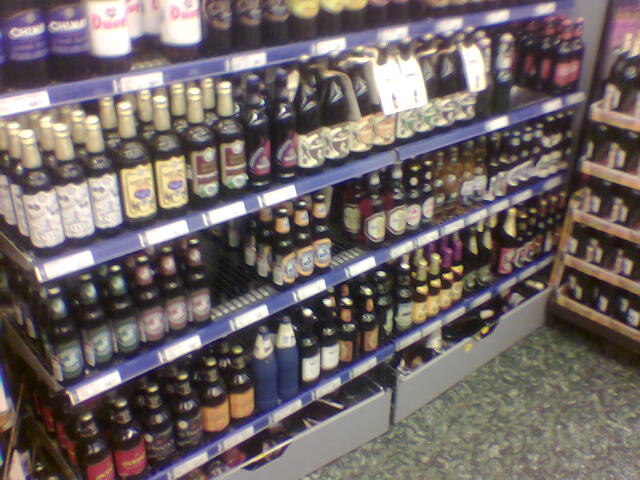
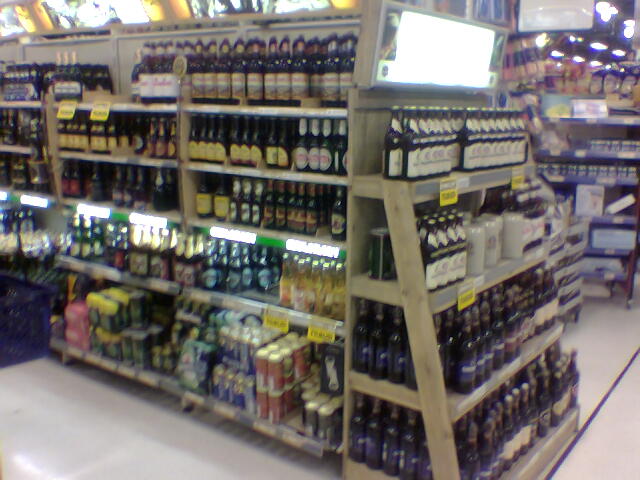
The humble beginnings of this revolution started in 2001 with the introduction of a very limited selection of premium quality foreign beers displayed on small wooden racks in a couple the national supermarket chains. These small wooden racks remain, however they now bookend an entire row of premium foreign beers in the stores of every major supermarket chain. The total space they are now allocated is comparable to that of Carlsberg and (Carlsberg-owned) Tuborg and the other low-quality Danish beers on offer.


An slowly expanding selection...


These foreign beers are sold at a price that is between double to triple that of Carlsberg and Tuborg, yet sales continues to skyrocket. Apparently, taste does mean something to a good number of people after all. The turnaround within the beer market has been astoundingly profound, and far beyond what even an amateur beer enthusiast like myself could have anticipated, must less hoped for, given the sorry the state of affairs that existed less than five years back. The tide is certainly shifting.

Most bars across Copenhagen now offer a small but increasing range of quality foreign beers, particularly Belgian and Czech ones. Whereas back in 2000, Carlsberg and Tuborg flowed exclusively from all but a tiny handful of taps in the bars of Copenhagen, now bars offering only Carlsberg/Tuborg on tap are sliding into the minority. And Hoegaarden, Chimay, Leffe, Staropramen, Erdinger, Franzikaner, Urquel and Budvar flow increasingly freely, with a few of the newer bars opting to leave Carlsberg/Tuborg off the menu entirely. In terms of taste, there is little challenge from Carlsberg/Tuborg for these other far superior mainstream quality offerings.

Unfortunately, for Carlsberg, of the largest brewers in the world (and owner of Tuborg), taste and quality has always been a distant goal after profit, and zooming in on Denmark, the strategy has always been market domination. Countless amounts of sponsorship and promotional cash are doled out by the company to ensure its products remain embedded deep within the collective national psyche of the nation. It has been a successful strategy - the company has generally held its ground and generated a mountain of cash in the process.

This truth was perhaps hammered home most forcefully one night back in 2001, sitting at one of the three bars in Copenhagen at the time that offered a decent selection of quality foreign beers. Carlberg had just released a new beer, called ‘Tuborg Hvede Øl’ (‘wheat beer’), it’s first unfiltered wheat beer. As far as I was concerned, this was fantastic news – at last an attempt to produce a quality mainstream beer from Carlsberg.

The bartender that night, recognising a couple of my friends from previous visits, offered us a round these on the house – he had received a complimentary batch from Tuborg. That night, we happened to be drinking some Belgian wheat beers – I cannot recall which one but I believe it was Hoegaarden. Doing a quick taste comparison, it was evident that Tuborg’s offering, though good, simply couldn’t hold a candle to the far superior Belgian wheat beer we were drinking. And admittedly, there are even better wheat beers than Hoegaarden! The Belgian beer had a depth of flavour that left one feeling Carlsberg/Tuborg’s offering must have been watered down, albeit with a decent flavour at least.

Now there is a couple ways this result could be interpreted. On one hand, in spite of a deep history of brewing, perhaps Carlsberg/Tuborg really did suffer from an underdeveloped experience brewing unfiltered beers - meaing maybe this was the best they could come up with. The bartender believed this was the first unfiltered wheat beer the company had ever attempted. Or perhaps, the real story was economic, and Carlsberg was quite capable of producing something better but couldn’t be bothered to offer up something even more interesting - acceptability over excellence with a strong dose of marketing to bridge the gap, in line with the traditional strategy that ran through the company’s and storied long history.

Bare in mind that around this time period, Carlsberg was running a sort of contest – which was rather in reality a marketing gimmick – involving four new beers introduced for a limited period (Hvede was one of them, the others being Dark, Red and Lager). Consumers could vote for their favourite, the winning beer would remain on the market, the losers would disappear into the black hole of Carlsberg history. Carlberg should have be trumpeting the arrival of four new members of its mainstream family. Instead, it proclaimed it would shortly remove three of them.

Now, for example, in Belgian – a comparably small country but one with a rich and deep history of brewing – between one to two hundred different types of beers are sold in all major supermarkets, double to triple this selection in the numerous specialty beer stores across the country. Similarly, in Germany and Czech, two other countries with a similarly long and proud brewing tradition, choice abounds. Surely, a slightly wider product line from Carsberg would meet with some acceptance in beer-oriented Denmark as well? Rather, Carlsbers’s mass marketing strategy revolved around a very small range of beers – Carl’s Special, Pilsner, and in it’s Tuborg range represented by Green and Guld. It still does, by in large.

The rest of the mainstream Danish market consists largely of smaller, low-cost, copy-cat producers who use the same Carlsberg/Tuborg formula - offering a range of cheap, similar tasting beers - though theirs cost on average around half the price of Carlberg/Tuborg. Interestingly, the taste difference is slight. One could quite convincingly argue a good many of them, such as most of the Harboe and Ceres range of beers, are perhaps even superiour in taste to Carlberg and Tuborg.

There is also one notable high high point of the beer-year in Denmark during the Christmas and Easter season when Carlsberg/Tuborg release, for a very limited time, a Christmas and Easter beer that happens to be a surpringly tasty beer - with the discount breweries also releasing their own competing products to match. Carlberg/Tuborg's is of a similar in quality to Hvede, which is to say, much higher than the standard of their other mainstream products.

Incidently, I recall Carlsberg Dark won that popularity contest a few years back, though the beer has subsequently all but disappeared from bars and pubs and does not generally feature in Carlberg's promotional efforts. From this outcome, one might be tempted to conclude that Denmark’s beer drinkers are conservative and not prone to shift their loyalties to a newcomer, in spite of taste and quality issues. One might thus conclude that to focus on expanding the product range, particularly on the quality end, may not be worth much, especially for a company like Carlberg.

Fortunately, this has proven to be far from the truth, as the exploding foreign beers sales figures demonstrate.

The latest development has seen the introduction of a small range of foreign beers at one of the two (high-volume) discount supermarket chains (Netto). To appreciate the significance of this development, one must shop at these discount supermarkets (and they are extremely successful) to experience just what an extremely limited range of products they sell, particularly on the quality end of things.

It is a genuine pleasure to experience such a rare turn of events where quality emerges from the shadow of a dominant other, much less worthy.

Curious to know more? Read on, Carlsberg strikes back - The remarkable Danish beer market (Part 2) and Setting the record straight - The remarkable Danish beer market (Part 3)

A Stroke of Pure Promotional Genius? Or Maybe Just Good Fun? What is Volkswagen up to?

by Tim Anderson (timothyanderson2005@gmail.com)


Club Volkswagen in Copenhagen...I mean, Club Fox.

An odd series of events took place in Copenhagen over the past three of weeks. Under the name ’Project Fox’ (project-fox.org), the events centred around a series of consecutive club evenings (20 of them!) in Østerbro (‘Club Fox’), an event hall in Christianshavn (‘Studio Fox’), and a Hotel (formerly known as Park Hotel, now ‘Fox Hotel’) in the centre of the city. Ostensibly the project, initiated by Volkswagen, has a commercial backbone, the launch of a new car model, the Volkswagen Fox. In truth, it is not Volkswagen that has fleshed the project into reality, rather a bunch of street artists, event promoters, performers, and a weekly internet newsletter read by those supposedly in the know (that has surely had a significant role in bringing out the crowds (humanmail@humanwebsite.com to get on this list – I highly recommend it if you live in Copenhagen).

With Volkswagen’s involvement all but invisible by the standard of more typical corporate-artistic endeavours, almost shockingly, this one simply doesn’t fit the prototypical vision one associates with promotional arrangements. I'm going to stick to talking about Club Fox, and only mention that 'Hotel Fox' is a rather original project involving about 60 street artists who each redisigned a room the hotel (with basically NO limitations placed upon what they were allowed to do), while Studio Fox has been the sight of a handful of public debates. But Club Fox has perhaps the most interesting.

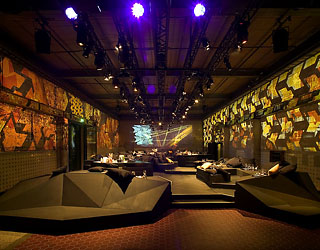
Club Fox can certainly not be accused of being staged on the cheap. No budget has been spared to achieve a memorable configuration of design, lighting and sound. I couldn’t be bothered to count how many projectors were hanging from the roof - a lot. Volkswagen’s largely ghost presence is one that has evidently included a donation of a significant chunk of change that has made it all possible. This is not the real story. The club nights have not only been top-notch, they have been unique and steadfastly non-commercial, featuring numerous outstanding (very) underground acts from around Europe.

Furthermore, staged everyday throughout the week (not only weekends), they have challenged the Copenhagen clubbing crowd that typically only appears on weekends, to alter their nightlife habits. There basically is no such thing as clubbing in Copenhagen on Monday or Tuesday (some notable activity can be found occasionally on Wednesdays and Thursdays, I will acknowledge). Project Fox, in wholeheartedly ignoring this longstanding convention, has effectively gambled it’s offering will prove more seductive than television or sleep. As a famous Monty-Python line once went, ‘nobody expects the Spanish Inquisition’ – and perhaps in the same vein, nobody expects such routine-defying provocation from a supposedly dull, corporate entity such as Volkswagen. But they have done it, and it has worked. The crowds have turned up most nights, even knowing (though I’m not even sure that many do) that it is all at the behest of Volkswagen! This is no small feat.


Is anybody buying a Volkswagen Fox?

Achieving such an level of authenticity has allowed the project to in effect ‘breath’ and it has taken on a certain life of it’s own as a result (with still a few days left to go before it’s all over). The feeling at the club by now each night is more akin to an ongoing underground music festival, not the promotional production that it nonetheless remains. It is a rare instance where a commercial presence has truly facilitated one hell of a cool party, rather than simply appearing as an incoherent presence stamped onto an event to which it just didn’t belong, or worse still, offering up some big-budget, dead-on-arrival piece of propaganda propped-up lifelessly by a big-name performer or two. This is the typical history of most promotional engagements of this commercial nature.

Now it is not at all obvious why Volkswagen, in initiating such a high profile event, would decide to keep their involvement at such a low profile. Yet something about the whole arrangement suggests that the strategy seems to have worked – at least in my reading of the whole thing. There is simply no other club or festival in Copenhagen that has managed to put together a comparable twenty night program of live performances in recent years – not to mention create a surprisingly funky setting to stage the thing. What is Volkswagen trying to do?

Almost the only hints of their involvement in all of this, or any other company for that matter, is the Volkswagen people carriers sitting outside the club, shuffling the German ‘VIPs’ and local organisers to and from the club each evening, and the shiny red Volkswagen Fox sitting outside the club a few meters from the entrance. In fact, it was only leaving the fourth arrangement at the club that I noticed the car for the first time. Its presence seemed like more the result of a last-second afterthought someone had, remembering it was probably a good idea to actually display the car for which the event was created and named.

Whatever the intentions, in this simple, strategic stoke of low-profile genius, Volkswagen has managed to avoid the inevitable pitfall that virtually every other sponsor of corporate-artistic collaborations has fallen victim to: the inability to refrain from demanding that their logos and attestations trumpeting their involvement get schlepped all over, in every which place imaginable. Crass commercialism ultimately detracts from any purity of artistic vision that such events may have otherwise possessed, which consequently doesn’t leave one feeling much enthusiasm for the event and even less the sponsor. Even on the widely distributed ‘Club Fox VIP’ passes that serve as the public admission tickets to Club Fox, only a single, very subtle mention of Volkswagen as the project ‘initiator’ is made – and not even on the booklet front page! All this has made it work.

It will never be entirely possible to produce a measure of ‘Project Fox’ as a success of failure; this must remain a subjective opinion. One cannot measure any translation into new car sales that may result. However, what can be suggested is that by avoiding almost all conventions of such sponsorship branding-promotional exercises, Volkswagen has perhaps hit upon the elusive magic equation for successful corporate-artistic cooperation. Put your corporate money in, but keep your corporate image out. When companies try to step inside of the artistic arena themselves, propaganda results, something that has always been of questionable artistic merit, meaningfulness and relevance.

Without being beaten over the head with the message from the first step inside (or even earlier), those attending tend to pretty quickly figure out the purposes behind such events, in any case. The less that is said, the more curiosity is aroused – a pretty effective way to get a message heard. When people are assumed to be intelligent, attentive and receptive - and actually treated that way - POOF, suddenly they just might listen!

Still, all of this begs an answer to the question: did Volkswagen get what they wanted to out of all of this, whatever it was? Let me offer an answer of sorts: WHO CARES! It has been fun, and I’m looking forward to attending one or two more nights before it’s all over. I’m sure there will be great debate at Volkswagen regarding the merits of getting involved in such conceptual ideas in the future. Myself, I am the first to admit that the ‘bang for the buck’ from this project besides being impossible to calculate, is highly debatable. In terms fun for those watching the spectacle, it has surely been an unparalleled success.


Okay, not everyone agrees...

A LITTLE NOTE: I have taken some flak from certain corners for not being more critical of Volkswagen for introducing yet another hardly necessary gas-guzzler to their existing line of hardly-necessary gas-guzzlers. My apologies for this. Nonetheless, it must be said that pollution takes many forms, and Volkswagen's Fox launch, in not being another mechanically cranked-out, brain-dead, loud and overhyped affair, at least avoided contributing to a couple froms of it - the visual and aural sorts. If more companies began taking such an approach - more subtle and requiring perhaps requires a little more intellectual engagement on the part of the subject, well, perhaps surprising and unexpected results touching seemingly unrelated areas may begin to follow...in time.

This article was featured in Sew Magazine - thanks to Nick and Roger at SEW.
SEW Magazine, Issue 10.

Courting controversy, Danish army style


by Tim Anderson (timothyanderson2005@gmail.com)

Recently a number of advertisements for the Danish army have quietly appeared all over Copenhagen. They show a young, normal-looking man below the caption, ’there’s war in the world’. On the flip side is the same young man in a tank - he has obviously decided to join the army and fight the (good) fight. A few days after these ads appeared, I noticed that the street artists had not allowed this one to slip by them. ‘Kill4Maersk’ and ‘Kill4Bush’ stickers were quickly being pasted onto some of these ads. To gratuitously slip in a bit of pop-culture, we may not have started the fire, but we sure know how to keep it burning.

To the questions: should the army be recruiting in this manner? And is a response in the manner of the ad-hackers constructive in any way to the wider discussion?

All of this has proven to be a provocative subject for discussion amongst my friends, people who position themselves politically slightly left-of-centre, some less slight than others. Nonetheless, a couple of them have been surprised to discover that in spite of being self-labelled left-wingers, they found themselves arguing from the right to a greater extent than they would have believed themselves capable of or interested in doing.

Let me declare my position straight away. To me the army ads are not only highly visible, they are clearly one-dimensional and intentionally provocative. Imagery blatantly employed to call upon the Danish participation in the ongoing Iraq war is bound to be just that. Consequently, a reaction from those incensed that creating ads that effectively ignore the various controversies stemming from Denmark’s decision to join the Americans (and all that has occurred as a result) is not only to be expected, it is justifiable. Attempts to coax people towards a position without any discussion – as the army’s ads do - challenge my neutral instincts. These ads are advertisements for fighting, a crude recruitment tactic for the Danish army to take. The ad-hackers message is equally crude and unreasoned, but at least each and every person walking by the ads gets a short blast from both sides, rather than only one. I accept that most people probably don’t really care to think especially hard on the issue, so the ad-hackers tactics may not change anything. Ad-hacking should certainly not be the only means of reacting - more intelligent discussion is also clearly required.

To begin with let’s first consider the ads themselves placed by the Danish army. As a Canadian, I’ve have been brought up - some might claim indoctrinated - in a ‘peace-keeping’ culture. This is what Canadians pride themselves on when they speak of their global military role. The Canadian military, often under the guise of blue UN helmets, has for better or for worse offered its services in this way for decades to various hotspots around the world. The Danish army’s ads are not about peacekeeping. There is nothing wrong with this since not all countries use their armies precisely in the manner Canada does. But in its place I would expect some reference to the greater good that will come from joining the army. Peace and harmony - those things one perhaps idealistically hopes will spring from the aftermath of fighting are not at all the point in this ad. This disturbs me. I have a sense that the Danish army has far a far greater purpose and responsibility in recruiting than this ad suggests, but this ad could lead one to believe the army has all but abandoned that idea. I know it is only a single recruitment ad, but is this why people should want to join the army? Does Denmark really want an army full of those attracted by the chance to fight? I hope not.

Yet the ad-hackers message is equally controversial. I’m uncertain how many in Denmark would be overly offended by the ‘Kill4Bush’ suggestion, especially those like me still in disbelief that the Americans could pass up the chance to elect a thoughtful and dignified leader precisely when they needed one the most. It is debatable just how much ‘killing for Bush’ the Danish army has in fact done in Iraq, but their is a certain guilt by association that Denmark must be accepted in going along with the Americans – in particular that right wing 51.5% who voted for Bush again. The Danish army is ultimately subject to the whims of the Americans forces – the same force that has killed an awful lot of innocent Iraqi civilians (though the Americans have opted not to keep an official count of the numbers). So, I accept the ‘Kill4Bush’ signs. But ‘Kill4Maersk’? Bringing Maesk into the picture is something else. What does Maersk have to do with any of this? Should they shoulder any of the blame?

Well, perhaps.

Maersk was contracted by the American Department of Defence before the start of the current hostilities in Iraq to provide transportation and logistics for the troops, supplies, weapons and ammunitions. This is serious business, indeed. As arguably the most economically significant company in Denmark, Maersk’s influence is felt in many ways - just look at the not-exactly-inconspicuous Maesk-funded opera house in the Copenhagen harbour. Even if Carlsberg had managed to land a contract to supply almost every liquid substance in the desert, and Danfoss had quietly convinced the Americans that only fools would dare cross the hot sands of Iraq without a mountain of radiator dials for the liberated to regulate their heating systems, no Danish company stood to benefit from the war in Iraq from the outset more than Maersk. Is it possible that the Danish Prime Minister might have the loud and persistent whispering in his ear shortly before he opted to join the coalition of the willing? In any event could he have been influenced, or like Tony Blair, was his mind already made-up?

As one left-wing friend of mine rather indignantly argued, if war is inevitable and some will profit as a result – an old story - what does it matter if it happens to be Maersk getting some of the cash? A professional company like Maersk can presumably help the situation in Iraq, not hinder it, so their presence is probably a good thing. If Maersk wasn’t involved, somebody else would surely have taken their place. Nothing changes with or without Maersk.

Well, maybe, maybe not. Maersk has taken on a significant level of moral and ethical responsibility by participating directly or indirectly in the war. If a weapon they have shipped kills somebody, as was the case when they were supplying Nazi’s with weapons during the second world war (recently chronicled in a series of articles run in Berlinske Tidende), the company must accept their actions played some role in the killing – which is not to say that the killing may not have otherwise occurred. But where does their responsibility begin and end? And who are the people in Maersk specifically tagged with this responsibility? Is an open discussion about such sensitive matters not a necessity if there is any hope that conflicts of interest are avoided? The open question remains: are companies particularly well-suited for making sound moral and ethical judgements? What evidence exists to suggest they can be entrusted with issues that wider society in itself struggles to handle? Are governments any better? After years of business studies, culminating in a Masters Degree in Economics and Business Administration, the answers are not at all clear to me.

Clearly not all companies are evil, or destined to become so, but assessing this issue is a fuzzy matter. Google’s recent declaration in their shareholders prospectus that the company will strive to ‘not be evil’ does not prove if they are or not. Neither does it foreshadow an inevitable future lapse, nor guarantees the long-term saintliness of the company. It does acknowledge the issue, which is a start. Recent documentaries like ‘The Corporation’ conclude companies may even be psychopathic by nature. This is only one side of the issue. The Economist, in arguing that companies are not necessary doomed to spread evil, has consistently, convincingly and intelligently argued over the years that those governments who have set the strictest limits on private-business are also the ones who have most consistently ignored and violated their own citizens basic human rights. But The Economist is also cautious to sound a note of warning at any suggestion that private business should be handed the only set of keys to the car.

The moral implications of choices are most likely be considered by companies when they could have an obvious negative effect on short-term profitability. Just think of Nike taking fast action to improve the pathetic standards of many of its third-world sweatshops a few years back when the issue was a hot media topic. Yet today when buying an unbranded pair of shoes to avoid the ubiquitous Nike swoosh-thing, one is still left with no way of knowing what conditions those who made the shoes were under. But do we trust that Nike will in future not use its influence to argue against further regulation regarding their behaviour in the third-world countries in which they do so much business? How do we know that Maersk has behaved responsibly in the lead-up to the Iraq war when the issue of whether the Danish government should participate at all was still officially undecided? Did they quietly try to influence the government? It may have lead to an lot of uncomfortable questions if the largest company in a company formally against the war was making so much money from it. What has been Maersk’s role since? What assurance should their be that the delicate moral and ethical issues that surround a companies actions, tactics and influence are being appropriately considered and addressed? So we come to the heart of the issue.

Are we just to turn a blind eye to Maersk’s habit of wartime profiteering because they are (in this war) on the side of the 'good' guys? Is it too late to ask such questions? The silence from Maersk on such matters is hardly reassuring.

So we are back to the ad-hacking dragging Maersk into a criticism of the Danish army’s recruiting tactics. Are these constructive attacks to be making? Well, why not? Maersk is involved in the war, and the company is big and rich enough to take criticisms. There surely should be means for holding companies accountable for all their actions, and somebody might as well start somewhere. Not everybody can get the mainstream media to broadcast their questions and opinions and it’s not exactly easy to ring up to old Maersk himself to get his thoughts, as interesting as this might be.

In any event, I hardly expect to hear a reaction for Maersk the person or A.P. Moller the company on the matter. But if a few people see the ads and the ad-hacking, and think for a couple seconds about the moral and ethical implications of the actions of private business in wartime, that would be a good start. In the meantime, I sure hope those army ads disappear.

Powered by Blogger