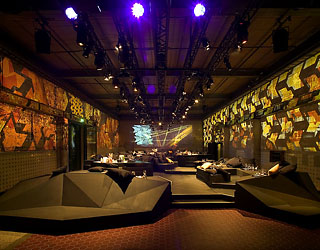
Closing Time In Copenhagen (Part 2) - The Housing Situation

by Tim Anderson (timothyanderson2005@gmail.com)

This is the second installment of a series of articles about life in Copenhagen, knowing that August is my last month living here for some time. The first one is Closing Time In Copenhagen (Part 1).

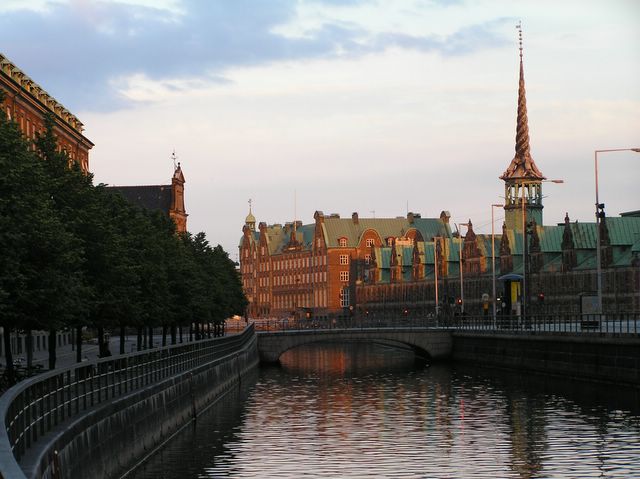
I look out the window of my apartment, down to the quiet cobblestone street below, feeling that where I am is a place distinctly Europe – old Europe, stereotypical Europe. In fact, where I live is not that old by such standards – the apartments around here are generally in the area of 100 years old, though there are certainly some that are much older. In certain respects, the ones on my street in Christianshavn even seem quite modern.


A friend of mine living right in the dead centre of town, no more than a 15 to 20 minute walk from my place (see how far that will take you in London) lives in a building nearly 200 years old that is built on 500 year old foundations. It looks it. Every now and then he asks me what I think the chances are that a building like that could suddenly become unstable – essentially crumble without much warning to a state beyond repair. He loves the place, but nonetheless has some genuine concern for the security of his investment - since he bought the apartment. I personally don’t think it is too likely to happen, but then again it’s not my bank loan on the line, so I'm probably not seeing it as he is. Why should I be worried?

There has been for sale signs in the windows of two apartments just across the street from ours for some time now – several months. Looking out at them just now, I see a sold sign has been pasted over one of them, though the other still remains. It’s about time. It has surprised me how long these two have been listed for sale since the housing market around here (all over Copenhagen) has been moving at more than a brisk pace. Rather, prices have been exploding over the past two years, and at a far greater rate than the official statistics suggest.

Various friends of mine, ones that had the good sense to buy an apartment at some point over the last years, have made more money during this time by selling their apartments or re-mortgaging them to take advantage of their increase in market value (and lower interest rates) then they have in salary. This is something endlessly frustrating for those not quite in a position to buy during this time (myself) or who (foolishly?) opted to rent and are now left pondering why they made this choice.

In fact, the housing market has been behaving in this manner for several years now, and shows few signs of stopping. The number of apartments available for sale in Copenhagen is at an all time low, as are interest rates (which at least makes loans more affordable than ever at the moment) which has consequently been driving prices up, up, up. Trying to find a decent place in central Copenhagen (that matches ones reasonable desires) on a first-or-second job after graduation type of salary is proving increasingly challenging.

Still, I know that this price appreciation simply cannot be sustained for that much longer – which does not at all mean that prices will suddenly drop. Of course they could – a few signs of greed are starting to show, always an ominous sign.

Just the other day, a story came out about a real estate agent who had been selling numerous contracts over the last months for reservations on apartments (over 100) in a new building development being finished shortly. She also happened to be one of the investors in the development. Because prices have shot up so dramatically since the reservations were first taken, the development board (of which she is a member) opted to (legally) cancel every one of them. In this way they could re-price the apartment units at a higher level – more money.

Such behaviour clearly strains the bonds of trust between client and customers, no question. On this scale where so many people are affected, it also suggests a brazen confidence, if not a possibly deluded overconfidence, in a market capable of producing an endless stream of customers willing to overlook such questionable tactics and accept whatever terms are on offer just for the chance to buy. Similar behaviour has lead to the demise of many a business in the past, even ones seemingly infallible, and it tends to reach it’s zenith just before an economic collapse of one sort or the other. Let’s see what happens.

The housing situation in Copenhagen is complex, to say the least, and not one that is easy for a foreigner to get a handle on.

On the more understandable side of things are the literally countless tens of thousands of generic two room apartments everywhere in the city. Somehow over the years, the layout of these apartments has come to be a sort of defacto-standard for what could be termed, ‘the two-room Copenhagen apartment’.

When one sees an advertisement with the words, ‘two room apartment’ accompanied by a measurement of around 50 to 60 sq metres, one can make a pretty solid guess at what the apartment looks like - a fair sized room at the front, a second smaller room for a bedroom looking out into the back garden, and beside this a small kitchen and tiny bathroom (with a shower practically hanging over the toilet and certainly no bathtub!).



All that remains is to ascertain the apartments precise location, how big are the windows are/how bright the apartment is, and if it needs painting.

Most apartments have accesss to a large shared garden out back for the up to 200 or more apartments overlooking it. This garden may be more or less sunny and usable, depending upon it's state of repair, and the amount of space between the buildings.

In the case of our most recent apartment, the back garden was just beautifully refurbished thanks to a government fund which is earmarked for such projects that footed the entire bill. Again, the wonders of living in a socialist country. At one end the buildings were quite close together, while at the other (our end) there was quite some space - which meant it was not as easy to watch what the neighbours were up to, something I always enjoy doing.
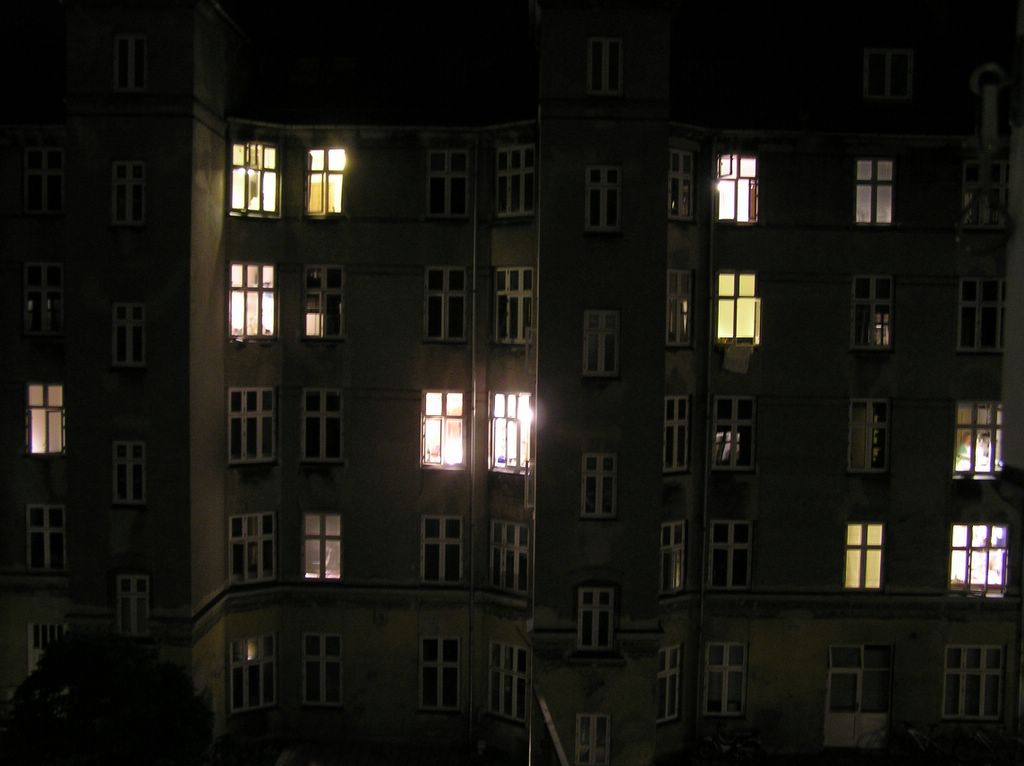
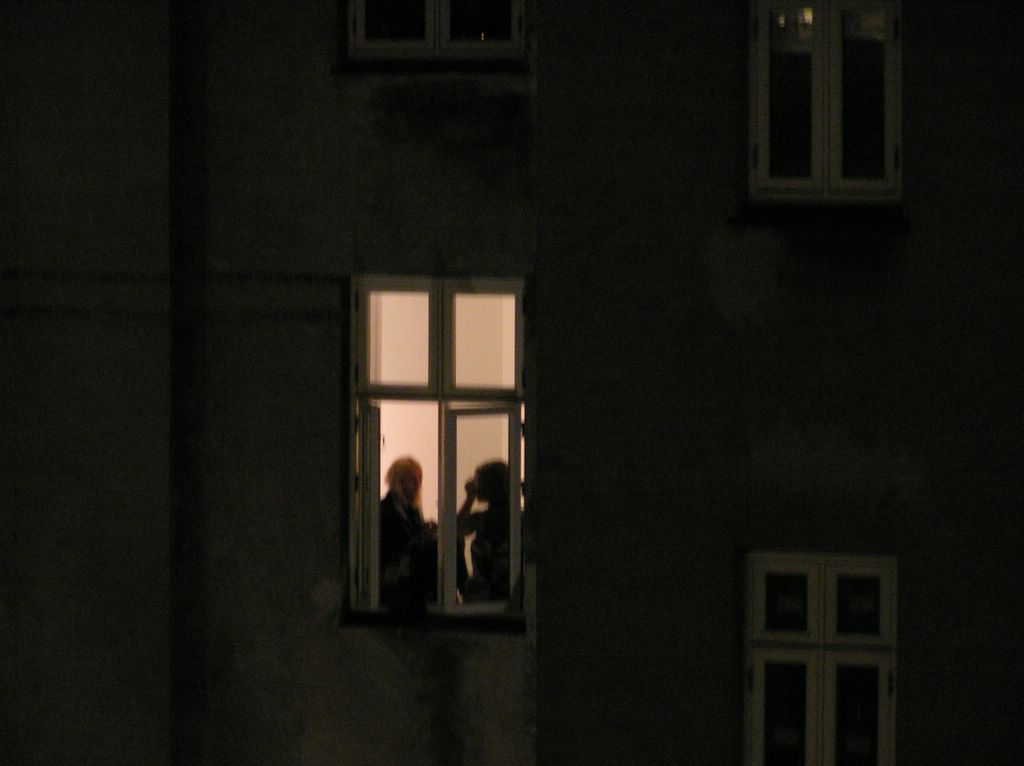


The monthly student (non-repayable) grants paid by the Danish government to all students in Denmark for up to six years of studies are perfect for renting one of these (or buying them as an andels apartment, which I will talk about shortly) with a friend, girlfriend or boyfriend – which is a very attractive proposition for a couple in love. Oftentimes, this is exactly what happens.

Moving into such a two-bedroom place is hardly a lifetime commitment, since they are certainly not big enough for very long once kids enter into the picture. Equally, it makes the process of splitting up and moving on, if it should ever come to that (and as statistics go, the odds are that it will) just as easy – they are highly sellable (or rentable). So there is a steady turnover of these places.

On the other side of things, is the peculiar form of ownership known in Danish as ‘andels’ apartments. There really isn’t an English equivalent (or translation) for this, so I will describe what they are instead. There are literally tens of thousands of these apartments all over Copenhagen (and the rest of Denmark).

These could loosely be described as collectively owned apartment blocks, each managed by an organisation that control the purchase and sales of the rights to live in the apartments within their block(s), and that decides the amount of the monthly rental-type fee that will be paid as well.

The thing is, the prices of the shares (ie. right to live) that one of these andels apartments gets bought and sold for by no means corresponds with their market value if they were being bought and sold on the private market. It is the board of each andels, consisting of residents living there, that dictate the prices for each. So the prices do move over time, just much more slowly than the market. As a rule, they are ludicrously cheaper to live in (by Copenhagen standards) often costing half as much as the monthly outlay for an equivalent privately owned apartment. If you’re lucky enough to get your hands on one. This is the other issue.

Without connections (typically close family, friends or work colleagues) or good foresight from your parents (more on this shortly), the waiting lists for these places range from 3 to 15 years. It’s a bit like playing a lottery that comes with a guarantee that you will win big eventually, at some indefinite point in your life, if you are willing (and able) to wait.

In many instances Danish parents put the children on an ‘inactive’ waiting list for one or more andels organisations when they are small, which means that when they are 18 and ready to move away from home, they will have the right to be put on the ‘active’ waiting list, which will typically be anywhere from 2 to 5 years long in itself. Eventually, they will begin to be offered the chance to purchase the rights to live in various andels apartments. One can only hope their parents have thought of doing this.

If all of this seems like it would be extremely bizarre for an outsider coming to live in the country to understand, it absolutely is.

The problem with this system as it stands is that it greatly distorts an already overheating housing market (pushing privately owned apartment prices up higher than they should be), while only offering benefits that can at best be described as unevenly dispersed. Because a board decides the purchase and sales prices of andels apartments, there is no free market operating here. And there are so many, many, many of them in Copenhagen, so it is an issue.

Rather, it could be suggested that this is an example of radical socialism at it’s most random. Regardless, it is a system that is unique, distinctly Danish, and has a significant influence on life in Copenhagen. No question about it. I don't expect that the housing market is something that I will miss very much when I leave.

But housing is hardly the only thing worth discussing, so read on. Coming shortly, Part 3.

Closing Time In Copenhagen (Part 1)

by Tim Anderson (timothyanderson2005@gmail.com)

August is my last month living in Copenhagen, after five extremely interesting and certainly not predictable years here. With that in mind, and inspired by various other blogs which I enjoy reading, (particularly City of Sound,a fascinating blog inspired by life in London) I'm going to change the tone a bit in my last few blog entries to a more rambling one. I want to try to capture a bit of what exactly Copenhagen is all about - that which is notable and oftentimes unique about the place.

Hopefully in using what is for me a more experimental approach and writing style, I will manage to reveal something that I previously was not able to and better paint the scenes I wish to portray. Since it is a type of writing I most enjoy reading myself, I may as well try. It is also a way of drawing a bit of a line which separates the various issues I have touched upon up to now, from the things I want to say in these last entries. I do hope I manage to succeed.


My time in Copenhagen, my introduction to Denmark and all that is valued here is soon coming to a close. This departure may be definitive – once and for all - it may not. I plan to be back in a year, but all the same it is by no means certain that I will return. If I should return, or when I do, I will no longer be viewing this place through the same eyes – rather I will be comparing what I am seeing to the images of a Denmark I remember, but that may never have been. The comparison is bound to be somewhat romanticised.

The introduction I have had to this place has been rather thorough, I would judge. It has been just short of five years since I arrived here, and it will be five years and two days from this arrival when I leave. I never expected to be here this long, but it's not like any other existing plans of mine were disrupted by staying. Five years seems a good round number and therefore a good one to part on, in my mind.

To begin to understand what it is to be part of daily life in Denmark, one must first realise just how exclusive a little club the Nordic countries are. These are amongst the richest in the world, taken on a per capita basis (and also the coldest and cloudiest). They are countries that have taught themselves how to succeed (speaking now of countries as if they were people). This is not some poor karaoke attempt of larger economies such as the U.S., the U.K. or Germany. The Nordic countries have created a model that is all their own - it is not an adopted one.

Many foreigners coming to Denmark to live for a time quickly become somewhat critical, at least of how daily life is structured, and how willingly people (Danes) accept this way of being. It seems so organised, so coldly efficient, and though the people are generally well-behaved, the streets seem empty and a things generally bit dull as a result. However, such a view is far to simplistic to represent the reality of the place. There is a rich past that has lead to this way of being, this unequivocally modern system. The state of things as they now exist is hardly an involuntary occurrence.

Denmark is a small, fairly uniform (and quite northern) country in comparison to many other western countries after all. If one expects a more extreme sort of diversity and less uniformity, one should not choose to live in a place with the characteristics of Denmark. France, England, Canada or the U.S. spring to mind as better choices.

Southern Europeans, for example, don't only complain about the weather being a little to cold (as most foreigners living in Denmark do). At a much deeper level they tend to feel frozen out of the Danish way of being, after a short while here. Danes are friendly, and genuine in their friendly gestures, but they have little interest in humouring or for that matter sympathising much at all with those coming to live here who refuse to adopt to their way of being - which is not to say they are not willing to meet somewhere closer to the middle. This is not a critisism, as Danes hardly the only nationality who are this way, and there are good reasons for their actions.

On the other hand when Danes travel, particularly for extended periods of time (which they do in huge numbers), it is often as if some alter ego seizes their personality and takes it over while they are out of the country. Consequently, many an unsuspecting foreigner has been lured back to Denmark by a beautiful (dyed-) blonde mane, a set of luscious curves, and an irrepressibly free-spirited personality - all of which can be overwhelmingly enchanting being so at odds with what they encounter typically in their daily lives, wherever they are from.

The thing is, Danes can afford to be carefree and a bit reckless when they wish to be. This is one of the luxuries that the system they have created for themselves permits, which is incidently something that is rather unique. Few countries offer a level of support to their citizens comparable to that which is offered in Denmark. Danes are generally aware of this, and they are also aware that they pay for dearly for this privledge with one of the highest tax rates in the world (68% at the highest level!).

So, many a foreigner that has fallen in love with one of these travelling Danes, once pulled back to Copenhagen, is suddenly shocked to discover how Danes behave at home . It can come as a surprise to many that the same factors that permit such freeness also enable one to more comfortably apply oneself in countless less carefree directions as well - education, jobs, kids, family and so on - knowing that change is not only possible (because one will never wind up with no income), but will be widely accepted to boot. This way of being is something that can be said to be distinctly Danish, or perhaps more appropriately, distinctly Scandinavian (but I've only lived in Denmark). Perhaps this is one of the reasons the divorce rate is so high in Denmark (50% and climbing), a figure which does not include the countless couples who live together for a time, and then split up. Of course there are countless relationships that succeed!

Even more shocking for foreigners, can be to experience just how abruptly and definitively Danes can move one when they decide to. (For the record, I came to Denmark alone and for the purpose of studying, which I did for the first three years I was here, so I speak from the position of observer in saying all of this, not from some bitter personal experience.)

In Denmark, there is no stigma whatsoever with moving in with a boyfriend or girlfriend, then moving out after a time, and then moving in with another, and so on. Even though most western countries are moving in this direction, Danes were already there 20 or 30 years ago. Oftentimes, a foreigner in Denmark who has suddenly been cast aside once the relationship hits a rough patch, have little from their own cultural background they use to relate to and understand just what has happened and how it can be like this. Not that anyone expects (much less plans!) from the outset that a given relationship they are in will eventually end.

There are not many places where people allow themselves this level of uninhibited personal freedom. Of course, there are other ways that Danes appear to inhibit themselves, it's just that sex and relationships are not among them, to generalise of course.

But life in Copenhagen is like that, because getting on with things is a pretty simple process, all things considered. One only has to take their salary (which is always an amount one can live comfortably on), or their SU money (provided by the Danish government to all students for up to six years of studies), or their unemployment money (which is generally just below the typical salary of whatever their previous job was), along with any supplemental money offered by the government if they have children, and get on with life.

I’m not at all suggesting that Danes are cold or calculating in any of this. Just that Danes rarely find themselves in such dire straights - whether from relationship troubles, trouble finding a decent job or even an unexpected pregnancy and various other unanticipated situations - as to feel the need threaten to throw themselves from the nearest bridge (much less actually do it) when things get a little rocky and uncertain from time to time. The result is a relative calmness and stability, not only behind closed doors, but also in the office and on the streets. It is just not always apparent, at first glance, why things are like this.

So this is my introduction, there is much more I have to say on many divergent areas of life in Denmark. Next up, Part Two.

Bombs explode in London, Copenhagen gets the jitters...

My apologies in advance for this one, I am trying too avoid bothering with too many purely political issues on this blog, as I think there are a lot more meaningful and productive ways to spend ones time and (mental) energy. But sometimes certain things just need to be said for the sake of one's own sanity!

As soon as the news came out that several explosions had rocked London, one could sense a palpable level rising tension in Copenhagen. For example, the day after the London attacks, a reported bomb threat (which proved to be false) shut down the Copenhagen metro as the bomb squad moved in to remove a suspicious looking package. Thankfully, there was no bomb. Since then, the police have been a frequent presense all over the metro, highly visible above and below ground at the various stations.


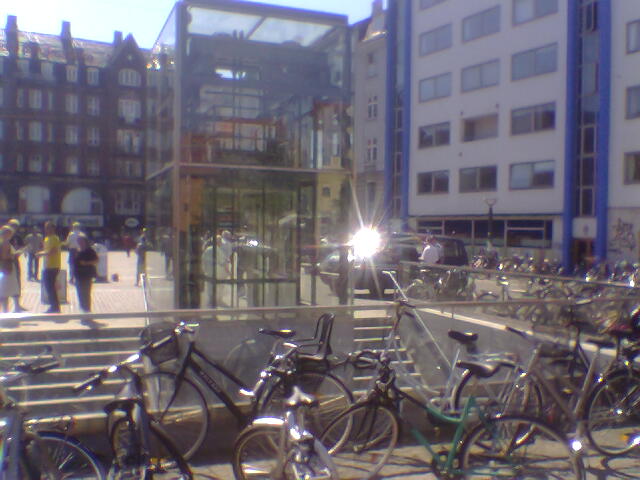
(Okay, this is not a great picture, but that is a police van to the right of the Christianshavn metro entrance in Copenhagen, with two police officers standing by).

It's not really surprising a lot of Danish voters are finding themselves a little anxious. After all, Denmark is a part of the Bush's coalition of the willing, and what's more, enough Danes recently thought it was a good idea to re-elect Anders Fogh Rasmussen, the guy who made the decision to put Danish troops there in the first place.

Although Rasmussen is a guy who steadfastly refuses to offer any constructive critisism of certain American military activities in the middle-east region or regarding American military conduct during the open-ended and undefinable 'war on terror' such as Guantanamo Bay, he is not a guy afraid to participate in a good, pandering suck-up or related photo op when the opportunity strikes.


Where's Waldo...I mean Anders? Oh, there he is!

Unfortunately, with bombs exploding in London, many Danes are increasingly wondering if Copenhagen might not become a terrorist target, sooner or later, given the Danish presense in Iraq.

Actually, why is Denmark in Iraq anyway? Though the decision to support the Iraqi war was one seemingly incoherent with values of socialist Denmark, some have quietly whispered about how it did coincide with the interests of Denmark's biggest company, Mærsk, a company that has profited greatly from the war - much more so than any other Danish company (see my previous article Courting controversy, Danish army style). Unfortunately, the mainstream Danish media doesn't really like to discuss this issue, and many Danes are in flat out denial that there might be such a connection.

Fortunately, it is not really necessary to rely on the mainstream media to figure out the links. See, Mærsk is not only a pretty big company, they also tend to make their activities fairly obvious. For example, when they do business somewhere, they often use little ships like these:


If one wonders whether Mærsk is making profits in Iraq, a quick internet turns up various press releases and so forth regarding Mærsk contracts in Iraq (many signed before the decision to send Danish troops to Iraq was made). In summary: it is very easy to see where the company is operating (look for the ships), and why there are there (look for the press releases). Thus, even when the Danish mainstream media prefers to avoid connecting the various issues together, it is very easy to figure out these things anyway.

So let me spell it out: Maersk is worth a lot of money to Denmark, in terms of taxes, employment and in terms of the an overall influence on society and politics. This is a huge elephant of a company in a very small petting zoo of a country. Too many uncomfortable questions were bound to be asked of Maersk doing business with the U.S. army and in Iraq if the Danish government didn't throw it's support behind the Americans.

Now, a little suggestion for those who think the bombing in London was bad (and it most certainly was), and who also may be thinking about how devasting inexplicable bombings in general can be: what about those
innocent civilians residing in Baghdad, who were subject to night after night of bomb attacks and destruction during the war along with countless civilian casualities ('collerateral damage') as a result (not to mention roving military patrols ever since)? It makes a one-time incident such as that in London - as horrendous, physically destructive and psychologically tormententing as it has surely been - pale in comparison.

Hmmm, what to do, what to do?

Well, imagine you are a Danish voter. Are the decisions made by the current government the best ones?

There are many ways to fight terror, unfortunately, dropping (more) bombs in hopes of eliminating it tends to rather increase it instead, since it makes a lot of those who are already angry even angrier, and worse, it tends to make a lot of (innocent) people who were not angry at all before suddenly very angry as well, since now their lives are also being affected.

So what is there a better way to react to these London terror attacks, and the perpetual threat of more to come elsewhere?

Personally, I found perhaps the most thoughtful and reasoned reaction in a column published in the UK newspaper, The Guardian, written by (Ed. note: now deceased) Robin Cook (who you may recall resigned from Tony Blair's cabinet in the lead-up to the Iraq war, owing to his disagreement with Blair's Iraq strategy of unconditional support for Bush's war). Cook has since become a loud critic of Blair's approach as a labour backbencher.

To link to the article: The struggle against terrorism cannot be won by military means

I have taken the liberty of reprinting it, in part, below:

"The struggle against terrorism cannot be won by military means. The G8 must seize the opportunity to address the wider issues at the root of such atrocities.

The danger now is that the west's current response to the terrorist threat compounds that original error. So long as the struggle against terrorism is conceived as a war that can be won by military means, it is doomed to fail. The more the west emphasises confrontation, the more it silences moderate voices in the Muslim world who want to speak up for cooperation. Success will only come from isolating the terrorists and denying them support, funds and recruits, which means focusing more on our common ground with the Muslim world than on what divides us.

The G8 summit is not the best-designed forum in which to launch such a dialogue with Muslim countries, as none of them is included in the core membership. Nor do any of them make up the outer circle of select emerging economies, such as China, Brazil and India, which are also invited to Gleneagles. We are not going to address the sense of marginalisation among Muslim countries if we do not make more of an effort to be inclusive of them in the architecture of global governance.

But the G8 does have the opportunity in its communique today to give a forceful response to the latest terrorist attack. That should include a statement of their joint resolve to hunt down those who bear responsibility for yesterday's crimes. But it must seize the opportunity to address the wider issues at the root of terrorism.

In particular, it would be perverse if the focus of the G8 on making poverty history was now obscured by yesterday's bombings. The breeding grounds of terrorism are to be found in the poverty of back streets, where fundamentalism offers a false, easy sense of pride and identity to young men who feel denied of any hope or any economic opportunity for themselves. A war on world poverty may well do more for the security of the west than a war on terror.

And in the privacy of their extensive suites, yesterday's atrocities should prompt heart-searching among some of those present. President Bush is given to justifying the invasion of Iraq on the grounds that by fighting terrorism abroad, it protects the west from having to fight terrorists at home. Whatever else can be said in defence of the war in Iraq today, it cannot be claimed that it has protected us from terrorism on our soil."

Square boxes, then and now...

by Tim Anderson (timothyanderson2005@gmail.com)

As irrelevant an issue as it may seem, I simply can’t resist offering my opinion regarding a classic discussion, the SAS Hotel in central Copenhagen designed by the legendary (and deceased) designer/architect Arne Jacobsen, source of much debate in Copenhagen over the years.

In Denmark, Arne Jacobsen is about as mainstream cult as one can possibly be. Even if his penchant for wearing bow ties created an aura of stiffness surrounding the man himself during his lifetime, most of his building and furniture designs pushed the boundaries of the time. There is no question that his influence lives on today in Denmark, particularly in Copenhagen - perhaps to a much greater extent than it should, some have suggested (after all, the man did most of his great work back in the 50’s and 60’s!).


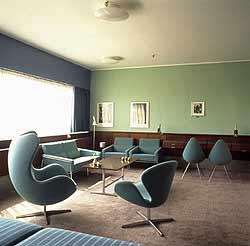
Jacobsen never feared being provocative; just consider the classic SAS Hotel in downtown Copenhagen that was entirely designed by the great man – the building itself and all of the interior furnishings. Though only one room (room 606, pictured) exists today with the original furnishings as selected and designed by Jacobsen intact, the image Jacobsen aspired to create lives on.

Debate about its exterior has never really ended, with opinion consistently split between those regarding it as brilliant (and very much ahead of it's time), and those less impressed who generally regard it as being dull (or worse). As history teeters towards myth (certainly the case in Denmark regarding anything involving Arne Jacobsen) and reality consequently becomes clouded, debate becomes more challenging.

However the SAS Hotel may have once seemed, and whatever the dissenting voices even today may whisper or shout, a quick glance at this industrial looking, army-green coloured box tells all you need to know – it is pretty ugly!


About the only thing remarkable about it's exterior at this point is the fact that it was designed by Jacobsen. Unfortunately this knowledge does nothing to improve the building's present-day appearance, though it may change one's perception of it, somewhat.

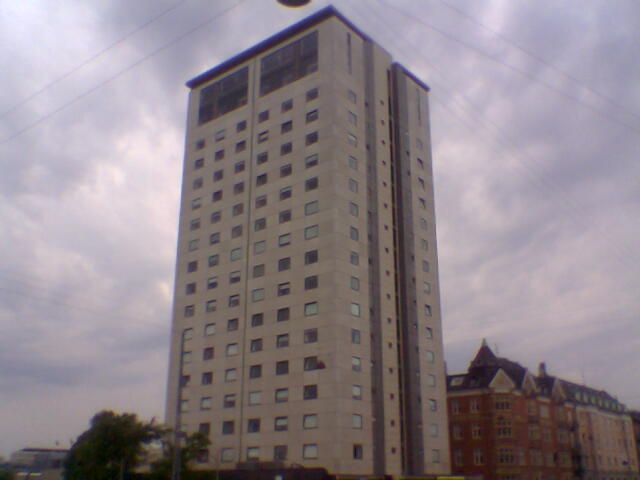
Discussion regarding this 60's building does matter, if only because so little has changed since that time. Though the building is unlikely to disappear anytime soon, new highrises continue to be built in Copenhagen, some with quite striking architecture, others less so.

Copenhagen, in spite of being the capital of Denmark and a fairly internationally oriented city, is not a place where the highrise building has ever really been embraced (ie. buildings higher than 10 stories). It's towering older brother, the skyscraper, even less so (ie. New York, Chicago or Toronto style).

In touring around Copenhagen (I would suggest a bicycle for the job) most buildings are no more than five to seven stories high, and very few more than ten stories - though there are a number around. Of those that exist, one may not be inclined to go as far as calling them ugly, however many would agree they are certainly not 'beautiful' in any most senses of the word. Perhaps uninspired would be a better term.


The very recently completed headquarters of Codan, a Danish insurance company.


In took a while to figure out what to do with this one, though it has recently been converted into a youth hostel.


Suffering from a little too much Arne Jacobsen influence?

On the other hand, recent residential highrise buildings such as some old warehouse conversions at Islands Brygge, overlooking the channel, (pictured below) show a degree of flair, creativity and inspiration clearly absent in most of the existing commercial highrises. In any event, the debate will continue, and hopefully more inspired building such as these will continue to appear.


In answer to the question, what are some of the current fashion trends in Copenhagen?

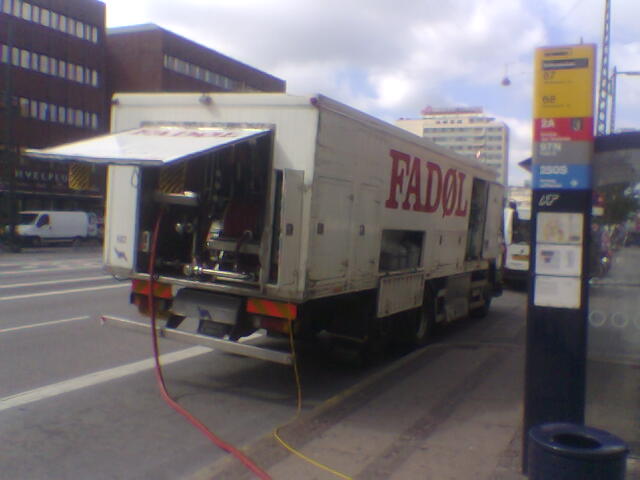
Morning delivery of draft beer in Copenhagen

Many mornings in Copenhagen, on my way to work, I cycle by a truck that always makes me laugh. It closely resembles the oil truck that used to come a couple times a year to the house I grew up in as a kid to fill up the oil tank in our basement (that fueled the furnace in the house). Except this truck here in Copenhagen carries no oil. In fact, it is a Carlsberg beer tanker!

For those without a working command of Danish, 'Fadøl' (as written on the side of the truck pictured below) means 'draft beer'.


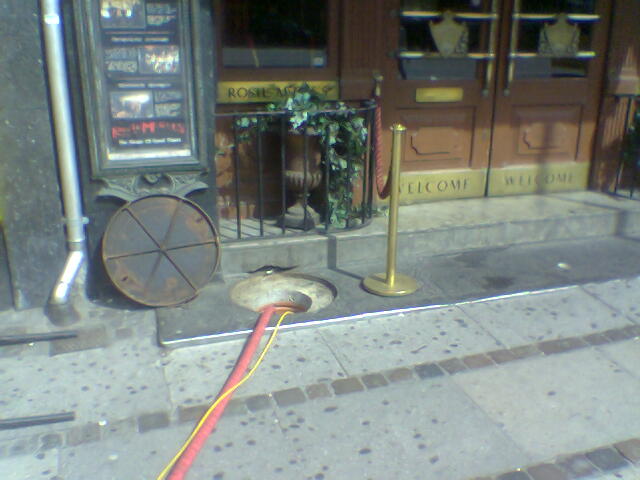
And just as it was done with those old oil trucks (that are still around), a hose is pulled from the truck and is connected to the beer tanks located in the basement of the bar...


...via a little hole in the ground, in front of the bar. Just pull the hose!


...and voila, tasty beer will be flowing from the taps in no time! Needless to say, this is not exactly the quality kind that I have been writing about in previous posts...

Setting the story straight - The Remarkable Danish Beer Market (Part 3)

by Tim Anderson (timothyanderson2005@gmail.com)

I want to set the record straight. After writing a couple of articles about the Danish beer market which I published earlier (The Remarkable Danish Beer Market (Part 1) and Carlsberg Stikes Back - The Remarkable Danish Beer Market (Part 2)), there was one crucial issue I had not tackled – exactly who was responsible for importing all of these foreign beers to Denmark? Who was it that was able to so quickly convince so many shops and bars across Denmark to dedicate less space to Carlsberg/Tuborg products, and much more to relatively expensive foreign ones? I had this nagging suspicion that maybe, just maybe, Carlsberg still had a hand in these matters. It turns out my suspicions were not without merit.

Now if I had been charged with writing these previous two articles for a mainstream news outlet, I would never have been able to get away with such a glaring omission. Fortunately, I was not. So here it is, the last pieces of the previously incomplete puzzle.


The Danish beer market makes a remarkably fascinating study. First, an influx of quality foreign beers into Denmark, alongside drastic leap in foreign beer sales over the last four years demonstrated clear willingness for Danish consumers for such quality beers. Foreign beer consumption, which stood around 0.7 million litres back in 2000, exploded to nearly 9 million litres in 2004. Sensing a definitive consumer trend towards these tastier (and more expensive) beers, a number of Danish microbreweries have been springing back to life in recent months. The average beer drinker in Denmark is now faced an abundance of choice, at long last.


Yet, there is more to this story than first meets the eye.

Few are aware that it was a decision back in 2002 by the brewing-giant, Carlsberg, long the dominant force in the Danish beer market and possessor of a finely-honed selection of market strangulation tricks, that finally kicked the doors open to a wide range of quality beers. More on that shortly.

Back in 2000, when I first moved to Copenhagen from London, the picture looked radically different then it does today. Carlsberg and Tuborg flowed exclusively from all but a tiny handful of taps in the bars of Copenhagen. Supermarkets were no better selling primarily on Carlsberg and Tuborg, the similar-tasting discount beers produced by knock-off copycat brands like Harboe and Ceres and an extremely limited selection of highly overpriced and relatively uninteresting foreign ones – names such as Fosters and Heineken.

Denmark’s long brewing tradition was never evident from tasting the narrow range mass-market beers offered in bars and supermarkets a few short years ago. It seemed these bars and supermarkets had somehow never discovered that there was a world of beers beyond the limited range they stocked – albeit a range that was essentially foist upon them by Carlsberg.

Nonetheless, as foreign beers slowly began trickling into Denmark a few years back, Carlsberg opted to take matters into it’s own hands in a significant strategy shift. Perhaps recognising that it was unlikely to ever match many of these foreign beers in terms of depth of taste, Carlsberg found another way around the issue through the creation a wholly owned import company, House of Beer (www.house of beer.dk) in 2002. Carlsberg owned House of Beer quickly became the exclusive Danish importer for many foreign beers. Perhaps it was never likely that the giant of Danish brewing would graciously risk giving away all the cash from this significant (if minor) share of its the home market.

It is largely owing to these efforts that various Belgian, Czech and German beers such as Hoegaarden, Chimay, Leffe, Staropramen, Erdinger, Franzikaner, Urquel and Budvar, among others, have come to flow increasingly freely at bars across Copenhagen over the past three years and are now sold in all major supermarkets. House of Beer is responsible for supplying many (though not all) of these quality foreign beers, and sales of foreign beers have being going through the roof as Danish consumers increasingly embrace them. In 2002, House of Beer imported 4.2 million litres of beer, and this year it will import over 13 million litres – the sort of growth most companies only fantasise about.

These foreign beers are generally priced between double or triple Carlberg and Tuborgs mainstream beers (and four to six times those of the Danish copycat producers similar knock-offs), but have become enormously popular in spite of this price disadvantage. Some of the newer bars in Copenhagen are even opting to leave Carlsberg/Tuborg off the menu entirely, an idea virtually unimaginable only a few years back.

Over the past months, the transformation has continued as a number of Danish microbreweries (brewing quality beers) have re-entered the fray. The products of Danish microbreweries such as Fur, Skand, Bryghus and Thisted now command significant shelf space on supermarket shelves, overwhelming Carlsberg’s long-neglected Semper Ardens range of quality beers which typically stand nearby (a range of specialty beers Carlsberg has long-ignored, having focussed its marketing efforts exclusively on its mainstream beers, while allocating no budget to its specialty products such as Semper). Priced similarly to the quality foreign beers now available, these small-time Danish brands appear to be succeeding.

Not to be outdone, and sensing a neglected market segment quickly being filled by these Danish microbreweries, Carlsberg recently responded by introducing another line of quality beers (beyond it’s Semper Ardens range) specifically for the Danish market. Under the name Jacobsen, these beers (Bramley Wit, Brown Ale, Dark Lager and Saaz Blonde) are marketed as ‘microbrewery’ beers and brewed at a small, purpose-built brewhouse, symbolically located beside the company’s Copenhagen headquarters. (See my previous article Carlsberg Stikes Back - The Remarkable Danish Beer Market (Part 2) for more on these.)

Thanks to all of this change, in Danish supermarkets an entire aisle can be found stocked with various quality beers from Denmark and around the world – an aisle that did not exist a few short years ago. Furthermore, in many of the supermarkets, the mainstream beers of Carlsberg and Tuborg are being relegated a lesser area of space then the quality foreign and domestic beers now occupy. It’s about time.

It is doubtful that even Carlsberg could have anticipated the far-reaching transformation being set in motion as it began importing beers back in 2002 – a transformation that continues unabated today.

It seems the days when an extremely limited range of quality foreign beers and quality domestic alternatives were virtually unavailable in any supermarkets are now long-gone, once and for all. I myself never imagined when I first arrived in Denmark five years ago that things would unfold in such a dramatic manner as they have. How refreshing it has been.


Carlsberg Strikes Back – The Remarkable Danish Beer Market, Part 2


by Tim Anderson (timothyanderson2005@gmail.com)

Apparently invigorated by the influx of foreign beers into Denmark over the last four years that has seen consumption of quality (generally foreign) beers skyrocket over the past years, Carlsberg has taken its first steps in response. Virtually at the same moment I hit the ’publish’ button for the last article I wrote regarding the Danish beer market (The Remarkable Danish Beer Market), Carlsberg announced the introduction of a new line of exclusive, upmarket beers, to be brewed under the name ‘Jacobsen’ (after J.C. Jacobsen, who founded Carlsberg in 1847) in a microbrewery located beside Carlsberg’s Copenhagen headquarters. The Jacobsen line of beers consists of Bramley Wit, Brown Ale, Dark Lager and Saaz Blonde.

This is an excellent sign, from my perspective. The trend towards quality, upmarket beers entering the Danish market is apparently more than a ‘blip’ on the radar screen. Unlike four years ago, when Carlsberg’s market domination of the beer market in Denmark was so comprehensive that the company's half-hearted attempt to revitalise its product range involved offering four new beers, quickly withdrawing three of them (keeping the 'best') and promptly ending all marketing and promotional efforts geared towards bringing this new offering into the mainstream beer market. But time does bring change.

So although this influx of foreign beers into Denmark may have had little financial impact on Carlsberg’s Danish operations – Carlsberg continues to dominate the market – the change is now visibly apparent when visiting bars and shops across Copenhagen, making Carlsberg’s domination seem not nearly as overwhelming as it once was. Choice has returned to the pubs and bars across the city.

Unfortunately, in terms of taste, the new Jacobsen beers, similar to it's 'Hvede' beer introduced a few years ago, do not offer a depth of taste comparable to that many of the foreign beers that are available. After enjoying a Jacobsen Dark Brown, and taking a few sips of the Jacobsen Saaz Blonde a friend was drinking, I was left with the clear impression that neither was bad at all – they were both decent beers with a fair amount of taste. And they were certainly infinitely more interesting than the typical Carlberg or Tuborg pilsner. However, I was nonetheless left with the overwhelming desire for something more. The Saaz Blonde simply did not possess the depth of flavour I have come to expect in a good wheat beer. The Hoegaarden I subsequently ordered did the trick in satisfying this urge. So Jacobsen is a nice addition to the Carlsberg beer family, no doubt, but Carlsberg hasn’t been able to cross over that invisible line that will allow it seriously challenge the more established foreign beers in the area of taste.

So the risk in all of this is that Carlsberg will reach into it’s old bag of market domination tricks, ones that have served it so well over the years, in order to try and convince significant numbers of Danish bars that may be considering adding one or two taps for more upmarket offerings, to opt for Jacobsen over those tasty foreign beers. I am the first to admit that whatever the outcome, all of this is better than no choice at all, which is how it was not that long ago.


There's more! Read on, Setting the record straight - The remarkable Danish beer market (Part 3).

The wonder of the driverless Copenhagen Metro...

The Remarkable Danish Beer Market (Part 1)


by Tim Anderson (timothyanderson2005@gmail.com)

Change can be dramatic and fast, and so it has been across the Danish beer market where a quiet revolution has been occurring over the past years. Though the mainstream beers of Carlberg/Tuborg remain dominant, foreign beer consumption in Denmark has skyrocketed from 0.7 million litres consumed in 2000, to 8.7 million litres in 2004.

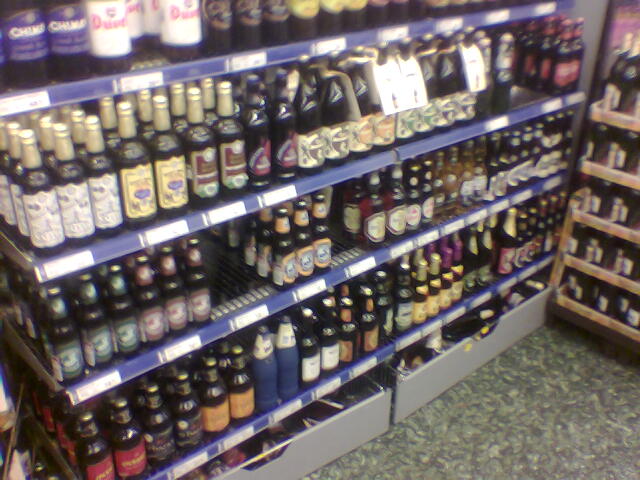
The humble beginnings of this revolution started in 2001 with the introduction of a very limited selection of premium quality foreign beers displayed on small wooden racks in a couple the national supermarket chains. These small wooden racks remain, however they now bookend an entire row of premium foreign beers in the stores of every major supermarket chain. The total space they are now allocated is comparable to that of Carlsberg and (Carlsberg-owned) Tuborg and the other low-quality Danish beers on offer.


An slowly expanding selection...


These foreign beers are sold at a price that is between double to triple that of Carlsberg and Tuborg, yet sales continues to skyrocket. Apparently, taste does mean something to a good number of people after all. The turnaround within the beer market has been astoundingly profound, and far beyond what even an amateur beer enthusiast like myself could have anticipated, must less hoped for, given the sorry the state of affairs that existed less than five years back. The tide is certainly shifting.

Most bars across Copenhagen now offer a small but increasing range of quality foreign beers, particularly Belgian and Czech ones. Whereas back in 2000, Carlsberg and Tuborg flowed exclusively from all but a tiny handful of taps in the bars of Copenhagen, now bars offering only Carlsberg/Tuborg on tap are sliding into the minority. And Hoegaarden, Chimay, Leffe, Staropramen, Erdinger, Franzikaner, Urquel and Budvar flow increasingly freely, with a few of the newer bars opting to leave Carlsberg/Tuborg off the menu entirely. In terms of taste, there is little challenge from Carlsberg/Tuborg for these other far superior mainstream quality offerings.

Unfortunately, for Carlsberg, of the largest brewers in the world (and owner of Tuborg), taste and quality has always been a distant goal after profit, and zooming in on Denmark, the strategy has always been market domination. Countless amounts of sponsorship and promotional cash are doled out by the company to ensure its products remain embedded deep within the collective national psyche of the nation. It has been a successful strategy - the company has generally held its ground and generated a mountain of cash in the process.

This truth was perhaps hammered home most forcefully one night back in 2001, sitting at one of the three bars in Copenhagen at the time that offered a decent selection of quality foreign beers. Carlberg had just released a new beer, called ‘Tuborg Hvede Øl’ (‘wheat beer’), it’s first unfiltered wheat beer. As far as I was concerned, this was fantastic news – at last an attempt to produce a quality mainstream beer from Carlsberg.

The bartender that night, recognising a couple of my friends from previous visits, offered us a round these on the house – he had received a complimentary batch from Tuborg. That night, we happened to be drinking some Belgian wheat beers – I cannot recall which one but I believe it was Hoegaarden. Doing a quick taste comparison, it was evident that Tuborg’s offering, though good, simply couldn’t hold a candle to the far superior Belgian wheat beer we were drinking. And admittedly, there are even better wheat beers than Hoegaarden! The Belgian beer had a depth of flavour that left one feeling Carlsberg/Tuborg’s offering must have been watered down, albeit with a decent flavour at least.

Now there is a couple ways this result could be interpreted. On one hand, in spite of a deep history of brewing, perhaps Carlsberg/Tuborg really did suffer from an underdeveloped experience brewing unfiltered beers - meaing maybe this was the best they could come up with. The bartender believed this was the first unfiltered wheat beer the company had ever attempted. Or perhaps, the real story was economic, and Carlsberg was quite capable of producing something better but couldn’t be bothered to offer up something even more interesting - acceptability over excellence with a strong dose of marketing to bridge the gap, in line with the traditional strategy that ran through the company’s and storied long history.

Bare in mind that around this time period, Carlsberg was running a sort of contest – which was rather in reality a marketing gimmick – involving four new beers introduced for a limited period (Hvede was one of them, the others being Dark, Red and Lager). Consumers could vote for their favourite, the winning beer would remain on the market, the losers would disappear into the black hole of Carlsberg history. Carlberg should have be trumpeting the arrival of four new members of its mainstream family. Instead, it proclaimed it would shortly remove three of them.

Now, for example, in Belgian – a comparably small country but one with a rich and deep history of brewing – between one to two hundred different types of beers are sold in all major supermarkets, double to triple this selection in the numerous specialty beer stores across the country. Similarly, in Germany and Czech, two other countries with a similarly long and proud brewing tradition, choice abounds. Surely, a slightly wider product line from Carsberg would meet with some acceptance in beer-oriented Denmark as well? Rather, Carlsbers’s mass marketing strategy revolved around a very small range of beers – Carl’s Special, Pilsner, and in it’s Tuborg range represented by Green and Guld. It still does, by in large.

The rest of the mainstream Danish market consists largely of smaller, low-cost, copy-cat producers who use the same Carlsberg/Tuborg formula - offering a range of cheap, similar tasting beers - though theirs cost on average around half the price of Carlberg/Tuborg. Interestingly, the taste difference is slight. One could quite convincingly argue a good many of them, such as most of the Harboe and Ceres range of beers, are perhaps even superiour in taste to Carlberg and Tuborg.

There is also one notable high high point of the beer-year in Denmark during the Christmas and Easter season when Carlsberg/Tuborg release, for a very limited time, a Christmas and Easter beer that happens to be a surpringly tasty beer - with the discount breweries also releasing their own competing products to match. Carlberg/Tuborg's is of a similar in quality to Hvede, which is to say, much higher than the standard of their other mainstream products.

Incidently, I recall Carlsberg Dark won that popularity contest a few years back, though the beer has subsequently all but disappeared from bars and pubs and does not generally feature in Carlberg's promotional efforts. From this outcome, one might be tempted to conclude that Denmark’s beer drinkers are conservative and not prone to shift their loyalties to a newcomer, in spite of taste and quality issues. One might thus conclude that to focus on expanding the product range, particularly on the quality end, may not be worth much, especially for a company like Carlberg.

Fortunately, this has proven to be far from the truth, as the exploding foreign beers sales figures demonstrate.

The latest development has seen the introduction of a small range of foreign beers at one of the two (high-volume) discount supermarket chains (Netto). To appreciate the significance of this development, one must shop at these discount supermarkets (and they are extremely successful) to experience just what an extremely limited range of products they sell, particularly on the quality end of things.

It is a genuine pleasure to experience such a rare turn of events where quality emerges from the shadow of a dominant other, much less worthy.

Curious to know more? Read on, Carlsberg strikes back - The remarkable Danish beer market (Part 2) and Setting the record straight - The remarkable Danish beer market (Part 3)

A truly unpretentious man of the people?


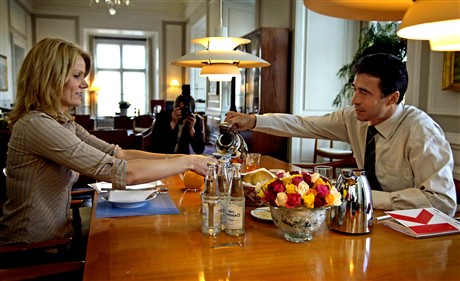
Pictures can be telling. In few countries would you find the Prime Minister carrying around an unstylish 10 kr (1.5 Euro) notebook such as the one Danish Prime Minister Anders Fogh Rasmussen is pictured with here (a cheap notepad available in countless discount stores all over Denmark) during his first official meeting with the new leader of the Social Democrat party Helle Thorning Schmidt (the main opposition party). Try to find a picture of Jacques Chiraq or Tony Blair taking notes in such a thing...

But what about it's contents? With regards to Denmarks continuing support and participation in the Iraq war, did Anders remember to pen a reminder note to himself to stop acting like the American puppet he has been and get Denmark out of Iraq and start raising questions such as just how many non-military human casualties ('collateral damage') there have been? Perhaps somewhere he penned an even more pressing reminder to himself to start (re-)humanising Denmark's "xenophobic immigration policies" - the highly quotable (and not exactly insignificant) qualification offered by The Economist when it recently assessed Denmark as the best place in the world to do business. Those immigration policies have taken a decided turn towards radical paranoia under his leadership. Pictures can be telling, but they don't tell everything.

A Stroke of Pure Promotional Genius? Or Maybe Just Good Fun? What is Volkswagen up to?

by Tim Anderson (timothyanderson2005@gmail.com)


Club Volkswagen in Copenhagen...I mean, Club Fox.

An odd series of events took place in Copenhagen over the past three of weeks. Under the name ’Project Fox’ (project-fox.org), the events centred around a series of consecutive club evenings (20 of them!) in Østerbro (‘Club Fox’), an event hall in Christianshavn (‘Studio Fox’), and a Hotel (formerly known as Park Hotel, now ‘Fox Hotel’) in the centre of the city. Ostensibly the project, initiated by Volkswagen, has a commercial backbone, the launch of a new car model, the Volkswagen Fox. In truth, it is not Volkswagen that has fleshed the project into reality, rather a bunch of street artists, event promoters, performers, and a weekly internet newsletter read by those supposedly in the know (that has surely had a significant role in bringing out the crowds (humanmail@humanwebsite.com to get on this list – I highly recommend it if you live in Copenhagen).

With Volkswagen’s involvement all but invisible by the standard of more typical corporate-artistic endeavours, almost shockingly, this one simply doesn’t fit the prototypical vision one associates with promotional arrangements. I'm going to stick to talking about Club Fox, and only mention that 'Hotel Fox' is a rather original project involving about 60 street artists who each redisigned a room the hotel (with basically NO limitations placed upon what they were allowed to do), while Studio Fox has been the sight of a handful of public debates. But Club Fox has perhaps the most interesting.

Club Fox can certainly not be accused of being staged on the cheap. No budget has been spared to achieve a memorable configuration of design, lighting and sound. I couldn’t be bothered to count how many projectors were hanging from the roof - a lot. Volkswagen’s largely ghost presence is one that has evidently included a donation of a significant chunk of change that has made it all possible. This is not the real story. The club nights have not only been top-notch, they have been unique and steadfastly non-commercial, featuring numerous outstanding (very) underground acts from around Europe.

Furthermore, staged everyday throughout the week (not only weekends), they have challenged the Copenhagen clubbing crowd that typically only appears on weekends, to alter their nightlife habits. There basically is no such thing as clubbing in Copenhagen on Monday or Tuesday (some notable activity can be found occasionally on Wednesdays and Thursdays, I will acknowledge). Project Fox, in wholeheartedly ignoring this longstanding convention, has effectively gambled it’s offering will prove more seductive than television or sleep. As a famous Monty-Python line once went, ‘nobody expects the Spanish Inquisition’ – and perhaps in the same vein, nobody expects such routine-defying provocation from a supposedly dull, corporate entity such as Volkswagen. But they have done it, and it has worked. The crowds have turned up most nights, even knowing (though I’m not even sure that many do) that it is all at the behest of Volkswagen! This is no small feat.


Is anybody buying a Volkswagen Fox?

Achieving such an level of authenticity has allowed the project to in effect ‘breath’ and it has taken on a certain life of it’s own as a result (with still a few days left to go before it’s all over). The feeling at the club by now each night is more akin to an ongoing underground music festival, not the promotional production that it nonetheless remains. It is a rare instance where a commercial presence has truly facilitated one hell of a cool party, rather than simply appearing as an incoherent presence stamped onto an event to which it just didn’t belong, or worse still, offering up some big-budget, dead-on-arrival piece of propaganda propped-up lifelessly by a big-name performer or two. This is the typical history of most promotional engagements of this commercial nature.

Now it is not at all obvious why Volkswagen, in initiating such a high profile event, would decide to keep their involvement at such a low profile. Yet something about the whole arrangement suggests that the strategy seems to have worked – at least in my reading of the whole thing. There is simply no other club or festival in Copenhagen that has managed to put together a comparable twenty night program of live performances in recent years – not to mention create a surprisingly funky setting to stage the thing. What is Volkswagen trying to do?

Almost the only hints of their involvement in all of this, or any other company for that matter, is the Volkswagen people carriers sitting outside the club, shuffling the German ‘VIPs’ and local organisers to and from the club each evening, and the shiny red Volkswagen Fox sitting outside the club a few meters from the entrance. In fact, it was only leaving the fourth arrangement at the club that I noticed the car for the first time. Its presence seemed like more the result of a last-second afterthought someone had, remembering it was probably a good idea to actually display the car for which the event was created and named.

Whatever the intentions, in this simple, strategic stoke of low-profile genius, Volkswagen has managed to avoid the inevitable pitfall that virtually every other sponsor of corporate-artistic collaborations has fallen victim to: the inability to refrain from demanding that their logos and attestations trumpeting their involvement get schlepped all over, in every which place imaginable. Crass commercialism ultimately detracts from any purity of artistic vision that such events may have otherwise possessed, which consequently doesn’t leave one feeling much enthusiasm for the event and even less the sponsor. Even on the widely distributed ‘Club Fox VIP’ passes that serve as the public admission tickets to Club Fox, only a single, very subtle mention of Volkswagen as the project ‘initiator’ is made – and not even on the booklet front page! All this has made it work.

It will never be entirely possible to produce a measure of ‘Project Fox’ as a success of failure; this must remain a subjective opinion. One cannot measure any translation into new car sales that may result. However, what can be suggested is that by avoiding almost all conventions of such sponsorship branding-promotional exercises, Volkswagen has perhaps hit upon the elusive magic equation for successful corporate-artistic cooperation. Put your corporate money in, but keep your corporate image out. When companies try to step inside of the artistic arena themselves, propaganda results, something that has always been of questionable artistic merit, meaningfulness and relevance.

Without being beaten over the head with the message from the first step inside (or even earlier), those attending tend to pretty quickly figure out the purposes behind such events, in any case. The less that is said, the more curiosity is aroused – a pretty effective way to get a message heard. When people are assumed to be intelligent, attentive and receptive - and actually treated that way - POOF, suddenly they just might listen!

Still, all of this begs an answer to the question: did Volkswagen get what they wanted to out of all of this, whatever it was? Let me offer an answer of sorts: WHO CARES! It has been fun, and I’m looking forward to attending one or two more nights before it’s all over. I’m sure there will be great debate at Volkswagen regarding the merits of getting involved in such conceptual ideas in the future. Myself, I am the first to admit that the ‘bang for the buck’ from this project besides being impossible to calculate, is highly debatable. In terms fun for those watching the spectacle, it has surely been an unparalleled success.


Okay, not everyone agrees...

A LITTLE NOTE: I have taken some flak from certain corners for not being more critical of Volkswagen for introducing yet another hardly necessary gas-guzzler to their existing line of hardly-necessary gas-guzzlers. My apologies for this. Nonetheless, it must be said that pollution takes many forms, and Volkswagen's Fox launch, in not being another mechanically cranked-out, brain-dead, loud and overhyped affair, at least avoided contributing to a couple froms of it - the visual and aural sorts. If more companies began taking such an approach - more subtle and requiring perhaps requires a little more intellectual engagement on the part of the subject, well, perhaps surprising and unexpected results touching seemingly unrelated areas may begin to follow...in time.

This article was featured in Sew Magazine - thanks to Nick and Roger at SEW.
SEW Magazine, Issue 10.

Live at Club Vesterbrogade 77: DJ Persia and Anderson hard at work...

Courting controversy, Danish army style


by Tim Anderson (timothyanderson2005@gmail.com)

Recently a number of advertisements for the Danish army have quietly appeared all over Copenhagen. They show a young, normal-looking man below the caption, ’there’s war in the world’. On the flip side is the same young man in a tank - he has obviously decided to join the army and fight the (good) fight. A few days after these ads appeared, I noticed that the street artists had not allowed this one to slip by them. ‘Kill4Maersk’ and ‘Kill4Bush’ stickers were quickly being pasted onto some of these ads. To gratuitously slip in a bit of pop-culture, we may not have started the fire, but we sure know how to keep it burning.

To the questions: should the army be recruiting in this manner? And is a response in the manner of the ad-hackers constructive in any way to the wider discussion?

All of this has proven to be a provocative subject for discussion amongst my friends, people who position themselves politically slightly left-of-centre, some less slight than others. Nonetheless, a couple of them have been surprised to discover that in spite of being self-labelled left-wingers, they found themselves arguing from the right to a greater extent than they would have believed themselves capable of or interested in doing.

Let me declare my position straight away. To me the army ads are not only highly visible, they are clearly one-dimensional and intentionally provocative. Imagery blatantly employed to call upon the Danish participation in the ongoing Iraq war is bound to be just that. Consequently, a reaction from those incensed that creating ads that effectively ignore the various controversies stemming from Denmark’s decision to join the Americans (and all that has occurred as a result) is not only to be expected, it is justifiable. Attempts to coax people towards a position without any discussion – as the army’s ads do - challenge my neutral instincts. These ads are advertisements for fighting, a crude recruitment tactic for the Danish army to take. The ad-hackers message is equally crude and unreasoned, but at least each and every person walking by the ads gets a short blast from both sides, rather than only one. I accept that most people probably don’t really care to think especially hard on the issue, so the ad-hackers tactics may not change anything. Ad-hacking should certainly not be the only means of reacting - more intelligent discussion is also clearly required.

To begin with let’s first consider the ads themselves placed by the Danish army. As a Canadian, I’ve have been brought up - some might claim indoctrinated - in a ‘peace-keeping’ culture. This is what Canadians pride themselves on when they speak of their global military role. The Canadian military, often under the guise of blue UN helmets, has for better or for worse offered its services in this way for decades to various hotspots around the world. The Danish army’s ads are not about peacekeeping. There is nothing wrong with this since not all countries use their armies precisely in the manner Canada does. But in its place I would expect some reference to the greater good that will come from joining the army. Peace and harmony - those things one perhaps idealistically hopes will spring from the aftermath of fighting are not at all the point in this ad. This disturbs me. I have a sense that the Danish army has far a far greater purpose and responsibility in recruiting than this ad suggests, but this ad could lead one to believe the army has all but abandoned that idea. I know it is only a single recruitment ad, but is this why people should want to join the army? Does Denmark really want an army full of those attracted by the chance to fight? I hope not.

Yet the ad-hackers message is equally controversial. I’m uncertain how many in Denmark would be overly offended by the ‘Kill4Bush’ suggestion, especially those like me still in disbelief that the Americans could pass up the chance to elect a thoughtful and dignified leader precisely when they needed one the most. It is debatable just how much ‘killing for Bush’ the Danish army has in fact done in Iraq, but their is a certain guilt by association that Denmark must be accepted in going along with the Americans – in particular that right wing 51.5% who voted for Bush again. The Danish army is ultimately subject to the whims of the Americans forces – the same force that has killed an awful lot of innocent Iraqi civilians (though the Americans have opted not to keep an official count of the numbers). So, I accept the ‘Kill4Bush’ signs. But ‘Kill4Maersk’? Bringing Maesk into the picture is something else. What does Maersk have to do with any of this? Should they shoulder any of the blame?

Well, perhaps.

Maersk was contracted by the American Department of Defence before the start of the current hostilities in Iraq to provide transportation and logistics for the troops, supplies, weapons and ammunitions. This is serious business, indeed. As arguably the most economically significant company in Denmark, Maersk’s influence is felt in many ways - just look at the not-exactly-inconspicuous Maesk-funded opera house in the Copenhagen harbour. Even if Carlsberg had managed to land a contract to supply almost every liquid substance in the desert, and Danfoss had quietly convinced the Americans that only fools would dare cross the hot sands of Iraq without a mountain of radiator dials for the liberated to regulate their heating systems, no Danish company stood to benefit from the war in Iraq from the outset more than Maersk. Is it possible that the Danish Prime Minister might have the loud and persistent whispering in his ear shortly before he opted to join the coalition of the willing? In any event could he have been influenced, or like Tony Blair, was his mind already made-up?

As one left-wing friend of mine rather indignantly argued, if war is inevitable and some will profit as a result – an old story - what does it matter if it happens to be Maersk getting some of the cash? A professional company like Maersk can presumably help the situation in Iraq, not hinder it, so their presence is probably a good thing. If Maersk wasn’t involved, somebody else would surely have taken their place. Nothing changes with or without Maersk.

Well, maybe, maybe not. Maersk has taken on a significant level of moral and ethical responsibility by participating directly or indirectly in the war. If a weapon they have shipped kills somebody, as was the case when they were supplying Nazi’s with weapons during the second world war (recently chronicled in a series of articles run in Berlinske Tidende), the company must accept their actions played some role in the killing – which is not to say that the killing may not have otherwise occurred. But where does their responsibility begin and end? And who are the people in Maersk specifically tagged with this responsibility? Is an open discussion about such sensitive matters not a necessity if there is any hope that conflicts of interest are avoided? The open question remains: are companies particularly well-suited for making sound moral and ethical judgements? What evidence exists to suggest they can be entrusted with issues that wider society in itself struggles to handle? Are governments any better? After years of business studies, culminating in a Masters Degree in Economics and Business Administration, the answers are not at all clear to me.

Clearly not all companies are evil, or destined to become so, but assessing this issue is a fuzzy matter. Google’s recent declaration in their shareholders prospectus that the company will strive to ‘not be evil’ does not prove if they are or not. Neither does it foreshadow an inevitable future lapse, nor guarantees the long-term saintliness of the company. It does acknowledge the issue, which is a start. Recent documentaries like ‘The Corporation’ conclude companies may even be psychopathic by nature. This is only one side of the issue. The Economist, in arguing that companies are not necessary doomed to spread evil, has consistently, convincingly and intelligently argued over the years that those governments who have set the strictest limits on private-business are also the ones who have most consistently ignored and violated their own citizens basic human rights. But The Economist is also cautious to sound a note of warning at any suggestion that private business should be handed the only set of keys to the car.

The moral implications of choices are most likely be considered by companies when they could have an obvious negative effect on short-term profitability. Just think of Nike taking fast action to improve the pathetic standards of many of its third-world sweatshops a few years back when the issue was a hot media topic. Yet today when buying an unbranded pair of shoes to avoid the ubiquitous Nike swoosh-thing, one is still left with no way of knowing what conditions those who made the shoes were under. But do we trust that Nike will in future not use its influence to argue against further regulation regarding their behaviour in the third-world countries in which they do so much business? How do we know that Maersk has behaved responsibly in the lead-up to the Iraq war when the issue of whether the Danish government should participate at all was still officially undecided? Did they quietly try to influence the government? It may have lead to an lot of uncomfortable questions if the largest company in a company formally against the war was making so much money from it. What has been Maersk’s role since? What assurance should their be that the delicate moral and ethical issues that surround a companies actions, tactics and influence are being appropriately considered and addressed? So we come to the heart of the issue.

Are we just to turn a blind eye to Maersk’s habit of wartime profiteering because they are (in this war) on the side of the 'good' guys? Is it too late to ask such questions? The silence from Maersk on such matters is hardly reassuring.

So we are back to the ad-hacking dragging Maersk into a criticism of the Danish army’s recruiting tactics. Are these constructive attacks to be making? Well, why not? Maersk is involved in the war, and the company is big and rich enough to take criticisms. There surely should be means for holding companies accountable for all their actions, and somebody might as well start somewhere. Not everybody can get the mainstream media to broadcast their questions and opinions and it’s not exactly easy to ring up to old Maersk himself to get his thoughts, as interesting as this might be.

In any event, I hardly expect to hear a reaction for Maersk the person or A.P. Moller the company on the matter. But if a few people see the ads and the ad-hacking, and think for a couple seconds about the moral and ethical implications of the actions of private business in wartime, that would be a good start. In the meantime, I sure hope those army ads disappear.

And Thou Shalt Not Shop on Sunday…

by Tim Anderson (timothyanderson2005@gmail.com)

I have been complaining to anyone who will listen for several years now (which usually means my girlfriend) about Denmark’s ridiculously antiquated Sunday shopping laws (‘lukkelovn’ in Danish). These laws are based on the most utterly nonsensical logic imaginable. The arguments for allowing shops to finally open on Sundays and later on weeknights are painfully obvious and compelling – yet they haven’t sunk in.

Outside of downtown Copenhagen, nearly all shops in Denmark close by two (!!) in the afternoon on Saturdays and six in the evening on Monday to Friday. Yes, this means that for the average working person in Denmark there is at best an hour after work on weekdays and five hours on Saturday at best for shopping – if one is willing and able to sacrifice the rare chance to sleep in on Saturday.

On the few Sundays each year when shops are allowed to open, the streets are buzzing with activity. Then there are the unbelievable weekly Sunday queues at the few grocery stores that can open on Sunday. To say there is a pent up demand for this kind of shopping flexibility could not be more dramatically underscored. Still, the government refuses to cede to the overwhelming evidence before it’s eyes.

In fact, with these ridiculously limited hours, getting out of the house on Saturday mornings to run around in a frenzy alongside the thousands of others facing these identical time constraints is the only real option most people have. The realities of life mean a certain amount of time is required each week for buying stuff, and there is only limited amount of time to buy it. The most grievously frustrating aspect of this state of affairs is that shortened shopping hours produce the polar opposite effects they are intended to.

Instead of leaving more time for the sort of loving, warm, fuzzy relationships the government has historically imagined are nurtured by closing shops early, people are forced to rush around hurriedly when they could most use a bit of time to relax – the day after a long work week. Under such time pressures, their worst sides often emerge: tempers become short, frustrations boil and resentment that previously didn’t exist appears – and all for the wrong reasons. Worse still, even when everybody agrees they would rather be doing something else, they are often forced by the necessity of their needs to go shopping nonetheless.

One wonders where exactly the benefits are in this perverse system of enforced madness?

It is an entirely unpleasant experience to run around trying to buy all those things that are best shopped for at a leisurely pace (clothes, furniture and so on) over a few inadequate hours. To imagine these pressures do not have unpleasant side-effects is outright delusional - they create some of the worst tensions that families and relationships are ritually forced to endure in Denmark.

Consider that the divorce rate in Denmark is currently running around 50% - and has been increasing for decades. While there are many factors behind this, what is certain is families have many demands placed on them, and they clearly do not always succeed in coping with them. It beggars belief to imagine that these short shopping hours make things any easier.

With an extra day of shopping on Sunday and longer weekday shopping hours, individuals and families could be flexible about how and when they wanted to spend time with their loved ones – some of which would include more leisurely shopping. Saturday may be the perfect day for a walk in the park, or a visit to a museum, or to simply spend time with the kids or a boyfriend or girlfriend doing whatever they would like to do. Currently, when one need new shoes, a new jacket and so on, for whatever reason, these become the overriding Saturday priorities – it is the only time to buy the stuff, so all else must wait. Even if these ‘other activities’ being put off are precisely the ones family relations could benefit most from. It is so patently obvious it should really not need to be said.

There are countless other points to be made. The fact that Danish ideal weather conditions for having ‘a family day’ are not always co-ordinated with Sundays is a significant point. While shopping can be done in most weather conditions, a walk in the park is most appealing on sunny days – which could be Saturday! Visitors to Copenhagen from around Denmark and tourists from other countries are a small but significant portion of the Copenhagen economy – these people can only walk around on Sundays with money to spend but nothing to buy. So forget the weather, forget the visitors, and forget flexibility - Saturday is designated ‘shopping day’ by the rationally-impaired Danish government. So it must be.

So here I sit on this Sunday typing this frustrated little rant – I’ve already been out for a pleasantly leisurely walk earlier with my girlfriend, the only real choice we had anyway. I’m home enjoying some of that lovely government-imposed family time. My girlfriend and I both agree it would be great to go shopping today for the new chair for the living room we have been intending to buy for ages now. What better day than Sunday to be able to leisurely visit a few furniture shops until we found what it was we were after? In fact, perhaps along the way we could stop at a cafe and have some lunch together…hmmm, this sounds suspiciously like the sort of quality-time together Sunday closings were supposed to facilitate in the first place? Funny that…

To continue to hold up the antiquated logic of Sunday closings benefiting society is simply unreasoned nonsense. Shopping hours in Denmark as they stand currently are a significant drag on a more smoothly functioning society. It is a shame, yet things could be so easily changed. And it can’t happen soon enough, if you ask me.

Getting the Christiania vibe...or not

by: Tim Anderson (timothyanderson2005@gmail.com)


Christianshavn including Christiania - A bit of Copenhagen.

The vibe of Christiania - the 60’s hippy ghetto/cultural experiment located in the heart of Copenhagen now in its 4th decade of peaceful existence - is as strong as ever, I am delighted to be able to report, in spite of the political challenges it is currently facing (more on those shortly).

As a resident of Christianshavn (the area of Copenhagen where Christiania can be found), I have the good fortune of being able to regularly enjoy numerous aspects of the place without actually living there. From it’s restaurants, clubs, walking paths and even the sauna, I have spent a fair amount of time in Christiania over the years, so I do feel capable of voicing a reasonably informed opinion on the subject.

Christiania rarely disappoints. What is perhaps most astonishing is the enduring popularity of the various events Christiania hosts. Some of my most enjoyable moments in Copenhagen during recent months have been there.

Loppen is a place where, for most events, a small but enthusiastic crowd spends as much time sitting at the tables beside the stage in conversation and doffing back pints as on the dance floor itself. On the evening of the recent sold-out Vive La Fete show (one of Europes finest underground electro pop/Berliner trash bands, though virtually unknown by mainstream/commercial standards), the crowd was an overwhelming mass of people. The coat room may have run out of hangars, and the floor of the rickety building may have bounced dramatically up and down as the crowd danced, but then again, at Loppen it’s all been done before.

I have listened to numerous fantastic late-evening jazz-jam sessions Wednesday nights at the Børneteatret (aka The Children’s Theatre). At a recent session with some friends, the place was buzzing, as usual. Having not been to such an evening for several months, I was amazed to re-discover that even long-after midnight it was standing room only – this on a cold, dark midweek winter night. The rest of Copenhagen is largely tranquil weeknights at this hour with but a few cars and bicycles moving through the streets. Yet a small, word-of-mouth event such as this one manages to draw a determined crowd nonetheless.

On the more pedestrian end of things, a couple weeks back I passed an enormously relaxing hour in the largely anonymous Christiania Bath House, the fantastic communal sauna existing since the 70’s. This was my first introduced to the place thanks to a couple friends who themselves had stumbled upon it only by chance. Frequented by in large by the Christiania locals, it is an infinitely pleasant experience – and costing a laughably meagre 20 kroner.

Then there are the incidentals like the Christiania falafel that is arguably (though only by those who haven’t tasted them) the best Falafel to be found in Copenhagen and the delights of the 24-hour Christiania bakery like decent coissants (a rarity in Copenhagen) and chocolate brownies (made the North American way with soft chocolate cake and plenty of rich, fudge-chocolate icing that I like oh so much). A passing conversation with a police officer (a friend of a friend of a friend) who regularly patrols Christiania provided me with the warning that Christiania is a rat-infested place – he wouldn’t eat anything sold there – but I continue to take my chances.

When my parents visited Copenhagen some months back, our obligatory tour of Christiania was inevitably successful. Our dinner at Spiseloppen, the undisputed finest of Christiania’s restaurants, ultimately proved to be one of the culinary highlights of my parents visit to Denmark. They still happily speak of Christiania, inquiring regularly about the state the current political challenges facing the place. My parents have never been hippies, so their interest stems from a genuine enthusiasm for what they saw and experienced - not some idealistic 60’s shadow persona that lingers from their past.

So here we come to a real topic of discussion, the political issues.

My experiences over the years have lead me to conclude that opponents, including those within the current parliament who have voted for legislation proposing to ’normalise’ Christiania, would be well advised to spend some hours discovering what is actually going on there. Clearly, most critics simply haven’t a clue what it is they are in fact criticising. The claims of the current government seem to mirror the views of those who alarm themselves to hysteria at the thought that a place exists (happily and peacefully, by in large) that is organised in a manner differing from much of the society they know, comprehend and believe in (read: a society conservative in nature by comparison). They simply cannot fathom it. Rather than simply being green with envy, they turn red with outrage. It is a sorry state of affairs when one finds such people in positions of power within the government and creating legislation encapsulating this ignorance in poetic legal terms.

Why is it there is such a strong sediment against Christiania, at least from certain corners of Danish society? The Danish government has recently passed legislation that, if implemented as it reads, will lead to the ‘normalisation’ of Christiania. In practise, this means that collective ownership of the area by it’s residents (or non-ownership, if you prefer) will no longer be possible. Some would be able to afford to purchase their houses, apartments and properties, while others would not. This is not the heart of the problem that will be created if the legislation is enacted.

Inevitably, the end of collective ownership would spell and end to the collective-decision making that has created the spirit of community that exists in this diverse yet closely-knit society. This would be a tragic and unrecoverable loss for Copenhagen, but moreover for those people who have spent much of their lives living and breathing it. And with spectacular success.

It is no coincidence that that which makes Christiania so unique, is found specifically in Christiania.

Nobody is forced to live in Christiania against their will. There is no overriding, compelling argument for why those who voluntarily opt to accept a system of non-ownership and collective-decision (including those who may choose do so in the future) should suddenly be forced to accept just the opposite. The government can negotiate with Christiania as a collective with regards to property issues, just as easily as it can as a society of individuals owners. The proof is the fact they have be doing it for over thirty years already. What is really motivating them?

Currently, the only representatives of government one is likely to see around Christiania come in the form of (endless) patrols of policemen - armed with full riot gear every time. They love to make their intrusive presence felt around the place. Sadly, their actions are disruptive, provocative and unnecessary. This approach to passive policing is about as subtle and endearing as is enduring a group during a movie roaming the aisles with very bright lights they shine randomly but constantly into various faces in the audience, just to see how people are doing. It is hardly the most effective way for the police to demonstrate their general engagement in the Christiania situation, nor does it show an adequate level of respect and decency for others ones expects in a civilised society. Why is it the police feel the need to endlessly patrol Christiania in a manner distinct from the methods they deploy elsewhere in Copenhagen? Some would say the answer is drugs.

After countless visits of my own to Christiania both day and night over the years, I can unequivocally state that I have never once felt threatened – even back in the days not so long ago when Pusher Street was home to a thriving and peaceful soft-drug trade that the police were will aware existed. A community of underground but easily accessible hash clubs continues exist in Copenhagen, in any event.

Something beyond the soft-drug trade is motivating these police actions, in spite of claims to the contrary. What exactly is the real problem? Is it simply a feeling felt by the government, mirrored in the police behaviour, that their absolute authority is challenged by the very existence of this continuing successful four decade-old social experiment?

The truth is that there never has been a problem in Christiania that warranted the creation of the artificial one the government has chosen to depict - and then pass legislation to supposedly rectify. But thanks to the legislation, a real problem now subsequently has been provoked – the threatened future of Chistiania and its ‘alternative’ lifestyle.

So, I would like to make a small confession: I am one of those green with envy that a place with the sense community and togetherness that Christiania has confidently thrives while I don’t know a single person living in my own multi-building complex (even in spite of its ample shared garden out back). How many others in Copenhagen have a similar relation with their neighbours? Those of us in this situation simply do not have the right to criticise those who have found a way around this issue – and nor does the government.

So I would like to also offer a small challenge to those Danish Members of Parliament that have voted in favour of normalising Christiania:

Muster some courage to enter into the unknown, and go wandering around Christiania on a few occasions. Go to some of the restaurants and participate in some of the events and try to understand just what the place really is about, for yourself. Don’t be scared to try talking to a few people. Then you will have done a genuine public service you can be proud of.

Forgiving the American right-wing through satire


by Tim Anderson (timothyanderson2005@gmail.com)

The Danes for Bush characters...

The genre of serious satire, of which Danes For Bush is a part, is a growing genre. It is satire that is lightly, if not cleverly, disguised - a part of pop culture found at some indefinite point where art, journalism and politics meet. If Michael Moore is the current king, Danes for Bush is an original derivative.

Danes for Bush hit the pavement in August 2004; just as the American Presidential campaign was beginning to heat up. The tour was timed to hit New York at the end of August at the same time as the Republican convention that would confirm George W. Bush as the Republican presidential candidate in 2004.

The two-man Danish road show of Jakob Boeskov and Mads Brugger plow their way across the United States in a camper van for a series of appointments with the right-wing grassroots of the American heartland during the weeks leading up to the Republican convention. With an air of determination they make continuous vows to do whatever they can to support the cause of making sure Bush and Cheney are around until 2008.

Their weapon of choice is a portrait of sincerity, a couple of over-the-top matching outfits, plenty of ‘Danes for Bush’ campaign paraphernalia, and a bizarre inflatable pork-sausage mascot wrapped in an American flag. Yet they steadfastly refuse to reveal that their fighting words should be taken at anything but their face value. It may all seem over the top, but so are the views espoused by hard-right republican after republican.

Ironically, Jakob and Mads’ very outrageousness and demeanour, if a dead-give away to fellow-Danes and others of a more moderate point of view, is the bait that catches and quickly convinces countless staunch Republicans. We witness a scattering of semi-formal speeches and informal discussion results where Jakob and Mads allow their mock-opinions to bubble out. Their comments regularly cross the line into what many would (hopefully) feel is outrageousness (Jakob: ‘Let’s face it, we need that fucking oil!’), before faithfully jumping back to (slightly) less outrageous territory, lest any of the less radical radicals in the crowd become disturbed and suspicious. The targets fail to register that it is pantomime and satire they are momentarily cast into. They believe in the sincerity of two passionate figures echoing their own warped thoughts!

This is the ticket into this surreal parallel world, and Jakob and Mads never give up the deep dark secret that they themselves are anything but genuine in their purported beliefs and stated intentions. Even on their website (www.danesforbush.org), they refuse to give up the gag. Their subjects remain unguarded and uninhibited. Free to speak candidly, they do. This is the source of the genius.

A district judge in Texas feels no shame in suggesting that dropping the bomb on Baghdad would save lives – his proof: it did in Japan. They create an award and give it to him – Americans love awards. There is no counterattack attack their targets face. No moment of revelation where the purpose is revealed to the unsuspecting. They will forever remain ignorant.

Yet it is the unexpected by-product of these countless encounters with hard right-wingers during their cross-country marathon that sets Danes for Bush apart in this genre of political satire.

While it is no surprise to find groups of radical right-ringers talking the talk one would expect of radical right-wingers, what is an eye-opener is the source of the feelings of uncertainty and paranoia their targets ultimately reveal.

The talk of the right-wingers they encounter is of the hopeless tragedy of friends and neighbours murdered by random gun-violence; Vietnam as a terrifying scar – one that we see lingering disturbingly on so many psyches; and of course the deep, oftentimes wildly fanatical, religious faith used to steady so many in the face of it all. The trauma of being hit by terrorists who, from the perspective of a small-timer in the heart of America, have emerged almost mystically from some unknown evil has been the final blow. These people are visibly shaken in many of the encounters. They have felt an enormous sense of betrayal of purpose over the years, and they are stunned by it. Unfortunately, they seem totally unarmed to deal with this deep bubbling well of conflict and contradiction that lays deep inside their country’s history, continuing to boil unrelentingly today.

The affects of violence, war and terrorism the Americans as individuals can see within their own homeland are dramatically at odds with the widely held belief in their own global superiority, domination and universal righteousness. These beliefs are deeply ingrained, and not easily displaced. They have been nurtured since age none, through their first steps as children; ritualistically pledged through a symbolic allegiance to the flag spoken each and every school day; hyperactively spoon-fed by a lifetime of not entirely coherent media; canonised by the deeply conservative judicial system; rubber-stamped by the various levels of government across the land and through the very words of the President himself. Mix in the symbolism, dogma and (oftentimes) fanaticism of the growing Christian right populating the heartlands in ever increasing numbers, and what is left is odd message of fearful hope amongst the senselessness.

Yet the air remains densely clouded with cynicism, confusion, tension, anger and repression because, spliced together, these disjointed fragments have become justification for policies of (pre-emptive) war and containment abroad, the curtailment civil liberties at home and few if any fundamental rights at all for those deemed as possible threats (evidence be damned). Only the hopeful language of universal freedom and peace on the march stands as the shaky premise buffering the reality of the madness they are supporting. So instead this premise has become the final nail in the coffin - what is a person to think? To imagine the issue is one extreme right-wing president and a misguided war is to miss the point.

What these people see surrounding them, all that is being told, all that has been taught, all they have learnt; it all purports to be the truth – yet not all of it can be. They themselves can sense that it all doesn’t add up, they can’t quite make sense of how this has come to be. The radicalisation of their views is the by-product, since countless friends, neighbours, colleagues and the rest would sooner part ways with them than accept a daring suggestion that another reasonable point of view may exist beyond the prevailing right-wing logic.

This is the point where surprisingly, the clouds begin to clear.

As we watch the Danes for Bush characters in full pantomime, Mads and Jacob meeting right-winger after right-winger, group after group; the puzzle pieces begin to fall into place. One now understands where it is the people they are meeting are coming from.

With this realisation, the disbelief that a group of such people and their radical viewpoints can exist mutates into a sort of momentary, if uneasy, forgiveness – which is not at all to say that one finds oneself agreeing with virtually anything being said.

The right-wingers are children stumbling through the unknown, ever fearful of what may lurk around the next corner, wishing for the impregnable protection they once imagined their parents to provide, a long time ago. Unsurprisingly, they opt to support the solutions that most closely mirror their childlike tendencies. Tough talk and unconditional support of those willing to accept war against an imaginary enemy, thereby subjecting others to the burden of their fears as they themselves cower defencelessly, waiting for the world to become the idealistic place they imagine it should be.

The enemy surely lurks somewhere in the Middle East, so attack, ATTACK! What better justification? There is no time to think about it, to debate. How can you put a price on comfort, reassurance? The violent and unpredictable world must be secured; perhaps a more manageable task than that of collectively coming to grips with ones own conflicted past.

In Bowling for Columbine, Michael Moore set out to convince anyone who cared to listen that America is a fearful nation, full of people scared silly, if not stupid. Danes for Bush has gone further still. In managing to communicate with the same group of people that John Kerry and the left wing of America were simply unable to touch, the Danes for Bush guys, if inadvertently, stumbled upon the reason why this very fear exists in the first place.

Sadly, dealing with this mess will preoccupy left-wing Americans for years to come. What can be said here and now at least, is that blended together with enough passion; politics, art and journalism certainly can reveal a lot.

Powered by Blogger