Editor's Note:
No time for an article today, but many more are on the way (beginning next week).
In the meantime, check out www.shortcutblog.eu, an excellent blog covering cities around Europe. I'll be writing an occasional article from Copenhagen for Shortcut, the first one Copenhagen: a European Paradise is now up.
Cheers,
Tim.
The joys of winter in Copenhagen: Skating at Kongens Nytorv (especially when there's snow)
the ice rink at Kongens Nytorv - overlooked in the background by
Det Kongelige Teatre (The Royal Threater) and Magasin (a big
department store, on the right)
After warm temperatures for the past 2 months, for a brief moment there, we had a little bit of (true) winter in Copenhagen. It started early last week with a light frosting of snow which stayed on the ground thanks to cool temperatures throughout the week.
But the real fun was waking up on Saturday morning and finding a good 10-15 cm of snow had fallen during the night. It's even nicer when these days line right up with the weekend.
That gave us a few hours on Saturday to get down to Kongens Nytorv in the center of town, rent some skates (the ones I own are unfortunately in a box in the basement at my parents house in Canada - an issue anyone who has adopted a second country as home is likely familiar with) and enjoy a couple hours of skating (too bad the snow was gone Sunday - even if the ice rink at Kongens Nytorv will remain for at least another month).
Now, the rink at Kongens Nytorv is a pretty fair sized circular track, not a bad size for something in the middle of the city. Sure it pales in comparison to such ice rinks I have experienced in the past - for example, when I lived in Ottawa in Canada many, many years ago now. The 8 kilometer long frozen canal running right through the center of the Ottawa, maintained as one long skating rink for 2-3 months every winter, is pure joy to skate on - and it was practically in my back yard (well, down the street, at least). I remember was even skating home from a job interview once...
Anyway, this is Copenhagen, and it is the best outdoor rink that I've come across anywhere in Europe. So that is saying something.
And I don't think I could come up with a better theme for pictures showing a bit about life in Copenhagen at its best during the winter months...
lining up to rent 'em...
'oops!!' ...incidently, that's the French embassy (flying the flag)
in the background)
An edited version of this article can be found on Shortcut - A European City Blog. Wanna see it? Click here: Copenhagen: Get your skates on.
The sound of the popping bubble: A bit about psychology and Copenhagen's housing market
by Tim Anderson (timothyanderson2005@gmail.com)
anybody selling...
Money is always an exciting thing to have dangled in front of you. Especially if, like me, you don't really have much of it. If you're buying or selling a property in Copenhagen (or elsewhere), this may help you make a bit more money and a bit faster, or maybe spend a bit less.
When a bubble pops, it's gone. Something to take to heart when the bubble in question happens to encompass a lot of cold hard cash. I'm talking about the billions of kroner in value that has been sheered off of the (supposed) value of houses and apartments across Copenhagen over the past few months. The housing market in Copenhagen, you see, has turned.
To be clear about my view on things, it is highly unlikely one will lose money in the long term in housing in any major city, especially Copenhagen - perennial destination of choice in Denmark. However, in the short term, this may not be the case. Then it's more about psychology and knowing when to make the right deal.
Psychology plays a surprisingly big role in things.
Buying and selling an apartment is ultimately a matter of deal making. Good dealmakers know how to harness (and overcome) the forces of psychology. That means leaving as much emotion aside as possible (or turning it to your advantage), taking a somber look at the prevailing tide, grasping just where things are heading, and tempering actions appropriately. Of course, emotions matter, you just can't let them run wild - especially if your view is a short term one. This is, of course, not exactly easy when the issue in question is a home.
So we have the case of the Copenhagen apartment buyer (of course, this story applies all over the western world).
About a year and a half ago, I discussed Copenhagen's complicated housing situation in an article (Closing Time In Copenhagen (Part 2): The Housing Situation). Among other things, I noted that housing prices had been rising at a wildly unsustainable rate (a rate that was well above what official statistics suggested).
For at least 18 month (up until mid-2005), the average apartment in Copenhagen had been rising at around 20,000 kroner (2000 euro) per month. In fact, this had been the case for several years, however the zenith was this final 18-month period.
To give some perspective on that number, this amount is a little above the average after tax monthly salary in Copenhagen. In other words, you could make the same amount on your house each month as you could by going to work. You don't need to know anything about interest rates and so forth to realise that this was just not a sustainable situation.
Ah, but how times change.
A brief digression. A few years ago, I had an unlikely job selling private jets (really), and here I learned a lot about buyer and seller behaviour and long-term market trends and patterns. Some day I hope to actually use this knowledge to make some money for myself, for now I can only share it. The private jet market mirrors the economy as a whole, and it also mirrors the typical behaviour of the housing market.
When prices rise, they do so for a number of years. And as they rise, the number of properties for sale drops. At the peak of the market, there are very few properties for sale. So a good way to get an idea of where the market is at, is to look at a long term chart showing the number of properties for sale (each month).
Then the market turns (though few realise it until months after it has happened). When the number of houses for sales begins to rise consistently, the market has already turned, even though few will realise it at this point - of course there can be a few false turns before the real one.
When the market turns, it's not simply a matter of dropping your asking price to match the market. It's more a matter of praying somebody falls in love with your place. You see, inevitably at this point, there are NO BUYERS (or at least far less buyers than there are sellers). So it also helps to have a long term chart showing a rough figure for the monthly number of apartments sold, as well. When it starts dropping consistently, that is the other indication that the market has turned.
A drop in monthly house sales is exactly what is happening in Copenhagen right now. A recent article in The Copenhagen Post noted that housing sales in Copenhagen decreased by 40% in 2006. FORTY PERCENT! That's a lot of panicking real estate agents, you can be sure, and a lot of sellers wondering why it's taking so long to get their place sold.
Why are there suddenly so few buyers?
Good question. You see, previously people just bought a new property, knowing that with prices rising and lots of buyers, it would be no problem to sell their old one later. With a shortage of buyers and prices dropping, people suddenly find themselves stuck with second properties they are trying to sell for a lot longer then they want to have them, and as more and more people begin waiting to sell before they buy (because they can see the market is dropping), the situation is compounded. That they are waiting to sell before buying is indeed a big change, hence (the often rather sudden) lack of buyers in the market.
A friend who is an estate agent in Copenhagen, and whom I have spoken to over the years about the real estate market in Copenhagen, confirmed that currently around 50% of apartment sellers in Copenhagen already own a second property. That's a lot. It happens when people get caught as the market turns.
Typically, these sellers make a second big mistake. Shortly after putting their property for sale, they may receive one or two serious offers from buyers, but at a much lower price then they expected to sell for. Inevitably, they reject these, not realising these will be the last offers they will be receiving for quite some time. It's an avoidable situation, but the best response to it requires a significant mindset shift - a psychological issue - and of course knowing what signs to look for in order to know that the market is indeed turning. Hence why getting ahold of an up to date chart showing the number of properties for sale over a few year period (in your region) can tell you a lot - both as a buyer or seller.
Those who are clever in this way and can see the trends, may be able to overcome their belief in what they thought their property was worth and make a timely deal (that may have nonetheless gone against the prevailing wisdom - since this is almost always lagging behind the actual market situation during these turning points).
If a seller made less than they first anticipated in this situation, they still have made an excellent deal. Several months later, those who declined these low offers would typically be thrilled to receive such an offer again. But it's too late.
In a downmarket, regardless of the price sellers are willing to sell for, the few buyers out there are only interested in the most desirable properties (location, location, location). If you have one of those, with an appropriate drop in price, it may get sold reasonably quickly. For those selling less desirable properties (ones that could nonetheless be sold easily, before the market turned) are typically out of luck and often end up sitting on them for months and months longer then they planned.
The Association of Danish Mortgage Banks, last week released figures claiming a 0.8 percent decline in housing prices in the Copenhagen area in the last quarter of 2006. That's not much. However, this doesn't tell the whole story.
Speaking again to my friend who sells real estate in Copenhagen, he noted that at present, sellers in Copenhagen are typically selling their apartments for at least 25% below the asking price. Given that until very recently sellers could expect to be able to sell their apartment or house for basically the asking price, the significant psychological shift necessary for a seller to accept this new situation is not necessarily an easy one to swallow. Not to mention the amount of money they thought they were going to get, but aren't.
The final mistaken assumption: the market will be turning around again soon, and once it does things will be back to 'normal'.
Wrong again. When the market turns, there is still a huge glut of unsold houses for sale. So it will take quite some time for the market to level out again. It takes a couple years for the average seller to feel any significant change once the market turns because asking prices will have fallen so dramatically over this time (even if selling prices, though lower now as well, are slowly recovering). The asking price is still typically closer to the amount they imagined they might get when the market turns, but most likely won't. Psychologically it's still a blow to end up with a lot less money than you expected.
The end result is sellers will have to accept a sales price much lower than their original expectations, long after the market has turned around. So in Copenhagen, buyers will remain in a much better position then they have been in the past several years for quite some time to come.
And that is why once a bubble pops, as it has in Copenhagen housing market, it really is gone.
At the heart of Vesterbro
by Tim Anderson (timothyanderson2005@gmail.com)
At the moment, Vesterbro, the area of Copenhagen in which I live with my girlfriend, happens to be my favourite area of the city. Biased, perhaps? Sure, I’ve lived in this part of town for 4 of the 5½ years I’ve been in Copenhagen. Obviously I like it. That said, I have lived in other parts of Copenhagen long enough to gain an ‘outsider’ perspective on Vesterbro. There are also other areas of Copenhagen that I quite like too.
While in recent history Vesterbro was always the workers quarters, now what was once the old worker's club building (designed by the Danish architech Vilhelm Lauritzen back in the 50’s and used by the labour movement for various events for many years) is now (arbuably) one of Copenhagen’s cooler nightclubs, Vega. Which is pretty much where the rest of Vesterbro is at, in relation to decades past.
There are two main veins running through Vesterbro – Istedgade and Vesterbrogade - streets running almost parallel to each other. A third parallel vein, Gamle Kongvej, is just one step outside of Vesterbro (in Frederiksberg). Historically, these three veins are very much social progression of each other, as much of a geographic one - they are a little less so today. They tell quite a bit about Copenhagen’s modern history.
While Gamle Kongvej begins near to the bottom of ‘the lakes’ – a series of 3 man-made bodies of water connecting the east and west of the city – then runs into the heart of old Frederiksberg (home to many of the weathier families of yesterday), Vesterbrogade and Istedgade are quite the opposite – at least historically. I have lived on both of these two. It Copenhagen terms, these are noisy streets that are full of life - day and night. It is Istedgade that is the more famous – widely known thanks to its seedy reputation not only around Copenhagen, but the whole of Denmark, though Vesterbrogade is probably noisier (at least in certain parts).
Istedgade is not a bad place to start if you are a newcomer to the city, though admittedly it will give you a rather skewed perspective of Copenhagen. The first part of Istedgade, the part that lies close to the central train station, the part of the street from which much of Istedgade's reputation stems, is hardly indicative of the rest of the street (nor the rest of Vesterbro).
By in large, the apartments constructed in the Vesterbro over the last decades (and centuries) directly reflect the history of the area – they are workers apartments. My own apartment is a typcial example – a very small 40 sq metre, 2 room apartment in an older building. So frustratingly typical it is, that to this day the shower remains in the basement – shared by all in the building.
Few apartments in Copenhagen were fitted with proper plumbing at the time of their construction (decades ago) and somewhat surprisingly for a city so supposedly modern and proud of it’s design traditions as Copenhagen, quite a number have yet to be fully ‘modernised’ so as to accommodate a shower inside the apartment.
Then there are Vesterbro's side streets, filled with the unexpected - given that what one expects to find there is basically flats, flats and more flats. There are these, but there is much more.
Take Oehlenslægersgade. Disguised as another residential street, in fact it is home to a number of design shops, a specialty beer store, a handful of galleries, one of Vesterbro cooler bars, and a tasty take-away chicken joint (not too mention a horribly seedy bodega).
Saxogade is another case in point. Made famous by the 1968 children's TV show 'Sonja fra Saxegade' that most Danes have heard of, if not seen, it's another street with its interesting points. Part immigrant ghetto, but also home to a handful of less obvious restaurants, shops and cafe's.
In fact, there is a surprising amount of tucked away randomness hidden down Vesterbro's sidestreets - some of it well known, restaurants such as Cofoco, while much remains largely unknown and undiscovered to but a few.
The upcoming series short series of (sometimes lengthy) articles, starting with a five part series exposing the many faces of Istedgade, are going to explore Vesterbro in some detail. The first one is: A stroll down Istegade (Part 1)
Live from Copenhagen: The Winter
What is that just outside the window...SNOW!! Excellent, Love it!!!
(no, it surely won't last for long...)
Editor's Note:
I've just added a nice new feature to The Copenhagen Report compliments of www.blogarithm.com - you can find it along the side panel - just enter you're email address in the box (where it says 'tell me when this blog is updated') and you'll get a nice little email whenever a new post is added.
Tim.
Quite an original social experiment, indeed!
by Tim Anderson (timothyanderson2005@gmail.com)
The most memorable events are often the most random, unplanned, and unexpected ones.
Undoubtedly the most amusing event I have witnessed in 2007 occurred in a club called Turbinehallen in Copenhagen the other night, which myself and a friend were there to witness. Our presence there had been quite accidental – we misread the name of the club we had been advised to go to by another friend (by SMS) thinking it was this one. In fact, it was not, but no matter. This chance error resulted in us witnessing what I can only describe as one of the most profound social experiments I have ever unwittingly been a part of. Fortunately, my camera phone did the job, so I captured a few of the moments as events unfolded.
It happened like this:
Emerging from the washroom and passing the small stage where people had been dancing, I noticed a rather conspicuous individual was on a small platform on stage, a single spotlight shining on him. Perhaps approaching 40 years old, wearing large sunglasses, bright red trousers and a blue tank top from which his fairly significant pot belly hung out just slightly, he was not exactly inconspicuous. Oh, he also maintained quite a scowl of a facial expression. He had adopted a particular ‘dance’, one where he held one hand in front of his stomach, and the other out to his side – while not moving his feet one bit. People quickly surrounded him, in the way they would a street performer in a public square.
I returned to where my friend was, a distance away from the stage, and pointed this fellow out – she hadn’t noticed him until this point. We found it odd, but carried on not paying much attention to him. The music, it should be noted, had changed to a rhythmic and unchanging barrage of electronic growling. After a few minutes, we realised he wasn’t going anywhere, as did many others. A few people began to take the ‘if you can’t beat ‘em, join ‘em’ approach, and started dancing on the small stage behind him. Unfortunately, owing to his commanding presence in the spotlight and the nature of the repetitive and unchanging music , it quickly proved impossible to continue for more than about a minute, so these attempts quickly faded away – leaving him on stage as the lone dancer.
Now the mood of a few people (the average age in the place was between 19-22, I would judge) began to change. This individual was becoming an intrusive presence – they wanted to dance. A few people seemed to be finding his presence not quite to their taste and began approaching him. Some tried talking to him, which failed, then others began trying to push him away. His stance was unchanging, and he continued to maintain his position – swaying his body slightly, with his arms lock in place in a sort of ‘dancing-like’ posture, his feet still unmoving.
'why did you punch my boyfriend, I mean, just because he punched you first...'
Now a few people were becoming quite provoked. A couple of guys came up behind him and pulled his trousers down to his feet. He pulled them back up again, and continued dancing. This left them unsatisfied and they approached him again, this time trying to shove him. When they did, he shoved back, immediately resuming his dancing position. One fellow tried to punch him and was promptly punched right back. Another girl came up and began shouting angrily in his ear. No reaction.
...some beer for you tank top, sir?
Finally a few people started spraying him with beer. He was still surrounded with people as a street performer would be, it should be noted. Somebody got the idea of turning off the single spotlight that was shining on him, as the ceiling was quite low and the power cord could easily be reached. So they did – but he just continued dancing, oblivious. And the music continued, unchanging.
After a few seconds, another member of the audience plugged the spotlight back in. This act changed the dynamic of the crowd somewhat. Now those who were provoked by him could see that, in fact, he did have support in the audience – not everybody was against him some seemed to imagine must be the case.
At this point my friend and I found our attention was rapt. We simply couldn’t believe this individual had manage to provoke so many aggressive acts out of those in attendence – he still hadn’t even moved a centimetre from the spot he was standing. It was a club, and he was dancing – albeit in his peculiar manner.
After a few minutes, those wanting to see him disappear regained some courage, and beer began to get dumped on him in increasing quantities – sometimes from a distance, and sometimes by people who would walk right up to him and pour it over his head. His tanktop was soaked.
Finally, after what I would judge to be somewhere between 20 to 30 minutes, the music at last stopped, he gave a wave to the crowd, which in turn gave him a hearty cheer, and then he disappeared. Two security guards of the club quickly removed the platform upon which he had been standing – confirming indeed that this had all been a planned event.
We simply couldn’t believe the anger that bubbled up out of a number of individuals over the course of his ‘routine’. If it hadn’t been all so damn fascinating to observe, it would have been outright disturbing. Well, okay, it was that too.
What can I say, the kids are alright, some of them just don't always get it...
Why Copenhagen is a happening place these days…
by Tim Anderson (timothyanderson2005@gmail.com)
After an absence of a year, I'm thrilled to be back in Copenhagen. And that being the case, I figure it's an ideal time tackle the subject of just why Copenhagen is a cool place to be these days. That’s my feeling about it, at least, given that I have chosen to return. In fact, more specifically I chose Copenhagen over a rather tempting offer to remain in Shanghai – a supposedly even more happening place if you believe the buzz (and I would say 'the buzz' is quite accurate, in many senses). However, just because a place is happening, doesn’t mean that it is happening in such a way that you are inspired to make an open-ended commitment to living there. Copenhagen is such a place – not the only such place, but one of them. Here we go...
In many areas and in many ways, Denmark (arguably lead by Copenhagen) is where the rest of Europe often aspires to be and imagines itself to be – at least in social terms. But aside from the other Scandinavian countries, nowhere else in Europe is anywhere close. And hey, there are even a few sunny days here, as well.
A day at the beach...
The term I would use to describe life in Copenhagen is ‘balance’.
Copenhagen is a big city, at least relative to small ones, but in terms of European capital cities it certainly could be a bit bigger. However, it’s as big as it gets in Denmark, so that’s just how it’s got to be. Being here, one still is afforded a healthy dose of urban living - without an unhealthy dose of the dark side of that – namely pollution, traffic jams and a lack of green space, visible poverty and so forth. In Copenhagen, there are numerous large parks around the city, the air is clean, bicycles are everywhere and you have to do something particularly stupid to get someone in a car at you (other than an impatient taxi driver). Though you may hear a bell ringing behind you if you don't quickly cede way to faster moving bicycles...
As the work week in Denmark generally clocks in around 37 hours with about 5 weeks of vacation (plus a bunch of national holidays), plenty of time is left for family, friends and fun and getting the hell out of Denmark for a little extra sun (and swimming) or snow (and skiing) from time to time – and isn’t that how life should be? Balance, you see, is what it's all about.
Even at the lowest possible Danish salary (about 100 kroner an hour – or 13 Euro/9 pounds), life is pretty liveable – maybe not luxurious, but certainly luxurious relative to life at the lowest end of the salary bracket in much of the rest of Europe (try making 5 pounds an hour in London, it ain’t all that fun…).
the streets of Copenhagen - always kids and baby carriages...
Copenhagen is a family friendly place – I challenge you to find more baby carriages in any other large city in Europe – even if there is a surprising lack of obviously child-friendly cafés and restaurants (a business opportunity, indeed), people manage because children in Denmark seem to know how to behave. This, I'm quite sure, is in large part thanks to the sophisticated network of day care centres where people put their kids, often by the time they have hit a year old. This chance for children even as young as a few months old to socialise with other children their age (and get away from their parents for a few hours each day) seems to stand them in pretty good stead as they grow older – they quickly learn how to behave. I’ve never seen a country where kids are better behaved in public from a very young age then in Denmark.
Significant change has been occurring over the last years around Copenhagen, even if it looks much the same on the surface. It was over 6 years ago that I first arrived, so I have had time to notice. If the buildings look much the same and the streets seem quiet most of the time, don’t let this fool you - what lies behind has been evolving at a much faster pace. This change includes the ever increasing diversity of cafés and restaurants serving cuisines inspired by all corners of the globe, more and more specialty shops selling quality imported foods (like beer and cheese), and a thriving arts scene (particulary involving film and music), and countless other improvement that make a real difference. For example, there are new swimming areas, like the relatively recently opened swimming area in the saltwater channel that cuts through Copenhagen. Unlike channels in pretty much any other major city you can name, the one in Copenhagen is actually clean enough to swim in.
Yes, negatives do remain, and frustratingly many of them could be so easily solved but just haven't been.
The attitude of the present government towards immigrants is outright embarrassing – and borders on institutionalised racism. And of course, once foreigners are let in, the government is so hung up on seeing them 'integrate' into Danish society that they end up a more alienated group then if they were just left alone and allowed to get on working (which is what most of them seem to want to do, anyway). Sadly, none of this immature behaviour and small-minded thinking from the Prime Minister downwards stopped the government from getting voted in for a second term. Please, please, please Danish voters – get rid of them next time. It is a poor needlessly poor reflection on you and there are other parties up for the job that can do much better. At least the government remains quietly pro-Europe, I'll give them that much (though would it hurt to fly a couple European Union flags - or even one - around the parliament buildings?)
Then there is the problem of Sundays in Copenhagen. Getting through Sunday remains all too often an unnecessarily torturous exercise which for lack of better alternatives (and often crappy weather) involves sitting at home or walking around empty streets lined with closed shops and cafés. A ridiculous underusage of a day thanks to Denmarks antiquated Sunday closing laws. These Sunday closing laws have no business in a thoroughly modern society as Denmark’s.
Copenhagen could remain a satisfyingly bustling place all weekend - with Sunday as the day when the shops would undoubtedly regularily ring up their second highest receipt tally of the week. If only these shops (and the rest of the oddly cowering population) had the will to put up a fight (it wouldn't take much) to get those laws changed so they could open. It seems many of these small shops are wilfully intent on speeding their own demise at the hands of the various larger corporate-owned shops and malls which are increasingly finding ways to open longer hours. The laws are slowly being loosened, at least, with many an increasing number of shops opening on an increasing number of Sundays throughout the year (and all of December).
But in the long term, all of these issues are problems that will get solved out of necessity, so I'm basically just frustrated, but certainly not overly concerned. Immigrants are increasingly needed to fill lower-end jobs and sooner rather than later more will have to be let in. Immigrants are already arriving in record numbers to fill the higher-end jobs - as the Danish media has been reporting recently. Shops in Copenhagen will have to meet the demands of society which increasingly need Sunday to shop. So they'll all be opening longer hours sooner or later.
So all of this, I believe, goes a long way to explaining the very one-side stance a non-Danish (Greek) friend of mine staked out during a recent conversation about just how wonderful life in Copenhagen was.
‘I love it here! Don’t try to destroy my paradise!’ he exclaimed each time anybody attempted to speak ill of daily life here.
I have to agree with him. But I know he's not really worried, it would take a lot more than a few words to wreck all that Copenhagen has to offer.
This article was also published on Shortcut - A European City Blog. Wanna see it? Just click Copenhagen: a European Paradise.
Editor's Note:
My new Shanghai website is now up and running at http://shanghaishakedown.typepad.com!
Tim.

Editors Note:
Well, that's about it for The Copenhagen Report for the next few months until I'm back in Copenhagen - there is one or two other little posts that I may get to posting that I didn't have time for, and any other updates if news trickles through from my various friends in Copenhagen that I will post, but otherwise, check out my travelling blogsite - http://www.sunsandsnorkelling.blogspot.com as Elisabeth and I make our way to Shanghai via Singapore, Malaysia and Thailand. I will get a Shanghai blog up and running once I get there, so keep your eye on The Copenhagen Report for more info!
Tim.
Closing Time In Copenhagen (Part 4) - Always Look on the Bright Side of Life...
by Tim Anderson (timothyanderson2005@gmail.com)
Here's the latest installment of this soon finishing series, perhaps slightly more opinionated than the previous ones (Closing Time in Copenhagen - Part 1, Part 2, Part 3).
I could easily make Copenhagen out to be a little slice of northern utopia - there are loads of unique and fascinating things about the place. It is equally easy to go on the attack and complain. Easy, because by way of being the biggest city in Denmark, Copenhagen is conferred a number of unavoidable expectations, yet it is still a small city by the standard of large, international cities. This puts Copenhagen in a challenging position.
With a population over a million (counting the carefully fairly managed urban sprawl surrounding it) there is really no other realistic choice of a place to live in Denmark for those with a taste for urban living - though those living in Aarhus, Denmark's second largest city, may disagree. But Aarhus is less than half the size of Copenhagen, so it really is something different. For my taste, the consequence of all of this is having to accept that Copenhagen is a great city, though a little less dynamic place than I would wish it to be.
In any major city, change and reinvention over time is a natural occurrence, propelled forward by a large, constantly shifting population. Copenhagen can seem a little slow on the uptake to this end. One is tempted to blame the city’s residents for so passively accepting this state of affairs, which is really not fair to say, and wish there was a greater level of ethnic diversity to help things along. But Copenhagen is not a very big city at all, by European standards, and it doesn't have the same sort of recent colonial past of places like Holland, England and France that helps bring in the immigrants - so ethnic diversity is somewhat lacking relative to other spots in Europe for good reason.
In a place like Canada, for example, there are four cities of more than one million people (Calgary, Vancouver, Montreal and Toronto), and at least three of them could be said to have a set of characteristics that would make them ‘major global cities’ (sorry, Calgary…). This means that in Canada, unlike in a small country as Denmark is, one need not give up on urban life altogether if one is dissatisfied with how it is to live in one particular place (though one may have to move a fair distance).
Take the evident lack of diversity among restaurants and cafes in Copenhagen. Try to find a restaurant or café willing to be a little more experimental than to offer more interesting seating arrangements than a bunch of square/rectangle tables and hard wooden chairs, and one quickly runs short of options. There are a few, just not enough - in my opinion.
Live in large cities like London or Berlin, and a constant flow of new bars and cafes opening and closing every week means there is always a new place to try. Not so in Copenhagen. Worse, some of the best places in Copenhagen don’t even bother opening on Mondays and Tuesdays - the good ones that do often close around midnight. And a good number of the cafes also close on Sunday – the very day when there is the most time to actually go out and enjoy them! This doesn’t say much for the residents of Copenhagen’s persistence and determination to make the most of the 7-day week.
Tuesday night at Boutique Lize - waiting for the weekend.
The restaurant culture is also somewhat underdeveloped. Sushi restaurants have finally arrived, but eight years after taking firm hold in cities like London. There are a few Indian, Thai and Mexican restaurants - a few of the Thai ones are fantastic, my Indian friends claim the Indian ones could be better (though a couple are quite good), the Mexicans I know here refuse to acknowledge that the Mexican restaurants even serve Mexican food. I never did find an authentic Chinese restaurant. And so on. I can say there are at least a small handful of absolutely outstanding Italian pizza places (the rest are by-in-large poor Italian knock-offs run by Turks).
But don’t get me wrong – all of this is not to say that Copenhagen is a bad city, a boring city, or an inadequate city. In spite of it's limitations, Copenhagen has an astounding capacity to suprise. I can note two example from the past week alone.
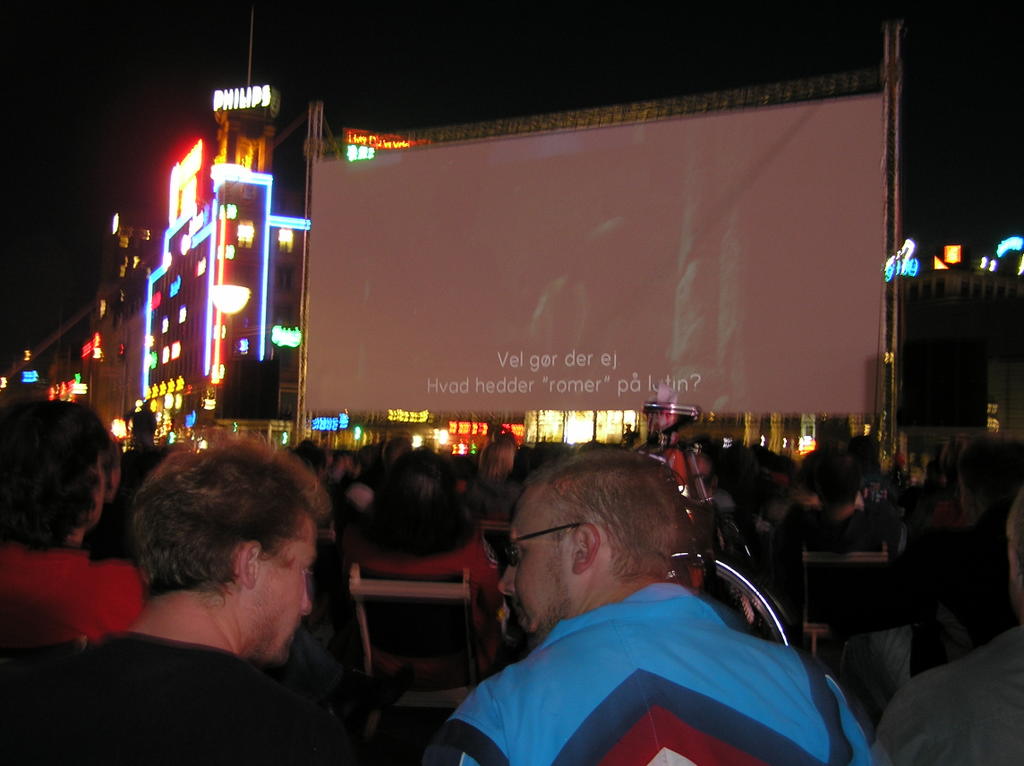
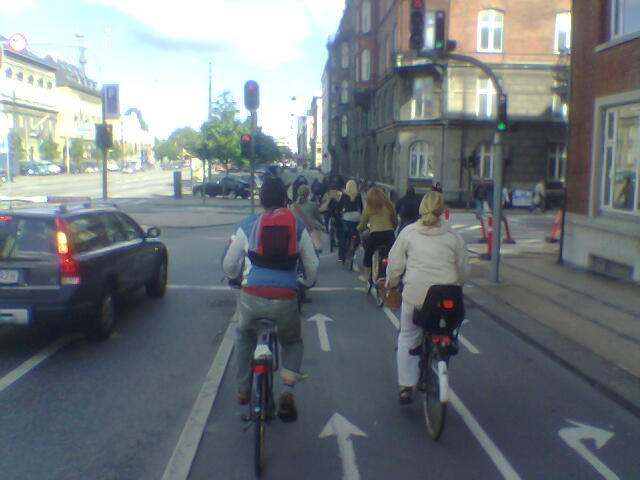
The other night to kick off the Copenhagen's International Film Festival, Monty Python’s Life of Brian was shown in the open air square in front of city hall. Pretty cool. And every summer there is a small film festival where recent blockbusters are shown outdoors for free in various parks and open spaces around the city. These are moment when heading home late at night amongst a swarm of hundreds of bicycles, you really feel you are part of something special, a happy little community.
Always look on the bright side of life...
A night later I found myself sitting in the beautiful Ostedsparken in the centre of town, a large public park with a big sunken lake in its centre, surrounded by trees and grass slopes just perfect for sitting in the sun in the summer. Only this night, the feature was a free sound and laser show. The lasers were shone out over the water along with steam pumped from various miniature cannons around the lake, while a live dj provided cool ambiant electronic music broadcast silently around the park heard through headphones provided for free at the park entrance. No deposit, no identification, no nothing to borrow those - just simple, old-fashioned trust that each person would return them when they left. The show went on until after midnight.
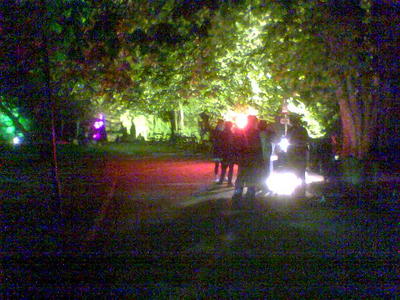
Smoke on the water, lasers in the sky and music in the air...
Much of the action in Copenhagen takes place off of the streets, because Danes do know how to have fun behind closed doors. Danes love private parties.
The candles get lit year-round for cosy, quiet little dinner evenings that often stretch late into the night and involve the consumption of loads of beer and wine. Some are not so quiet. Wander around Copenhagen on a Friday or Saturday night and late into the night you are likely to hear music coming through the windows on at least a few apartment on almost any street. Neighbours are powerless to interfere - if one wants to have a party in their apartment, the only tradition is to put a small note in the stairwell a few days in advance warning the neighbours there will be some noise (and possibly inviting them if it is a large enough party). If the police are called, the only thing they will do is ask that the party be moved indoors (if it is outside), and that the windows be closed (if it is inside). Otherwise, the show can continue as long as desired. In truth the police are rarely, if ever, called anyway.
Denmark also happens to be one of the most liberal countries with regards to the sale of alcohol. It has never been a problem getting alcohol day or night - even if most of the best places close early during the week. On weekends especially, there is always an option available if one wishes to keep drinking through the night - even it the hour has reached 5, 6, or even 7 in the morning. Even on a Monday or Tuesday, somewhere in the city a bar is always open for business (though many of them one would not want to set foot inside), while kiosks sell beer and spirits from the early morning to late into the night.
Probably a more fruitful lens to view Copenhagen through is as a major city that has improbably managed to maintain a certain degree of small-town charm.
Examples are numerous. I have never found a major city where so many baby carriages, pregnant woman and kids are visible - a remark repeated by countless newcomers to the city. Copenhagen is an astonishingly family-friendly city, with it's ample parks and quiet streets.
It is impossible to get stuck in a Copenhagen traffic jam - because there are none!! In fact, there is hardly any traffic at all for a city of Copenhagen’s size. People cycle, take trains, the metro, but the car remains the transportation choice of last resort – an extremely flat terrain, good city planning that includes bicycle lanes lining virtually every street, expensive fuel and a tax on new cars that wildly inflates their price (basically doubling it in comparison to surrounding countries!) has ensured this.
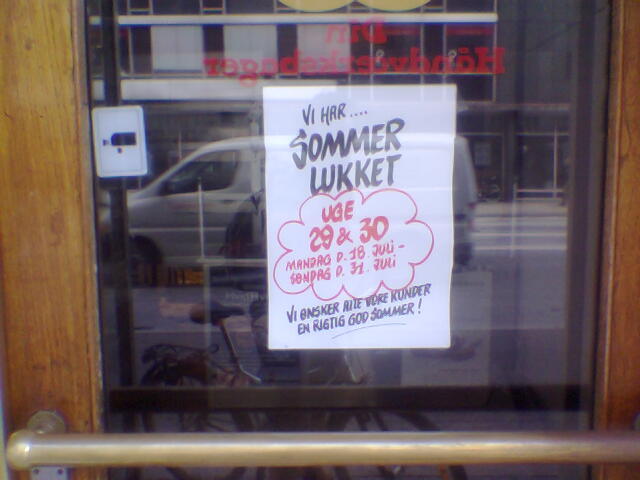
It is somewhat reassuring to see countless shops closing for two or three weeks in the summer while their owner’s vacation - they really are the small, un-corporate operations that they seem.
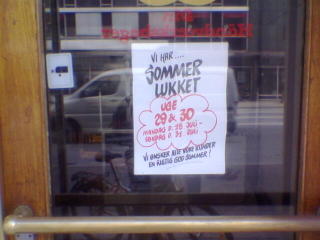

Closed for summer vaction ('sommer ferie lukket').
If there is one universal complaint about life in a small town, it is the tiny space separating the present from the past (and the future). In any place with a relatively static population, mistakes and embarrassments are rarely forgotten entirely over time. This could also describe life in Copenhagen, almost, since as the only major city in Denmark, Copenhagen is the one place where most return to again and again. So the past is never very distant here.
In wandering around Copenhagen, one continually and unexpectedly stumbles across it - long-lost friends, former classmates, ex-colleagues, old teachers, former lovers, ex-boyfriends and girlfriends, and so forth. Talk for a while, and one often discovers countless unpredictable connections that link friends, family, and colleagues and so forth together. It happens continually. Knowing this demands an extra level of maturity from those living here – one must get used to living with any mistakes, poor choices and old disagreements from the past (and the distinct possibility that you may already know the person you ex-girlfriend or boyfriend is now dating). You really can’t run away without leaving the country – even retreating to the countryside is hardly any guarantee. Everyone seems to have ties to Copenhagen in one way or another.
It is indeed something special about life here, something that distinguishes Copenhagen from many other major cities where it is much easier for a person to become another anonymous face in the crowd, or disappear outright. But what kind of enthusiastic urban-dweller wants to do that anyway?
Closing Time In Copenhagen (Part 3) - To Feel Or Not To Feel
by Tim Anderson (timothyanderson2005@gmail.com)
I promised a more rambling style in these articles (Closing Time in Copenhagen - Part 1, Part 2) and what follows is certainly that…
Is there any greater display of feelings than during
an opera at the (Maersk sponsored) opera house?
In an email the other day, a good friend of mine suggested that perhaps she was too much of a sap to allow herself to be too reflective (and hence overly sentimental) during times of change – such as moving cities. But I guess she gave herself away in saying this - obviously she feels something during such times.
On the other hand, my girlfriend's brother-in-law who produces films, began a project making deep-sea oil platforms safety videos for the Oil and Gas Division of Maersk (Denmark’s largest company) a few months ago. He recently relayed the story of one of the first meetings he had with Maersk, where he first introduced a few ideas for the contents of the safety videos. He suggested beginning the videos with a few short clips of Maersk employees (those that had spent time out at sea on Maersk's platforms) discussing how they felt about working an environment as atypical as an oil platform. The Maersk manager with whom he was meeting pointedly corrected a fatal flaw in the idea by noting (without humour) that, 'at Maersk, we do not feel'. (I realise it is difficult to imagine somebody actually saying this, but seriously, I'm not making this up!) So ‘feelings’ were left out of the safety videos.
Anyway, here we have the two solitudes – to feel or not to feel.
The summer here in Copenhagen has been cloudy and rainy and not all that warm most days for the past 3 weeks (and counting) – which has been a feature of each and every summer I have experienced here in Denmark in the past five years. It’s annoying. July was never meant to be a ‘trousers and jacket’ sort of month.
Perhaps this weather is contributing to my present feelings.
Still, capturing the essence of why something new is so enticing is hard enough in the moment. It’s even more challenging after five years when some of the initial fascination remains, though there is much that doesn’t hold the same captivating sway that it once did. Nonetheless, Copenhagen can be an exciting place to be. Allow me to digress a bit from the subject of life in Copenhagen, just for a bit more.
I recently read one of the weekly columns of Nigel Slater (the popular English food writer) in The Observer ("Catholic Tastes") (who I incidentally once worked for back when I lived in London - I cleaned his flat for several months) in which he tried to capture the essence of what was so special, so enthralling, about visiting a small but authentic Italian food shop. The most remarkable thing about the column was not simply his ability to transfer such feeling into lively description. Rather, I think it was the decision to focus on something so ordinary, then steadfastly refuse to acknowledge it as such.
He succeeded by allowing feeling, his feelings, to bubble to the surface in the process as he held this ordinary thing - a little Italian food shop - high in the air as if it were placed on a large pedestal, thereby better allowing everyone to behold what it really was. Suddenly, it seemed not so ordinary after all.
A nice reminder that we are surrounded by the remarkable. It passes by us, and us by it, constantly. However, it is only made remarkable when we recognise it as such. Otherwise it remains ordinary and wholly unremarkable. When we insist upon viewing things in such a mundane manner, it is unlikely we will register any notable reaction whenever they quietly pass by our eyes – or under our noses in the case of Nigel’s Italian food shop. And if that happens, it is a real shame. Not that it requires over-dramatisation either.
So this is a little preamble.
After a time here, it is easy to come to believe that Copenhagen is a rather mundane sort of place, in many respects (albeit one filled with a seemingly endless supply of beautiful women). New shops, restaurants and cafes open, close and change names at a surprisingly slow pace for a major city of this size, the streets all over the city are shamefully quiet on Sundays, and even the downtown core tends to become eerily quiet once the shops close each evening.
Coming from two plus years living in London, a place where the pace of life is frantic most of the time, I certainly know what it is to deeply love and despise a place all at once. I never felt more at home that I did while I was living there, and I haven’t since. Yet after two years and a bit of being there, I ran, ran, ran - knowing another couple of months could leave me foaming at the mouth. Anybody who has lived in London for a time knows what I’m talking about.
Copenhagen is not a place that is likely to draw such passionate, raw or contrasting emotions. And it could certainly not be described as a frantic place. I doubt it ever has. Perhaps it is better described as a part-time lover who you get excited about seeing, enjoy spending time with, yet know all the while that you could never marry.
Or maybe I’ve got it backwards.
Perhaps the part-time lover is really London, a place that in provoking such raw emotion may eventually eat you alive if you don’t walk away in good time. Perhaps the less frantic Copenhagen pace is bound to prove the more compelling one, if you're in for the long run.
So about Copenhagen…
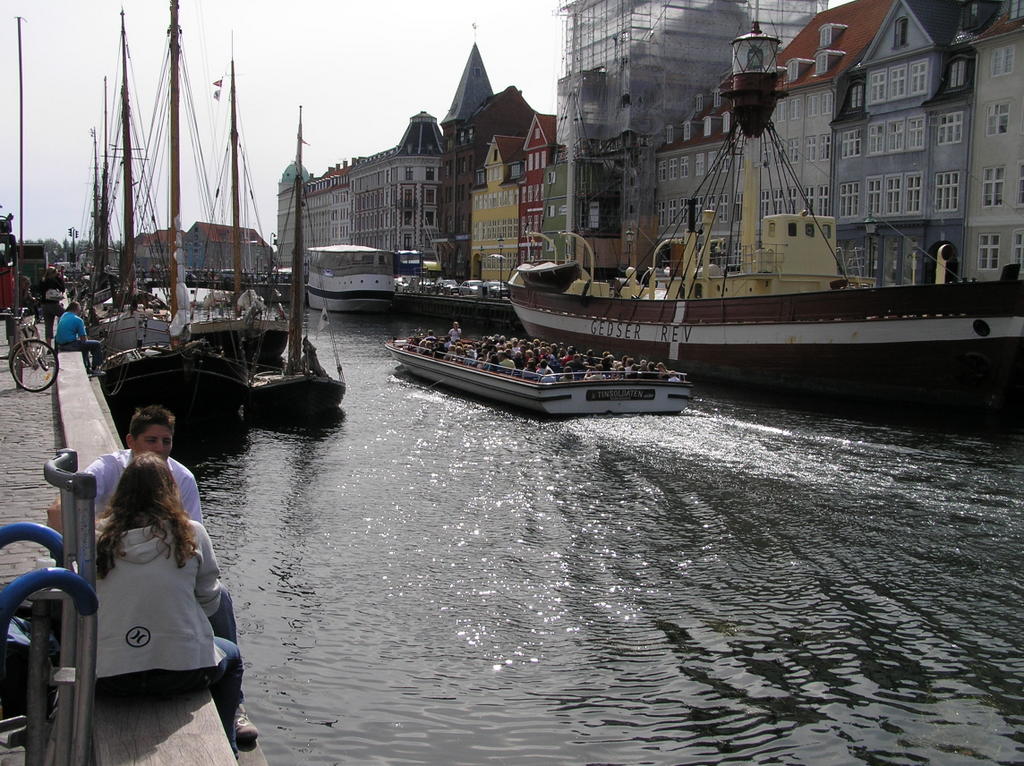
Take Nyhavn, the beautiful canal in downtown Copenhagen, running just off of the main channel.
If you look at it in the wrong light, it just seems like a horribly tourist-cramped place, and for good reason. It is, but it is not only this. Both tourists and locals alike congregate there on sunny days, year round. It is a place that one is typically drawn to as a newcomer to the city quite simply because it is an enormously compelling spot. Colourful, gracefully aging, unsymetric buildings from centuries past line either side of the canal - buildings that could never be described using contemporary terms like ‘clean lines’ - while old wooden boats gently bob in its still waters. Focus on the wrong thing, and you’ll only notice the tourist boats shuffling hundreds of tourists in and out of the canals every hour.
The thing is, the canal is a marvellous place to be on a sunny day, or a sunny evening after work. It lies in such a way as to get the maximum benefit from the setting sun each day – one suspects this may have even been the plan, way back when. The Hong Kong Bar near the top of the strip is the sole remnant of the areas colourful past, when seaman came by day but mostly by night for what they couldn’t get while at sea.
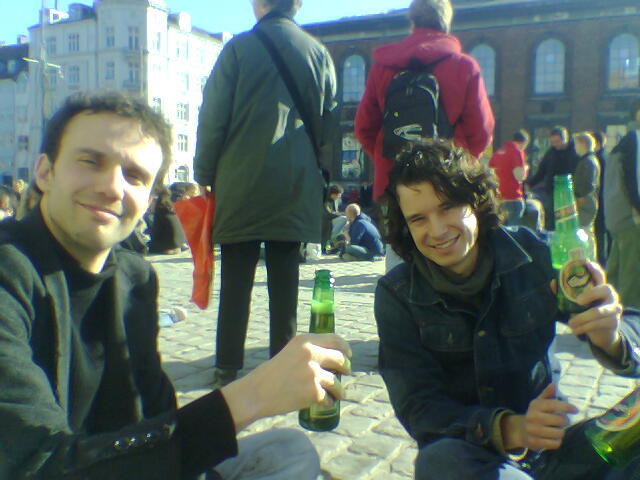
It is difficult to replicate the feeling brought about sitting with a beer on the side of the canal on the wooden beams that line the canal on a hot, sunny day. The locals buy cold beers for cheap at a kiosk nearby or simply bring their own (Danes don't generally put much of a premium on drinking cold beer, so I have adapted myself to this habit out of necessity as best I can). Asian immigrants hover like friendly vultures, waiting to collect the empty bottles and cans for the 1 kr return deposit from them, occassionally offering a free service of opening an unopened beer or even scooping up a bit of garbage in the process. On a sunny day, I suspect they do quite well financially.

Tourists prefer to drink and eat at tables of the restaurants that lay opposite, in the sun when it is available, sheltered by umbrellas when it is not, and warmed by those mushroom heat lamps and wrapped in blankets provided by the cafes when it is cold.

In fact, it's not only the tourists willing to brave the cold. Sitting outside wrapped in blankets is a very Scandinavian thing to do.
I remember one time many years ago, back when I was working at a café in London in Covent Garden, it was a particularly miserable cold and rainy day, far moreso than most days at that time of year. The head waiter nonetheless demanded that we set the outside tables. We could turn the heat lamps on and people might want to sit there, or so he insisted. He was a professional sort of guy, not prone to overt display of soft feelings at the workplace but he did at least have a sense of humour. When I asked him who he thought would like to sit out there he replied with dead-pan seriousness, "Oh, plenty of people - Danes, Swedes, Finns…". I laughed. (When the wine glasses began blowing off the tables that blustery day, he at last relented).
Apropos, this comment of his was not far off from the truth. Cafes in Copenhagen have long adapted to the Danish desire for fresh air, even if it is bone-chillingly fresh, by offering all the blankets to customers that one needs to stay moderately warm. And people, terraces full of people, do use them.
When the weather is as it is here, however you might feel about it, you just have to adapt.
Yes, up next, Part 4...
Closing Time In Copenhagen (Part 2) - The Housing Situation
by Tim Anderson (timothyanderson2005@gmail.com)
This is the second installment of a series of articles about life in Copenhagen, knowing that August is my last month living here for some time. The first one is Closing Time In Copenhagen (Part 1).
I look out the window of my apartment, down to the quiet cobblestone street below, feeling that where I am is a place distinctly Europe – old Europe, stereotypical Europe. In fact, where I live is not that old by such standards – the apartments around here are generally in the area of 100 years old, though there are certainly some that are much older. In certain respects, the ones on my street in Christianshavn even seem quite modern.
A friend of mine living right in the dead centre of town, no more than a 15 to 20 minute walk from my place (see how far that will take you in London) lives in a building nearly 200 years old that is built on 500 year old foundations. It looks it. Every now and then he asks me what I think the chances are that a building like that could suddenly become unstable – essentially crumble without much warning to a state beyond repair. He loves the place, but nonetheless has some genuine concern for the security of his investment - since he bought the apartment. I personally don’t think it is too likely to happen, but then again it’s not my bank loan on the line, so I'm probably not seeing it as he is. Why should I be worried?
There has been for sale signs in the windows of two apartments just across the street from ours for some time now – several months. Looking out at them just now, I see a sold sign has been pasted over one of them, though the other still remains. It’s about time. It has surprised me how long these two have been listed for sale since the housing market around here (all over Copenhagen) has been moving at more than a brisk pace. Rather, prices have been exploding over the past two years, and at a far greater rate than the official statistics suggest.
Various friends of mine, ones that had the good sense to buy an apartment at some point over the last years, have made more money during this time by selling their apartments or re-mortgaging them to take advantage of their increase in market value (and lower interest rates) then they have in salary. This is something endlessly frustrating for those not quite in a position to buy during this time (myself) or who (foolishly?) opted to rent and are now left pondering why they made this choice.
In fact, the housing market has been behaving in this manner for several years now, and shows few signs of stopping. The number of apartments available for sale in Copenhagen is at an all time low, as are interest rates (which at least makes loans more affordable than ever at the moment) which has consequently been driving prices up, up, up. Trying to find a decent place in central Copenhagen (that matches ones reasonable desires) on a first-or-second job after graduation type of salary is proving increasingly challenging.
Still, I know that this price appreciation simply cannot be sustained for that much longer – which does not at all mean that prices will suddenly drop. Of course they could – a few signs of greed are starting to show, always an ominous sign.
Just the other day, a story came out about a real estate agent who had been selling numerous contracts over the last months for reservations on apartments (over 100) in a new building development being finished shortly. She also happened to be one of the investors in the development. Because prices have shot up so dramatically since the reservations were first taken, the development board (of which she is a member) opted to (legally) cancel every one of them. In this way they could re-price the apartment units at a higher level – more money.
Such behaviour clearly strains the bonds of trust between client and customers, no question. On this scale where so many people are affected, it also suggests a brazen confidence, if not a possibly deluded overconfidence, in a market capable of producing an endless stream of customers willing to overlook such questionable tactics and accept whatever terms are on offer just for the chance to buy. Similar behaviour has lead to the demise of many a business in the past, even ones seemingly infallible, and it tends to reach it’s zenith just before an economic collapse of one sort or the other. Let’s see what happens.
The housing situation in Copenhagen is complex, to say the least, and not one that is easy for a foreigner to get a handle on.
On the more understandable side of things are the literally countless tens of thousands of generic two room apartments everywhere in the city. Somehow over the years, the layout of these apartments has come to be a sort of defacto-standard for what could be termed, ‘the two-room Copenhagen apartment’.
When one sees an advertisement with the words, ‘two room apartment’ accompanied by a measurement of around 50 to 60 sq metres, one can make a pretty solid guess at what the apartment looks like - a fair sized room at the front, a second smaller room for a bedroom looking out into the back garden, and beside this a small kitchen and tiny bathroom (with a shower practically hanging over the toilet and certainly no bathtub!).
All that remains is to ascertain the apartments precise location, how big are the windows are/how bright the apartment is, and if it needs painting.
Most apartments have accesss to a large shared garden out back for the up to 200 or more apartments overlooking it. This garden may be more or less sunny and usable, depending upon it's state of repair, and the amount of space between the buildings.
In the case of our most recent apartment, the back garden was just beautifully refurbished thanks to a government fund which is earmarked for such projects that footed the entire bill. Again, the wonders of living in a socialist country. At one end the buildings were quite close together, while at the other (our end) there was quite some space - which meant it was not as easy to watch what the neighbours were up to, something I always enjoy doing.

The monthly student (non-repayable) grants paid by the Danish government to all students in Denmark for up to six years of studies are perfect for renting one of these (or buying them as an andels apartment, which I will talk about shortly) with a friend, girlfriend or boyfriend – which is a very attractive proposition for a couple in love. Oftentimes, this is exactly what happens.
Moving into such a two-bedroom place is hardly a lifetime commitment, since they are certainly not big enough for very long once kids enter into the picture. Equally, it makes the process of splitting up and moving on, if it should ever come to that (and as statistics go, the odds are that it will) just as easy – they are highly sellable (or rentable). So there is a steady turnover of these places.
On the other side of things, is the peculiar form of ownership known in Danish as ‘andels’ apartments. There really isn’t an English equivalent (or translation) for this, so I will describe what they are instead. There are literally tens of thousands of these apartments all over Copenhagen (and the rest of Denmark).
These could loosely be described as collectively owned apartment blocks, each managed by an organisation that control the purchase and sales of the rights to live in the apartments within their block(s), and that decides the amount of the monthly rental-type fee that will be paid as well.
The thing is, the prices of the shares (ie. right to live) that one of these andels apartments gets bought and sold for by no means corresponds with their market value if they were being bought and sold on the private market. It is the board of each andels, consisting of residents living there, that dictate the prices for each. So the prices do move over time, just much more slowly than the market. As a rule, they are ludicrously cheaper to live in (by Copenhagen standards) often costing half as much as the monthly outlay for an equivalent privately owned apartment. If you’re lucky enough to get your hands on one. This is the other issue.
Without connections (typically close family, friends or work colleagues) or good foresight from your parents (more on this shortly), the waiting lists for these places range from 3 to 15 years. It’s a bit like playing a lottery that comes with a guarantee that you will win big eventually, at some indefinite point in your life, if you are willing (and able) to wait.
In many instances Danish parents put the children on an ‘inactive’ waiting list for one or more andels organisations when they are small, which means that when they are 18 and ready to move away from home, they will have the right to be put on the ‘active’ waiting list, which will typically be anywhere from 2 to 5 years long in itself. Eventually, they will begin to be offered the chance to purchase the rights to live in various andels apartments. One can only hope their parents have thought of doing this.
If all of this seems like it would be extremely bizarre for an outsider coming to live in the country to understand, it absolutely is.
The problem with this system as it stands is that it greatly distorts an already overheating housing market (pushing privately owned apartment prices up higher than they should be), while only offering benefits that can at best be described as unevenly dispersed. Because a board decides the purchase and sales prices of andels apartments, there is no free market operating here. And there are so many, many, many of them in Copenhagen, so it is an issue.
Rather, it could be suggested that this is an example of radical socialism at it’s most random. Regardless, it is a system that is unique, distinctly Danish, and has a significant influence on life in Copenhagen. No question about it. I don't expect that the housing market is something that I will miss very much when I leave.
But housing is hardly the only thing worth discussing, so read on. Coming shortly, Part 3.
Closing Time In Copenhagen (Part 1)
by Tim Anderson (timothyanderson2005@gmail.com)
August is my last month living in Copenhagen, after five extremely interesting and certainly not predictable years here. With that in mind, and inspired by various other blogs which I enjoy reading, (particularly City of Sound,a fascinating blog inspired by life in London) I'm going to change the tone a bit in my last few blog entries to a more rambling one. I want to try to capture a bit of what exactly Copenhagen is all about - that which is notable and oftentimes unique about the place.
Hopefully in using what is for me a more experimental approach and writing style, I will manage to reveal something that I previously was not able to and better paint the scenes I wish to portray. Since it is a type of writing I most enjoy reading myself, I may as well try. It is also a way of drawing a bit of a line which separates the various issues I have touched upon up to now, from the things I want to say in these last entries. I do hope I manage to succeed.
My time in Copenhagen, my introduction to Denmark and all that is valued here is soon coming to a close. This departure may be definitive – once and for all - it may not. I plan to be back in a year, but all the same it is by no means certain that I will return. If I should return, or when I do, I will no longer be viewing this place through the same eyes – rather I will be comparing what I am seeing to the images of a Denmark I remember, but that may never have been. The comparison is bound to be somewhat romanticised.
The introduction I have had to this place has been rather thorough, I would judge. It has been just short of five years since I arrived here, and it will be five years and two days from this arrival when I leave. I never expected to be here this long, but it's not like any other existing plans of mine were disrupted by staying. Five years seems a good round number and therefore a good one to part on, in my mind.
To begin to understand what it is to be part of daily life in Denmark, one must first realise just how exclusive a little club the Nordic countries are. These are amongst the richest in the world, taken on a per capita basis (and also the coldest and cloudiest). They are countries that have taught themselves how to succeed (speaking now of countries as if they were people). This is not some poor karaoke attempt of larger economies such as the U.S., the U.K. or Germany. The Nordic countries have created a model that is all their own - it is not an adopted one.
Many foreigners coming to Denmark to live for a time quickly become somewhat critical, at least of how daily life is structured, and how willingly people (Danes) accept this way of being. It seems so organised, so coldly efficient, and though the people are generally well-behaved, the streets seem empty and a things generally bit dull as a result. However, such a view is far to simplistic to represent the reality of the place. There is a rich past that has lead to this way of being, this unequivocally modern system. The state of things as they now exist is hardly an involuntary occurrence.
Denmark is a small, fairly uniform (and quite northern) country in comparison to many other western countries after all. If one expects a more extreme sort of diversity and less uniformity, one should not choose to live in a place with the characteristics of Denmark. France, England, Canada or the U.S. spring to mind as better choices.
Southern Europeans, for example, don't only complain about the weather being a little to cold (as most foreigners living in Denmark do). At a much deeper level they tend to feel frozen out of the Danish way of being, after a short while here. Danes are friendly, and genuine in their friendly gestures, but they have little interest in humouring or for that matter sympathising much at all with those coming to live here who refuse to adopt to their way of being - which is not to say they are not willing to meet somewhere closer to the middle. This is not a critisism, as Danes hardly the only nationality who are this way, and there are good reasons for their actions.
On the other hand when Danes travel, particularly for extended periods of time (which they do in huge numbers), it is often as if some alter ego seizes their personality and takes it over while they are out of the country. Consequently, many an unsuspecting foreigner has been lured back to Denmark by a beautiful (dyed-) blonde mane, a set of luscious curves, and an irrepressibly free-spirited personality - all of which can be overwhelmingly enchanting being so at odds with what they encounter typically in their daily lives, wherever they are from.
The thing is, Danes can afford to be carefree and a bit reckless when they wish to be. This is one of the luxuries that the system they have created for themselves permits, which is incidently something that is rather unique. Few countries offer a level of support to their citizens comparable to that which is offered in Denmark. Danes are generally aware of this, and they are also aware that they pay for dearly for this privledge with one of the highest tax rates in the world (68% at the highest level!).
So, many a foreigner that has fallen in love with one of these travelling Danes, once pulled back to Copenhagen, is suddenly shocked to discover how Danes behave at home . It can come as a surprise to many that the same factors that permit such freeness also enable one to more comfortably apply oneself in countless less carefree directions as well - education, jobs, kids, family and so on - knowing that change is not only possible (because one will never wind up with no income), but will be widely accepted to boot. This way of being is something that can be said to be distinctly Danish, or perhaps more appropriately, distinctly Scandinavian (but I've only lived in Denmark). Perhaps this is one of the reasons the divorce rate is so high in Denmark (50% and climbing), a figure which does not include the countless couples who live together for a time, and then split up. Of course there are countless relationships that succeed!
Even more shocking for foreigners, can be to experience just how abruptly and definitively Danes can move one when they decide to. (For the record, I came to Denmark alone and for the purpose of studying, which I did for the first three years I was here, so I speak from the position of observer in saying all of this, not from some bitter personal experience.)

In Denmark, there is no stigma whatsoever with moving in with a boyfriend or girlfriend, then moving out after a time, and then moving in with another, and so on. Even though most western countries are moving in this direction, Danes were already there 20 or 30 years ago. Oftentimes, a foreigner in Denmark who has suddenly been cast aside once the relationship hits a rough patch, have little from their own cultural background they use to relate to and understand just what has happened and how it can be like this. Not that anyone expects (much less plans!) from the outset that a given relationship they are in will eventually end.
There are not many places where people allow themselves this level of uninhibited personal freedom. Of course, there are other ways that Danes appear to inhibit themselves, it's just that sex and relationships are not among them, to generalise of course.
But life in Copenhagen is like that, because getting on with things is a pretty simple process, all things considered. One only has to take their salary (which is always an amount one can live comfortably on), or their SU money (provided by the Danish government to all students for up to six years of studies), or their unemployment money (which is generally just below the typical salary of whatever their previous job was), along with any supplemental money offered by the government if they have children, and get on with life.
I’m not at all suggesting that Danes are cold or calculating in any of this. Just that Danes rarely find themselves in such dire straights - whether from relationship troubles, trouble finding a decent job or even an unexpected pregnancy and various other unanticipated situations - as to feel the need threaten to throw themselves from the nearest bridge (much less actually do it) when things get a little rocky and uncertain from time to time. The result is a relative calmness and stability, not only behind closed doors, but also in the office and on the streets. It is just not always apparent, at first glance, why things are like this.
So this is my introduction, there is much more I have to say on many divergent areas of life in Denmark. Next up, Part Two.
Bombs explode in London, Copenhagen gets the jitters...
My apologies in advance for this one, I am trying too avoid bothering with too many purely political issues on this blog, as I think there are a lot more meaningful and productive ways to spend ones time and (mental) energy. But sometimes certain things just need to be said for the sake of one's own sanity!
As soon as the news came out that several explosions had rocked London, one could sense a palpable level rising tension in Copenhagen. For example, the day after the London attacks, a reported bomb threat (which proved to be false) shut down the Copenhagen metro as the bomb squad moved in to remove a suspicious looking package. Thankfully, there was no bomb. Since then, the police have been a frequent presense all over the metro, highly visible above and below ground at the various stations. 
(Okay, this is not a great picture, but that is a police van to the right of the Christianshavn metro entrance in Copenhagen, with two police officers standing by).
It's not really surprising a lot of Danish voters are finding themselves a little anxious. After all, Denmark is a part of the Bush's coalition of the willing, and what's more, enough Danes recently thought it was a good idea to re-elect Anders Fogh Rasmussen, the guy who made the decision to put Danish troops there in the first place.
Although Rasmussen is a guy who steadfastly refuses to offer any constructive critisism of certain American military activities in the middle-east region or regarding American military conduct during the open-ended and undefinable 'war on terror' such as Guantanamo Bay, he is not a guy afraid to participate in a good, pandering suck-up or related photo op when the opportunity strikes.
Where's Waldo...I mean Anders? Oh, there he is!
Unfortunately, with bombs exploding in London, many Danes are increasingly wondering if Copenhagen might not become a terrorist target, sooner or later, given the Danish presense in Iraq.
Actually, why is Denmark in Iraq anyway? Though the decision to support the Iraqi war was one seemingly incoherent with values of socialist Denmark, some have quietly whispered about how it did coincide with the interests of Denmark's biggest company, Mærsk, a company that has profited greatly from the war - much more so than any other Danish company (see my previous article Courting controversy, Danish army style). Unfortunately, the mainstream Danish media doesn't really like to discuss this issue, and many Danes are in flat out denial that there might be such a connection.
Fortunately, it is not really necessary to rely on the mainstream media to figure out the links. See, Mærsk is not only a pretty big company, they also tend to make their activities fairly obvious. For example, when they do business somewhere, they often use little ships like these:
If one wonders whether Mærsk is making profits in Iraq, a quick internet turns up various press releases and so forth regarding Mærsk contracts in Iraq (many signed before the decision to send Danish troops to Iraq was made). In summary: it is very easy to see where the company is operating (look for the ships), and why there are there (look for the press releases). Thus, even when the Danish mainstream media prefers to avoid connecting the various issues together, it is very easy to figure out these things anyway.
So let me spell it out: Maersk is worth a lot of money to Denmark, in terms of taxes, employment and in terms of the an overall influence on society and politics. This is a huge elephant of a company in a very small petting zoo of a country. Too many uncomfortable questions were bound to be asked of Maersk doing business with the U.S. army and in Iraq if the Danish government didn't throw it's support behind the Americans.
Now, a little suggestion for those who think the bombing in London was bad (and it most certainly was), and who also may be thinking about how devasting inexplicable bombings in general can be: what about those innocent civilians residing in Baghdad, who were subject to night after night of bomb attacks and destruction during the war along with countless civilian casualities ('collerateral damage') as a result (not to mention roving military patrols ever since)? It makes a one-time incident such as that in London - as horrendous, physically destructive and psychologically tormententing as it has surely been - pale in comparison.
Hmmm, what to do, what to do?
Well, imagine you are a Danish voter. Are the decisions made by the current government the best ones?
There are many ways to fight terror, unfortunately, dropping (more) bombs in hopes of eliminating it tends to rather increase it instead, since it makes a lot of those who are already angry even angrier, and worse, it tends to make a lot of (innocent) people who were not angry at all before suddenly very angry as well, since now their lives are also being affected.
So what is there a better way to react to these London terror attacks, and the perpetual threat of more to come elsewhere?
Personally, I found perhaps the most thoughtful and reasoned reaction in a column published in the UK newspaper, The Guardian, written by (Ed. note: now deceased) Robin Cook (who you may recall resigned from Tony Blair's cabinet in the lead-up to the Iraq war, owing to his disagreement with Blair's Iraq strategy of unconditional support for Bush's war). Cook has since become a loud critic of Blair's approach as a labour backbencher.
To link to the article: The struggle against terrorism cannot be won by military means
I have taken the liberty of reprinting it, in part, below:
"The struggle against terrorism cannot be won by military means. The G8 must seize the opportunity to address the wider issues at the root of such atrocities.
The danger now is that the west's current response to the terrorist threat compounds that original error. So long as the struggle against terrorism is conceived as a war that can be won by military means, it is doomed to fail. The more the west emphasises confrontation, the more it silences moderate voices in the Muslim world who want to speak up for cooperation. Success will only come from isolating the terrorists and denying them support, funds and recruits, which means focusing more on our common ground with the Muslim world than on what divides us.
The G8 summit is not the best-designed forum in which to launch such a dialogue with Muslim countries, as none of them is included in the core membership. Nor do any of them make up the outer circle of select emerging economies, such as China, Brazil and India, which are also invited to Gleneagles. We are not going to address the sense of marginalisation among Muslim countries if we do not make more of an effort to be inclusive of them in the architecture of global governance.
But the G8 does have the opportunity in its communique today to give a forceful response to the latest terrorist attack. That should include a statement of their joint resolve to hunt down those who bear responsibility for yesterday's crimes. But it must seize the opportunity to address the wider issues at the root of terrorism.
In particular, it would be perverse if the focus of the G8 on making poverty history was now obscured by yesterday's bombings. The breeding grounds of terrorism are to be found in the poverty of back streets, where fundamentalism offers a false, easy sense of pride and identity to young men who feel denied of any hope or any economic opportunity for themselves. A war on world poverty may well do more for the security of the west than a war on terror.
And in the privacy of their extensive suites, yesterday's atrocities should prompt heart-searching among some of those present. President Bush is given to justifying the invasion of Iraq on the grounds that by fighting terrorism abroad, it protects the west from having to fight terrorists at home. Whatever else can be said in defence of the war in Iraq today, it cannot be claimed that it has protected us from terrorism on our soil."
RSS Feed
Twitter